
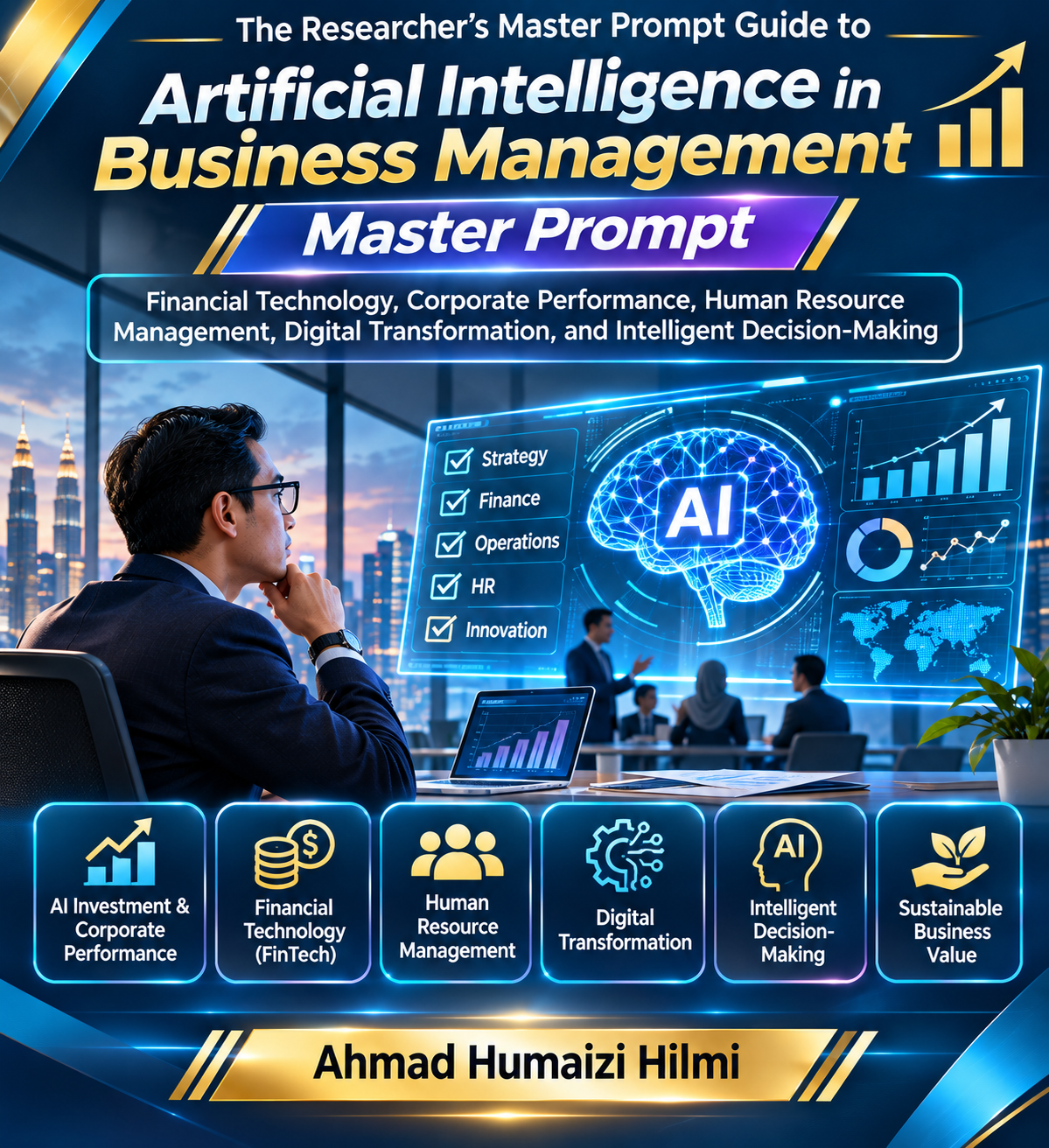
7. AIM-BUS-007 — Artificial Intelligence in Business Management, Financial Technology, Corporate Performance, Human Resource Management, Digital Transformation, and Intelligent Decision-Making
Description
This Master Prompt theme examines the economic, managerial, organizational, and financial implications of artificial intelligence adoption across businesses, industries, and institutional environments. It guides researchers in investigating AI investment, corporate financial performance, digital transformation, organizational productivity, knowledge absorptive capacity, strategic decision-making, financial risk management, and intelligent business operations. The theme addresses AI-driven financial analytics, regulatory technology, fraud detection, corporate governance, human resource acquisition, workforce allocation, customer experience management, and organizational innovation. Researchers are guided to examine how AI capabilities influence firm competitiveness, operational efficiency, resource optimization, financial sustainability, and business-model transformation. Particular attention is given to the mediating and moderating effects of digital leadership, executive technological competence, organizational readiness, institutional conditions, and technology adoption. The theme also explores the implications of AI for employment, wage inequality, workforce restructuring, psychological well-being, customer acceptance, and service delivery. Researchers are encouraged to apply quantitative econometric methods, structural equation modeling, panel-data analysis, mediation and moderation analysis, causal inference, and comparative organizational research where appropriate. The selected literature includes investigations of AI investment and corporate financial performance, AI applications and regulatory technology in financial fraud prevention, AI adoption and audit quality, and AI policy in labor resource allocation. These studies provide a foundation for developing comprehensive Master Prompts examining artificial intelligence as a driver of business transformation, financial innovation, and organizational decision-making.