






Leverage Explained — Measured (PDF Guide)
You were told to keep leverage low and to use a stop, and never shown where the liquidation floor sits relative to that stop. They are the same distance problem, and almost nobody puts them on one page.
This guide computes the distance to the floor at every leverage setting, compares it against a stop measured in average true ranges on real bars, and names the point where the floor arrives first. It is arithmetic plus a measured range, and both are checkable. This is a 44-page PDF that teaches Leverage from the first thing you see on the screen through to a written strategy with an entry, a stop and an explicit rule for when the trade is wrong.
Nothing is taught underneath a chart. Every label sits on the candle, the line or the level it is describing, on real BTC, ETH, SOL and LINK charts. There are three quizzes on real charts, each followed by the same chart re-shown annotated with the reasoning, plus faded practice pages where the first steps are filled in and you finish the rest.
WHAT'S INSIDE
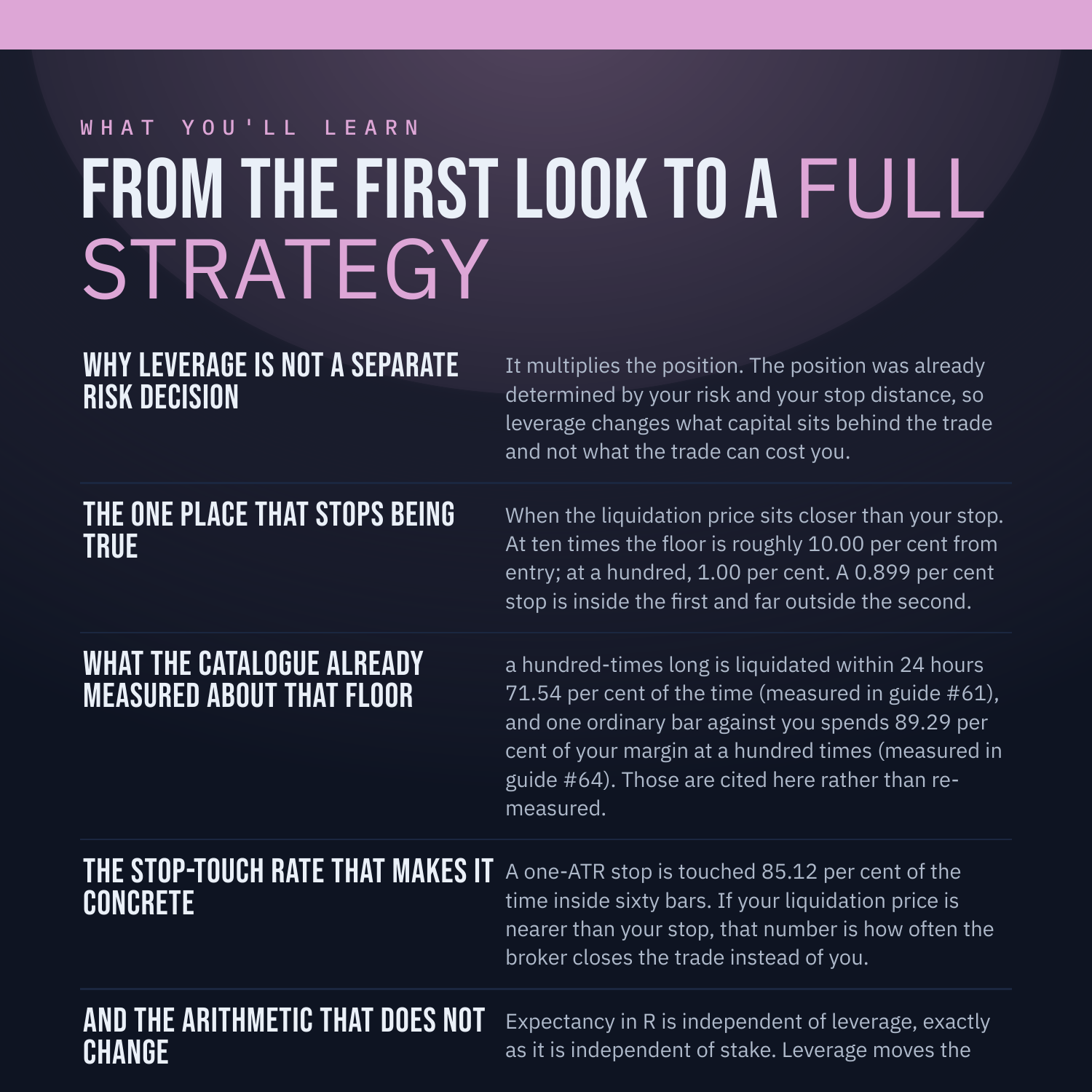
Why leverage is not a separate risk decision -- It multiplies the position. The position was already determined by your risk and your stop distance, so leverage changes what capital sits behind the trade and not what the trade can cost you.
The one place that stops being true -- When the liquidation price sits closer than your stop. At ten times the floor is roughly 10.00 per cent from entry; at a hundred, 1.00 per cent. A 0.899 per cent stop is inside the first and far outside the second.
What the catalogue already measured about that floor -- a hundred-times long is liquidated within 24 hours 71.54 per cent of the time (measured in guide #61), and one ordinary bar against you spends 89.29 per cent of your margin at a hundred times (measured in guide #64). Those are cited here rather than re-measured.
The stop-touch rate that makes it concrete -- A one-ATR stop is touched 85.12 per cent of the time inside sixty bars. If your liquidation price is nearer than your stop, that number is how often the broker closes the trade instead of you.
And the arithmetic that does not change -- Expectancy in R is independent of leverage, exactly as it is independent of stake. Leverage moves the speed of a result and never its sign, which is guide #85's finding applied here.
WHAT YOU'LL BE ABLE TO DO
Say whether your stop sits inside or outside your liquidation price.
Convert a leverage multiple into a distance from entry.
Explain why leverage is a capital decision and not a risk decision.
Spot the moment leverage stops being a multiplier and becomes a hard floor.
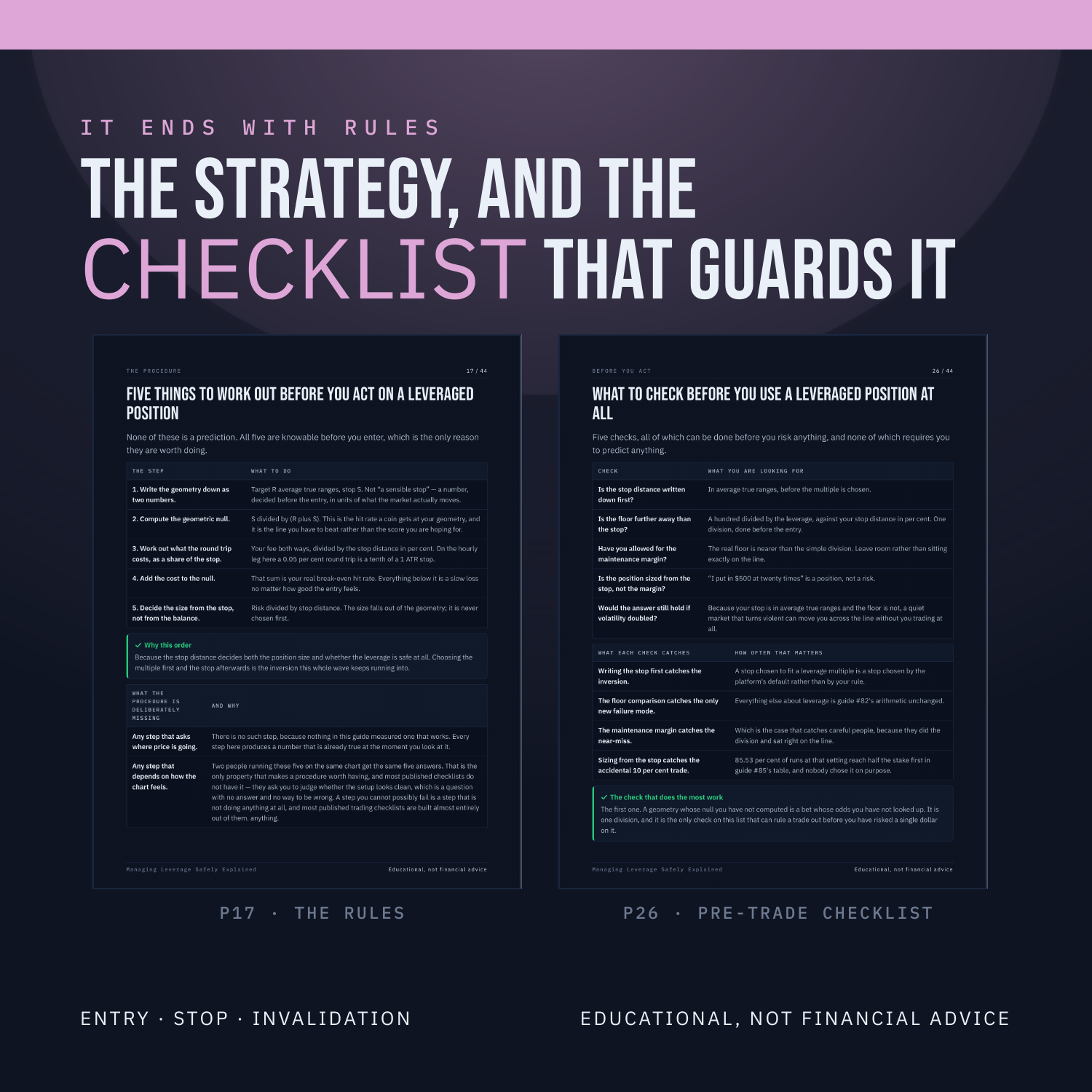
Size a leveraged position from the stop rather than from the margin.
AN HONEST NOTE
Leverage is a clue, not a crystal ball. It describes what price has already done. This guide contains no win-rates, no backtest results and no promises about what you will make, because nobody can verify those and you should not trust anyone who prints them. What it hands you instead is a set of rules you can test yourself on TradingView in an afternoon. Educational, not financial advice.
Instant download. 44 pages, PDF.