
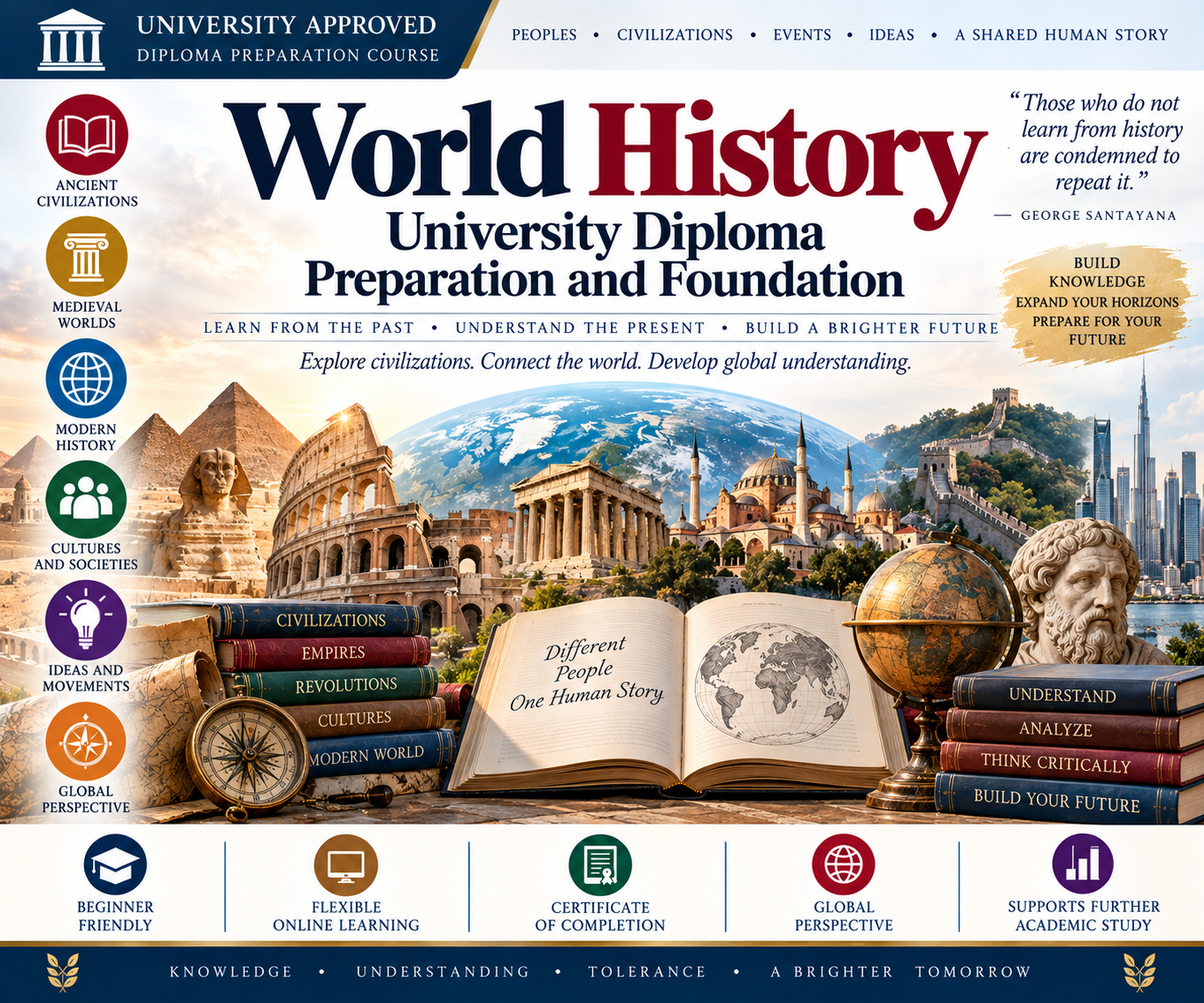
World History University Diploma Preparation and Foundation
World History – University Diploma Preparation and Foundation Course
Learn from the Past. Understand the Present. Prepare for the Future.
World history is the story of humanity.
It is the story of civilizations rising and falling, societies transforming, ideas spreading, empires expanding, cultures interacting, technologies changing, conflicts reshaping borders, and people continuously adapting to new realities.
The World History – University Diploma Preparation and Foundation Course provides a broad and structured introduction to the major periods, civilizations, events, movements, and transformations that have shaped the modern world.
Designed as a foundation and academic preparation course, this program helps learners develop the historical knowledge, critical-thinking skills, chronological awareness, and global perspective needed for further university-level study.
The course is suitable for complete beginners as well as learners preparing for more advanced studies in history, politics, international relations, sociology, archaeology, cultural studies, education, and related fields.
No previous university-level knowledge of history is required.
Why Study World History?
Studying history is much more than memorising names and dates.
History helps us understand:
- How societies develop
- Why civilizations rise and decline
- How political systems change
- Why wars begin
- How religions and ideas spread
- How trade connects distant regions
- How technology transforms societies
- How migration changes cultures
- How revolutions reshape institutions
- How historical events continue to influence the present
By studying world history, learners can develop a deeper understanding of the complex connections between past and present.
A Global Approach to History
This course takes a broad international perspective.
Rather than studying only one country or region, learners are introduced to historical developments across multiple civilizations and continents.
Topics may include developments in:
- Africa
- Europe
- Asia
- The Middle East
- The Mediterranean
- South Asia
- East Asia
- Central Asia
- The Americas
- The wider global world
This helps learners understand that human history is deeply interconnected.
Civilizations have influenced one another through trade, migration, diplomacy, warfare, religion, scholarship, technology, and cultural exchange.
What You Will Learn
Throughout the course, you will explore major themes such as:
- Early human societies
- Ancient civilizations
- Classical civilizations
- Ancient Egypt
- Mesopotamia
- Greece
- Rome
- Persia
- India
- China
- Medieval societies
- Islamic civilizations
- European kingdoms and empires
- Trade routes
- Exploration
- Renaissance
- Reformation
- Enlightenment
- Political revolutions
- Industrialisation
- Imperialism
- Nationalism
- World War I
- World War II
- The Cold War
- Decolonisation
- Globalisation
- Contemporary world history
The purpose is to create a strong chronological and thematic foundation.
Early Human Societies
The course begins by exploring the earliest stages of human history.
Learners may examine:
- Hunter-gatherer societies
- Early migration
- Development of agriculture
- Permanent settlements
- Domestication
- Early technologies
- The rise of villages and cities
The agricultural revolution was one of the most important developments in human history.
It changed how people lived, worked, organised communities, and interacted with the environment.
The Birth of Civilization
As settlements became larger and more complex, early civilizations emerged.
Students will explore characteristics commonly associated with civilizations, including:
- Cities
- Governments
- Writing
- Religion
- Social organisation
- Trade
- Agriculture
- Law
- Architecture
This foundation helps learners understand how complex societies developed.
Ancient Mesopotamia
Mesopotamia was home to some of the earliest known urban civilizations.
Learners may explore:
- Sumer
- Akkad
- Babylon
- Assyria
- Writing systems
- Law
- Religion
- Urban life
- Trade
- Political organisation
Mesopotamian civilizations made important contributions to administration, literature, mathematics, astronomy, and law.
Ancient Egypt
Ancient Egyptian civilization developed along the Nile and became one of history’s most recognisable societies.
Topics may include:
- Pharaohs
- Religion
- Hieroglyphics
- Pyramids
- Government
- Agriculture
- Society
- Art
- Burial traditions
- Egyptian influence
The course places Egyptian civilization within its wider African and Mediterranean historical context.
Ancient Persia
Persian empires played a major role in the political and cultural history of the ancient world.
Learners may explore:
- Imperial administration
- Royal authority
- Trade
- Roads
- Multicultural governance
- Military organisation
- Relations with neighbouring civilizations
The Persian experience demonstrates how large empires attempted to govern diverse populations across vast territories.
Ancient Greece
Ancient Greece influenced politics, philosophy, science, literature, and art.
The course introduces themes involving:
- City-states
- Athens
- Sparta
- Democracy
- Philosophy
- Warfare
- Culture
- Alexander the Great
Greek civilization played an important role in the intellectual development of the Mediterranean world.
The Roman World
The Roman Republic and Roman Empire had an enormous historical impact.
Students may explore:
- Roman government
- Law
- Military expansion
- Citizenship
- Engineering
- Trade
- Religion
- Imperial administration
- Decline and transformation
Roman political, legal, architectural, and linguistic influences continued long after the empire itself changed.
Ancient India
South Asia developed rich political, cultural, religious, and intellectual traditions.
Topics may include:
- Early civilizations
- Major empires
- Trade
- Hindu traditions
- Buddhism
- Political organisation
- Art
- Literature
- Science
Studying Indian history helps learners understand the importance of South Asia within global historical development.
Ancient China
Chinese civilizations developed long-lasting political, philosophical, technological, and cultural traditions.
Learners may explore:
- Early dynasties
- Imperial government
- Confucianism
- Daoism
- Trade
- Agriculture
- Writing
- Technology
- The Silk Road
China’s influence extended across large areas of Asia and beyond.
Trade Routes and Cultural Exchange
Ancient and medieval societies were connected through trade.
Important trade networks included:
- The Silk Road
- Indian Ocean routes
- Mediterranean trade
- Trans-Saharan routes
- Regional caravan networks
These routes carried more than goods.
They also helped spread:
- Religions
- Languages
- Technologies
- Ideas
- Art
- Scientific knowledge
The Medieval World
The medieval period was complex and diverse.
Learners may study developments involving:
- European kingdoms
- The Byzantine Empire
- Islamic civilizations
- African kingdoms
- Asian empires
- Trade networks
- Religious institutions
- Feudal systems
- Cities
The course avoids presenting medieval history as simply a period of decline.
Instead, learners explore the innovation and cultural development that occurred across different regions.
Islamic Civilizations
Islamic civilizations became major centres of political, commercial, intellectual, and cultural activity.
Topics may include:
- Early Islamic history
- Caliphates
- Trade
- Urban development
- Science
- Medicine
- Philosophy
- Mathematics
- Literature
- Cultural exchange
Islamic scholars and institutions played a major role in preserving, developing, and transmitting knowledge.
Medieval Europe
Learners may explore:
- Feudal systems
- Monarchies
- The Church
- Cities
- Agriculture
- Warfare
- Trade
- Universities
- Social organisation
Students will also consider how medieval Europe changed gradually through economic, political, and intellectual developments.
The Renaissance
The Renaissance was associated with important developments in European art, learning, scholarship, and culture.
Learners may explore:
- Humanism
- Art
- Literature
- Classical learning
- Scientific inquiry
- Printing
- Education
The invention and spread of printing had a profound influence on communication and access to knowledge.
The Reformation
Religious reform movements transformed European politics and society.
Topics may include:
- Religious criticism
- Protestant movements
- Catholic responses
- Political consequences
- Religious conflict
- Social change
The Reformation demonstrates how religious ideas can have major political and cultural consequences.
Exploration and Global Contact
From the late fifteenth century onward, increased maritime exploration connected distant parts of the world in new ways.
Learners may examine:
- Maritime exploration
- European expansion
- Trade networks
- Colonisation
- Cultural exchange
- Disease
- Forced migration
- Economic transformation
These developments created new global connections but also produced exploitation, violence, and long-term inequality.
Colonialism and Empire
Colonial expansion reshaped large parts of the world.
Students will explore:
- European imperial expansion
- Economic motives
- Political control
- Cultural influence
- Resistance
- Indigenous experiences
- Long-term consequences
The course encourages learners to examine colonialism from multiple perspectives rather than viewing history only through the experiences of imperial powers.
The Enlightenment
The Enlightenment introduced influential discussions about:
- Reason
- Rights
- Government
- Liberty
- Science
- Religion
- Society
These ideas later influenced major political revolutions and constitutional developments.
Political Revolutions
Revolutions transformed political systems around the world.
Learners may explore examples such as:
- The American Revolution
- The French Revolution
- The Haitian Revolution
- Other revolutionary movements
Important themes include:
- Liberty
- Equality
- Representation
- Citizenship
- Rights
- Political change
The Industrial Revolution
Industrialisation changed the way people worked and lived.
Topics may include:
- Factories
- Machinery
- Urbanisation
- Labour
- Transportation
- Technology
- Capitalism
- Social change
Industrialisation increased productivity but also created new social and economic problems.
Nationalism
Nationalism became a major force in modern history.
Learners may examine:
- National identity
- State formation
- Political movements
- Independence
- Unification
- Ethnic tensions
Nationalism has contributed both to political solidarity and to conflict.
Imperialism in the Modern Era
During the nineteenth and early twentieth centuries, imperial powers expanded their influence across many regions.
Students may investigate:
- Africa
- Asia
- The Middle East
- Political domination
- Economic exploitation
- Missionary activity
- Resistance movements
- Cultural change
Understanding modern imperialism is important for interpreting many contemporary international relationships.
World War I
World War I transformed politics, society, and international relations.
Learners may study:
- Causes of the war
- Alliances
- Nationalism
- Military technology
- Trench warfare
- Civilian experiences
- Political consequences
- The post-war settlement
The war contributed to the collapse of several empires and reshaped international borders.
The Interwar Period
The years between the two world wars included major political and economic instability.
Topics may include:
- Economic crisis
- Political extremism
- Fascism
- Communism
- Social change
- International tensions
Understanding this period helps explain the conditions that contributed to World War II.
World War II
World War II was one of the most destructive conflicts in human history.
Learners may explore:
- Causes
- Major theatres of war
- Political leadership
- Military strategy
- Civilian experiences
- The Holocaust
- Resistance
- The use of atomic weapons
- Post-war consequences
The course approaches these subjects with appropriate historical seriousness.
The Cold War
After World War II, global politics became increasingly shaped by rivalry between major political blocs.
Learners may examine:
- The United States
- The Soviet Union
- Nuclear competition
- Ideological conflict
- Proxy wars
- Space exploration
- Political alliances
- The eventual end of the Cold War
The Cold War influenced international politics for decades.
Decolonisation
After World War II, many colonies gained independence.
Learners may study:
- Independence movements
- National liberation
- New states
- Political challenges
- Economic development
- Postcolonial identity
Decolonisation transformed the international political system.
The Modern Middle East
The course may also introduce key developments affecting the modern Middle East.
Topics can include:
- The end of empires
- Nation-state formation
- Colonial influence
- Oil
- Political movements
- Regional conflicts
- International intervention
The aim is to provide historical context rather than partisan interpretation.
The Rise of the Modern Global Economy
Modern economies became increasingly interconnected through:
- Trade
- Industrialisation
- Finance
- Transportation
- Technology
- Multinational companies
Students can explore how economic globalisation changed relationships between countries and societies.
Globalisation
The modern world is more interconnected than ever.
Globalisation involves:
- Trade
- Migration
- Communication
- Technology
- Cultural exchange
- International organisations
The course helps learners consider both the opportunities and challenges created by global interdependence.
Technology and Historical Change
Technology has repeatedly transformed human society.
Examples include:
- Agriculture
- Writing
- Printing
- Navigation
- Steam power
- Railways
- Electricity
- Telecommunications
- Computers
- The internet
Technology can change economies, warfare, education, communication, and social relationships.
Culture and Society
History is not only about political leaders and wars.
Learners will also examine:
- Family life
- Social classes
- Gender
- Education
- Religion
- Art
- Literature
- Everyday life
This wider perspective helps learners understand how ordinary people experienced historical change.
Ideas That Changed the World
Ideas can transform societies.
Students may encounter major intellectual movements involving:
- Democracy
- Liberalism
- Socialism
- Nationalism
- Human rights
- Secularism
- Religious reform
Understanding these ideas can help explain modern political and social institutions.
Historical Sources
Historians reconstruct the past using evidence.
Sources may include:
- Letters
- Government documents
- Archaeological remains
- Newspapers
- Photographs
- Diaries
- Oral histories
- Maps
- Art
- Objects
The course introduces learners to the importance of evaluating sources carefully.
Primary and Secondary Sources
Students will learn the basic distinction between:
Primary sources – materials produced during or close to the historical period being studied.
Secondary sources – later interpretations created by historians and researchers.
Both are important, but they must be used critically.
Evaluating Historical Evidence
Historical evidence can contain:
- Bias
- Limited perspectives
- Political agendas
- Errors
- Missing information
Learners are encouraged to ask:
Who created this source?
Why was it created?
What does it tell us?
What does it leave out?
Can it be confirmed by other evidence?
These questions help build historical thinking skills.
Historical Interpretation
Historians do not always agree.
Different historians may interpret the same events differently because of:
- New evidence
- Different methodologies
- Different questions
- Different theoretical perspectives
Learning history therefore involves understanding interpretation as well as facts.
Cause and Consequence
Major historical events rarely have only one cause.
Students learn to distinguish between:
- Long-term causes
- Short-term causes
- Immediate triggers
- Political causes
- Economic causes
- Social causes
- Cultural causes
They also examine intended and unintended consequences.
Continuity and Change
History involves both change and continuity.
Political governments may change rapidly, while social customs can remain stable for generations.
Learners are encouraged to identify what changed, what remained, and why.
Comparison
Comparing societies can help learners identify:
- Similarities
- Differences
- Shared challenges
- Different solutions
Historical comparison develops analytical skills and reduces the risk of viewing one society as the universal model.
Chronological Understanding
A strong understanding of chronology helps learners place events in context.
The course supports learners in developing:
- Timeline awareness
- Historical sequencing
- Periodisation
- Understanding of overlapping developments
Chronology provides the framework necessary for deeper historical analysis.
Critical Thinking Skills
World history develops skills that extend beyond history itself.
Learners can strengthen:
- Analytical thinking
- Evaluation of evidence
- Argumentation
- Comparative analysis
- Research
- Academic writing
- Source criticism
- Reasoned judgement
These skills are useful across many university disciplines.
Academic Preparation
The course is designed partly as a foundation for learners considering further university study.
Students can gain familiarity with academic activities such as:
- Structured reading
- Taking notes
- Comparing sources
- Developing arguments
- Writing historical explanations
- Preparing assignments
- Using evidence
This can make the transition to more advanced study easier.
Who Is This Course For?
This course may be suitable for:
- Complete beginners
- University applicants
- Prospective history students
- History enthusiasts
- Teachers
- Education students
- Political science students
- International relations students
- Sociology students
- Archaeology students
- Cultural studies students
- Journalists
- Writers
- Researchers
- Lifelong learners
No previous university-level history qualification is required.
Beginner Friendly
The course begins with fundamental concepts and develops gradually.
Historical terminology and major events are explained in context.
Learners do not need extensive previous historical knowledge before starting.
Flexible Online Learning
Study online and progress according to your own schedule.
This format is particularly useful for:
- Working professionals
- International learners
- University applicants
- Busy parents
- Independent students
- Lifelong learners
You can revisit course material whenever necessary.
What You Can Gain From This Course
By completing this course, you can develop a broader understanding of:
- Ancient civilizations
- Medieval societies
- Global trade
- Renaissance
- Reformation
- Exploration
- Colonialism
- Revolution
- Industrialisation
- Nationalism
- Imperialism
- World War I
- World War II
- Cold War
- Decolonisation
- Globalisation
- Modern world history
- Historical research
- Source analysis
- Critical thinking
A Foundation for Further Study
This course may support preparation for further learning in areas such as:
- History
- International relations
- Political science
- Archaeology
- Cultural studies
- Sociology
- Anthropology
- Area studies
- Education
- Journalism
It provides foundational knowledge rather than replacing a full university degree program.
Certificate of Completion
Learners who successfully complete the applicable requirements may receive a Certificate of Completion for:
World History – University Diploma Preparation and Foundation Course
The certificate may be useful for:
- CVs and résumés
- LinkedIn profiles
- Academic portfolios
- Continuing education records
- Personal development portfolios
- Preparation for further study
- Demonstrating additional learning
Course Format: Online
Level: Foundation / Diploma Preparation
Study Method: Self-Paced
Subject: World History
Certificate: Available upon successful completion of applicable course requirements
Why Choose This Course?
Global Perspective
Explore history across civilizations, continents, cultures, and historical periods.
Strong Academic Foundation
Prepare for more advanced study in history and related disciplines.
Critical Thinking
Learn to evaluate evidence, arguments, sources, and historical interpretations.
Chronological Understanding
Build a structured overview of major developments in world history.
Beginner Friendly
No previous university-level history knowledge is required.
Flexible Online Learning
Study according to your own schedule.
Real-World Relevance
Understand how historical developments continue to influence politics, culture, society, and international relations.
Certificate of Completion
Receive documentation of your learning after successfully completing applicable course requirements.
Different Peoples. One Human Story.
World history shows us that civilizations have never existed entirely in isolation.
People have always travelled.
They have traded.
They have fought.
They have exchanged ideas.
They have migrated.
They have built cities.
They have created religions, governments, technologies, and artistic traditions.
And every generation has inherited a world shaped by those who came before it.
The World History – University Diploma Preparation and Foundation Course provides an opportunity to explore this extraordinary shared human story while building the academic foundation needed for further study.
Learn from the past.
Understand civilizations.
Analyse major historical change.
Develop a global perspective.
Prepare for further academic study.
Build a deeper understanding of the modern world.
Knowledge. Understanding. Perspective. A Brighter Tomorrow.
Begin your world history journey today.
Important Academic Notice
This course is designed as a foundation and university diploma preparation course.
Completion of the course does not itself constitute a university diploma, academic degree, or automatic admission to a university program.
Academic credits, recognition, progression opportunities, entry requirements, diploma structures, and transfer arrangements differ between institutions and jurisdictions.
Learners intending to use this course for admission, credit transfer, professional purposes, or progression to a formal qualification should verify the specific requirements of the relevant university or educational institution.