

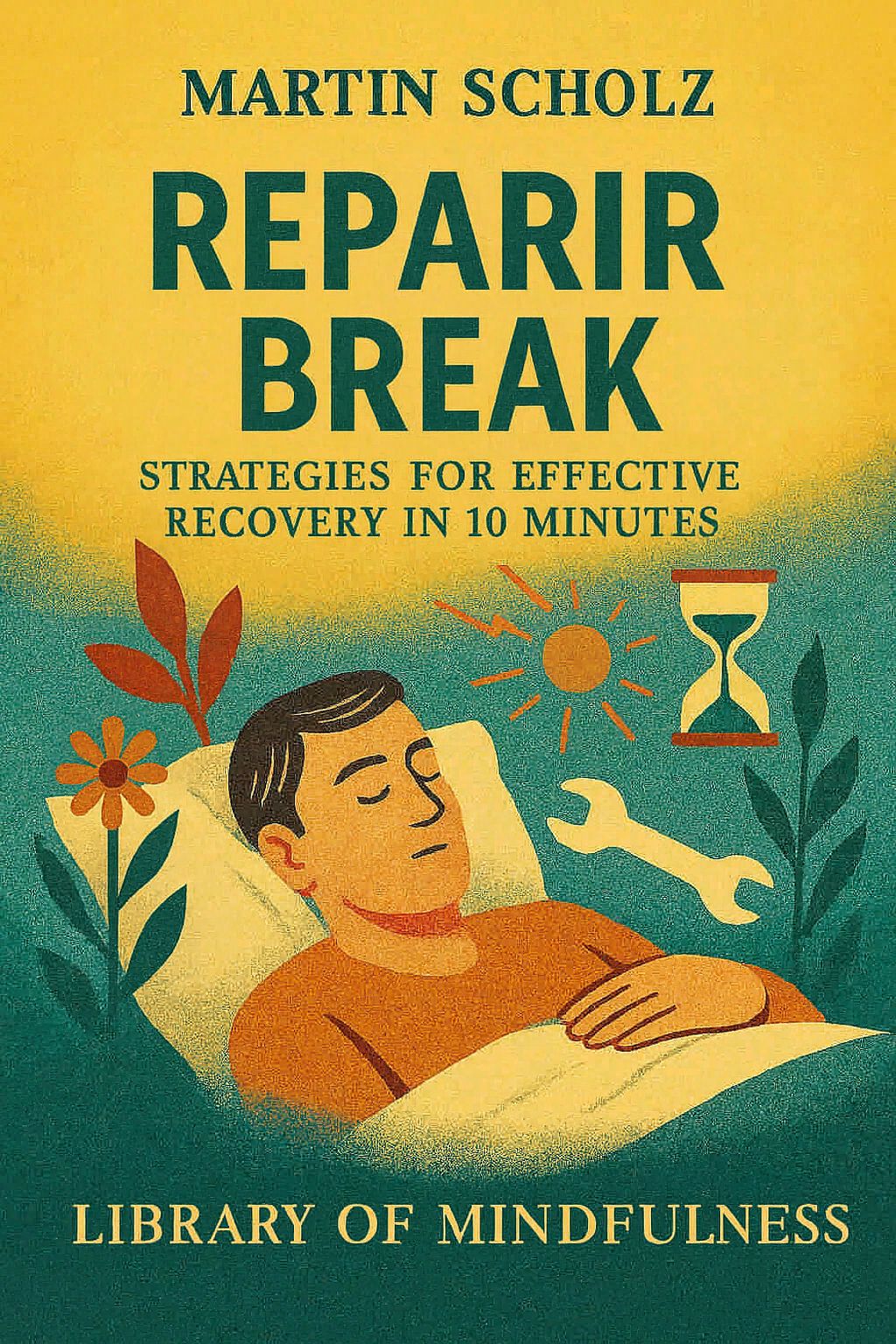
Repair Break
⏸️ Repair break
Strategies for effective recovery in 10 minutes Scientifically proven. Suitable for everyday use. Immediately effective.
Why this book?
In a world that celebrates performance and forgets regeneration, exhaustion has become the norm. But what if you could recalibrate your nervous system, measurably reduce stress hormones, and regain mental clarity in just 10 minutes—without expensive therapies or hours of meditation?
“Repair Break” combines neuroscientific findings (including polyvagal theory, heart rate variability (HRV), neuroplasticity, vagus nerve activation) with practical micro-rituals that work immediately in everyday life. Whether in the office, at home, or on the go, this book shows you how to use mindfulness, breathing techniques, movement, and sensory awareness to switch your autonomic nervous system from stress to calm in minutes—without esotericism, but with evidence.
What to expect: Neurobiology meets practice
🔹 The inner battery – biology of the break: Why the sympathetic nervous system (stress) and parasympathetic nervous system (rest) are out of balance – and how you can activate the vagus nerve in 3–10 minutes to lower cortisol and increase heart rate variability (HRV) (Lehrer & Gevirtz, 2014).
🔹 The body as an early warning system: How somatic mindfulness (e.g., body scan, muscle tension, breath awareness) helps you recognize exhaustion 90 minutes earlier – before it turns into burnout. 🔹 Breathing as a quick way to calm down: 3 scientifically proven breathing techniques (4-6 breathing, box breathing, focus word breathing) that reset your nervous system within 90 seconds – ideal for meetings, commuting, or stressful moments (Hölzel et al., 2011).
🔹 The vagus effect: How warmth, humming, touch, and prolonged exhalation stimulate the “wandering nerve”—and why this immediately regulates heart rate, blood pressure, and stress hormones (Porges, 2011).
🔹 Micro-meditations: 5 everyday forms of focus (breathing, sounds, body, gratitude, open attention) that dampen the default mode network (DMN) and strengthen presence in 3–5 minutes – without cushions or candles (Lutz et al., 2008).
🔹 Movement as an active break: Why fascia stretching, walking meditation, and micro-yoga release serotonin, myokines, and endorphins – and how 10 minutes of movement can increase your cognitive performance by up to 30% (Ratey, 2008).
🔹 Mental detoxification: 3 mini methods (keyword journaling, 3-sentence reflection, thought stopping) to interrupt rumination loops and relieve working memory – ideal for creative blocks or decision-making stress.
🔹 Sensory relaxation: How smells (lavender, lemon), light (warm/cold), temperature (heat/cold), and touch calm your limbic system—and why a scent anchor or sound break lowers your stress levels in 2 minutes (Insel, 2010).
🔹 Social micro-regeneration: Why oxytocin (bonding hormone) reduces cortisol by 30% through short, genuine contact (eye contact, gratitude, hugs) – and how to design team rituals that strengthen resilience (Heinrichs et al., 2003).
🔹 Culture of regeneration: A plea for “slow productivity” – why breaks are not an interruption of work, but a prerequisite for it – and how you can establish a mindful attitude in your everyday working life.
Who is this book for?
✔ Those interested in science and STEM who want to understand neuroscientific mechanisms (e.g., vagus nerve, HRV, neuroplasticity) and apply them in practice – without esotericism.
✔ Professionals in stressful environments (IT, research, management, healthcare) who want to strengthen resilience and mental clarity through evidence-based 10-minute rituals – without wasting time.
✔ Freelancers and self-employed people who want to balance performance pressure and digital overload with micro-breaks – ideal for home office or project work.
✔ Managers and HR managers who want to promote team culture and employee health through mindful rituals – with measurable effects on productivity and satisfaction.
✔ Teachers, educators, and social workers who want to reduce emotional stress through short regeneration breaks – without additional working hours.
✔ Parents and caregivers who want to reduce stress and exhaustion in everyday life through scientifically based mini-exercises.
✔ Readers of other books (e.g., “Neurobiology of Happiness” or “Learn to Suffer Without Complaining”) who are looking for practical, neurobiologically based strategies for stress management and mindfulness.
Your advantages at a glance
✅ No radical lifestyle changes – instead, 12 scientifically based micro-strategies that fit into any daily routine (e.g., breathing exercises, body scans, sensory anchors).
✅ Evidence-based & transparent – Studies from neuroscience, psychology, and stress research (including Harvard, Stanford, Max Planck Institute) are explained in an understandable way – perfect for those interested in STEM who want to understand the biophysics and physiology behind the methods.
✅ Suitable for everyday use & time-saving – practices for the office, home office, commuting, or waiting times that don't take any extra time (e.g., 3-breath reset before meetings, mindful walking while on the phone).
✅ Focus on measurable effects – HRV, cortisol levels, neural activation as biomarkers that show: The rituals work – not just subjectively, but physiologically verifiable.
✅ Lasting effect – increased concentration, creativity, and emotional balance – without expensive courses or radical changes.
✅ Social integration – rituals for teams, families, and friends that promote compassion and connection – without pressure or obligation.
✅ Bridging the gap between science and practice – specific exercises (e.g., vagus nerve stimulation, micro-meditations, sensory anchors) that directly affect neurochemistry and brain structure – ideal for your science journalism focus (Memory n°5).
Get started now – with your first conscious impulse!
You don't have to meditate for hours or completely change your routine to gain more energy, clarity, and resilience. Sometimes a single mindful moment is enough – a conscious breath between two emails, a gentle stretch at your desk, a quick smile in a team meeting.