
Industrial Electrical Training Textbook
Industrial Electrical Training Textbook
From Electrical Fundamentals to Shift-Ready Industrial Troubleshooting
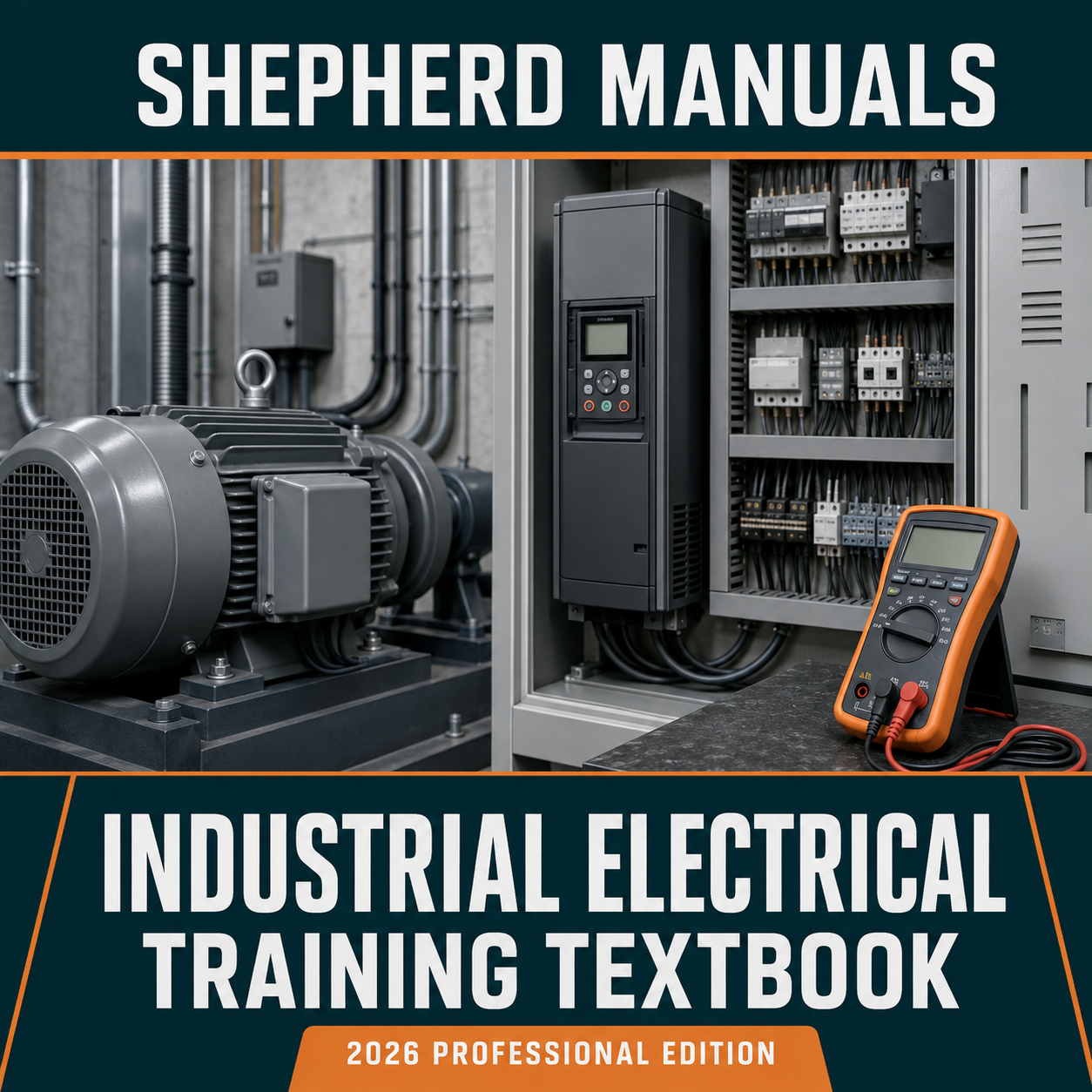
The Shepherd Manuals Industrial Electrical Training Textbook is a comprehensive 500-page professional reference designed for industrial electrical apprentices, maintenance electricians, technicians, instructors and experienced tradespeople who want to strengthen their troubleshooting knowledge.
This is not a short overview or a collection of disconnected assessments. It is a structured, explanation-heavy industrial electrical textbook that progresses from fundamental electrical theory to motors, controls, drives, PLC I/O, conduit systems, panel construction and systematic plant troubleshooting.
Every major subject includes technical explanations, an additional way of understanding the concept, worked examples, calculations, expected readings, field procedures, common failure patterns and practical troubleshooting applications.
What the textbook covers
The 31 chapters include:
- Responsibilities and working practices of the industrial electrician
- Electrical shock, arc-flash and arc-blast hazards
- Lockout/tagout and electrically safe work conditions
- PPE selection and safe electrical measurement practices
- Voltage, current, resistance, power and energy
- Ohm’s law and electrical calculations
- Series, parallel and combination circuits
- Magnetism, inductance and capacitance
- AC theory, frequency, reactance and impedance
- Single-phase and three-phase electrical systems
- Wye and delta relationships
- Transformers and instrument transformers
- Conductors, insulation, wire identification and terminations
- Raceway selection, conduit bending and wire pulling
- Pull boxes, conductor preparation and pull planning
- Grounding, bonding and effective fault-current paths
- Overcurrent protection, interrupting ratings and SCCR
- Digital multimeters and safe voltage testing
- Clamp meters and insulation-resistance testing
- Open, shorted, grounded, intermittent and high-resistance circuits
- AC motor theory, torque, speed, slip and nameplates
- Motor branch circuits, contactors, starters and overload protection
- Electrical and mechanical motor-failure patterns
- Relays, contactors and machine-tool relays
- NEMA ladder diagrams, seal-in circuits and interlocks
- Reversing, jogging, timing and sequence-control circuits
- Solenoids, limit switches and industrial sensors
- Variable-frequency drives and soft starters
- PLC input and output troubleshooting without program access
- 24 VDC control power, digital sensors and analog signals
- Systematic evidence-based troubleshooting
- Preventive and predictive maintenance
- CMMS documentation and recurrence elimination
- Installation planning, commissioning and controlled startup
- Conduit types, fittings, supports, fasteners and channel systems
- Hand and power bending—including industrial conduit systems through 4 inches
- Raceway-fill percentages and code-table methodology
- Industrial enclosures, panelboards and control-panel workmanship
- VFD panel layout, thermal management, segregation and grounding
- Shift handoff, competency development and professional responsibility
Built for real industrial work
The textbook teaches the reader to move beyond random component replacement. Its troubleshooting method emphasizes:
- Establishing the expected operating state
- Controlling electrical and mechanical hazards
- Preserving the original fault evidence
- Separating facts from assumptions
- Testing meaningful system boundaries
- Recording exact measurement points and operating conditions
- Identifying the first abnormal state
- Verifying the repair under realistic operating conditions
- Addressing the reason the failure occurred
The reader learns not only what measurement to take, but what that measurement proves—and what it does not prove.
Professional tools and measurement practices
The textbook discusses professional industrial instruments and tools used by electricians, including appropriately rated digital multimeters, clamp meters, insulation-resistance testers, process meters, signal tracers, hand tools, wire-pulling equipment and conduit-bending systems.
Fluke industrial meters are recognized and encouraged when properly rated for the voltage, measurement category and task. Fluke 787B- and 789-class process meters are discussed for 4–20 mA instrumentation work. Professional tools from Klein Tools, RIDGID, Wiha, Greenlee and other qualified manufacturers are recognized for industrial installation and maintenance work.
No brand name replaces proper ratings, inspection, training or an approved safe-work procedure.
Standards-conscious—not a substitute for the codebook
The 2026 Professional Edition references the 2026 National Electrical Code, 2027 NFPA 70E and 2026 NFPA 70B as the current national publications at the edition’s verification date.
Because adopted editions and local amendments vary, the textbook teaches the reader how to locate and apply governing requirements rather than reproducing copyrighted code tables or treating remembered values as universal.
Always verify the code edition, local amendments, manufacturer instructions and employer procedures governing the actual installation.
Designed for
- Industrial electrical apprentices
- Maintenance electricians
- Electrical and mechatronics technicians
- Manufacturing maintenance departments
- Technical schools and community colleges
- Apprenticeship programs
- Corporate industrial-training programs
- Instructors developing plant-specific electrical courses
- Experienced electricians moving into industrial maintenance
- Mechanical technicians expanding into electrical troubleshooting
- Engineers and supervisors who work with industrial electrical systems
What you receive
- One professionally formatted 500-page PDF textbook
- 31 structured instructional chapters
- Worked calculations and industrial examples
- Professional electrical illustrations and diagnostic diagrams
- Field procedures and expected-reading guidance
- Failure traps and troubleshooting situations
- Conduit, enclosure and panel-construction coverage
- Searchable PDF text
- A complete table of contents, list of figures, list of tables and index
- Immediate digital access after purchase
Companion materials
This listing is for the textbook only.
The following companion products are available separately:
- Industrial Electrician Student Workbook — 313 pages of knowledge checks, calculations, industrial situations, unit reviews and applied activities
- Industrial Electrician Instructor Manual — controlled instructor edition containing teaching guides, workbook solutions, examinations, answer keys and performance rubrics
Important safety notice
Electrical work can expose personnel to shock, arc flash, arc blast, fire, unexpected machinery movement and stored electrical, mechanical, pneumatic, hydraulic, thermal or gravitational energy.
This textbook is an educational and professional-development resource. It does not replace employer procedures, task-specific qualification, adopted codes, an engineered study, manufacturer instructions, the authority having jurisdiction or supervision by a qualified person.
Completion of this textbook does not by itself authorize energized electrical work or establish journey-level qualification.
Build the knowledge. Understand the circuit. Measure with purpose. Troubleshoot from evidence.