
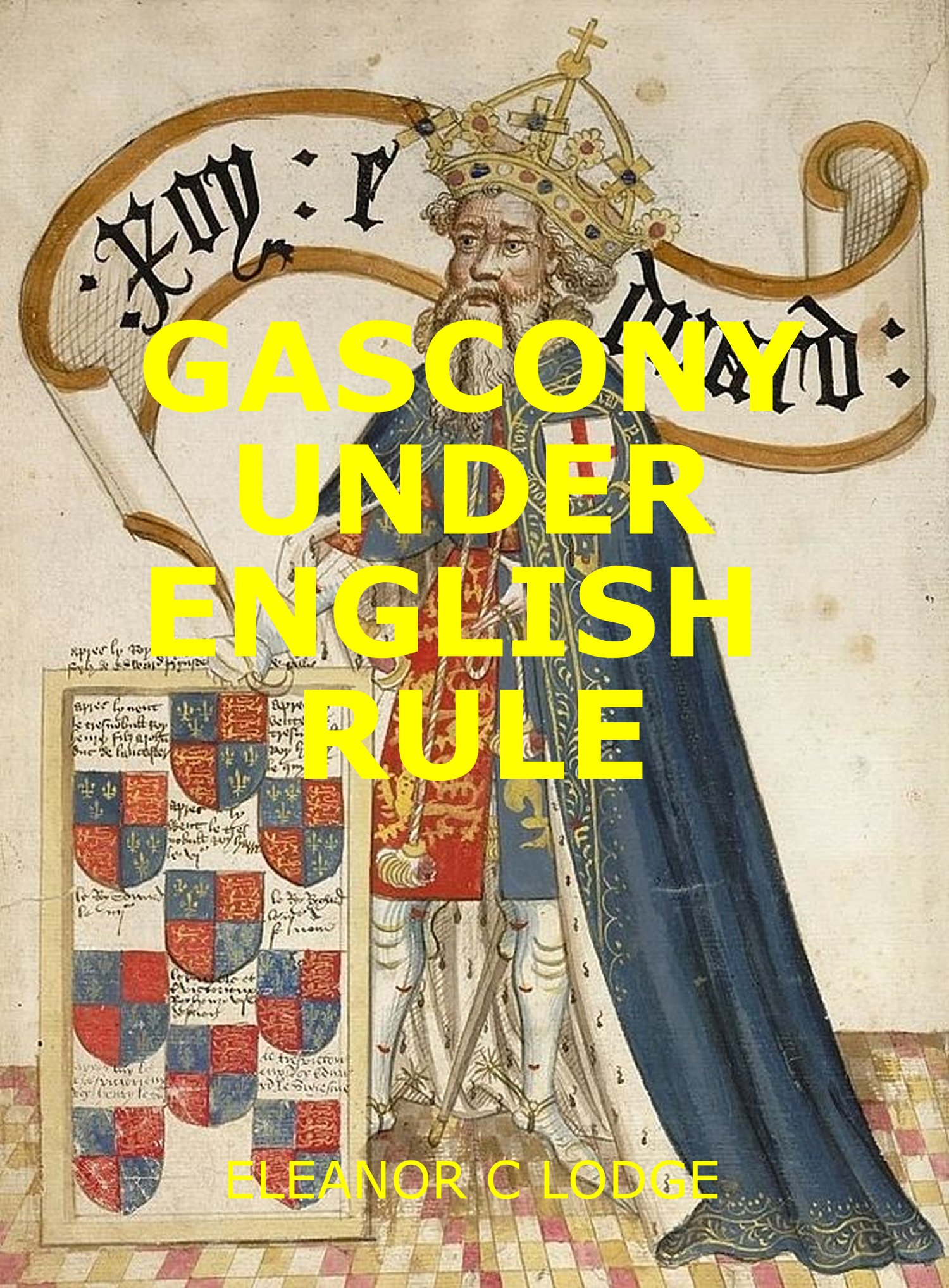
Gascony Under English Rule - Eleanor C Lodge
For 300 years large parts of France were ruled by English kings. The story involved some of the most interesting characters of medieval European history and some of its most dramatic events. The characters include Eleanor of Aquitaine, Henry II, Richard I, Henry III, The Black Prince and Joan of Arc. The events encompass the battles of Crecy, Poitiers and Agincourt and other events such as the peasants revolt and the black-death. This book is the most complete accounts of that period.
Extract:
For 300 years Gascony was connected with the crown of England. In 1152 the marriage of Eleanor, Duchess of Aquitaine, to the young Henry Plantagenet, shortly to become King of England and it brought to him vast possessions of South Western France, of which Gascony was a part; a part which, through many vicissitudes, was not completely lost to the English until the final conquest of Bordeaux by the French King in 1453.
At first this territory was a personal possession of the English King, a feudal holding which he treated as his private property, but as time went on the connection with England and the English people was drawn closer. Gascon nobles and burgesses visited England, English officials and traders visited Gascony, Englishmen fought side by side with Gascons, not only in France, but in Scotland.
Gascon ships came to English ports with the wine which all the well-to-do English desired, whilst English ships carried corn and other goods to the shores of the Gironde.
In the thirteenth century Gascon government was a problem which concerned England directly, for it was Englishmen who were sent out to act as royal Lieutenants and Seneschals. The fourteenth century the Hundred Years broke out mainly as a result of conflicts over English dominion in Gascony, and in the fifteenth century the final loss of the province was looked upon as a national disaster and humiliation.
The history of Gascony is a complicated one, for it is the history of a mass of feudal states, sometimes with a certain unity through subjection to one common overlord, but seldom for long together, as homage was transferred from one lord to another with apparently little compunction, and the boundary between French and English possessions was constantly altered. The name of Gascony is itself difficult to define. As Monsieur Barrau Digiho, in an article on "La Gascogne" writes; "According to novelists and poets Gascony includes a large part of Southern France and is the chosen home of talkers, fighters and boasters, men poor in income but rich in invention. According to experts it is the land bordered by the Pyrenees and the left bank of the Garonne excluding Bordeaux, Bazadais and Medoc." Neither definition he concludes is really satisfactory; "If the former is too fantastic, the latter is too restricted." The problem is indeed extremely complex. If it were to be settled by language, Bordeaux and the Agenais would have to be included, for they are Gascon speaking districts; but, on the other hand, linguistic considerations would lead to the exclusion of the French Pays Basque, undoubtedly a part of Gascony, but speaking a distinct tongue of its own. From the historical point of view the difficulty becomes still greater. The lands of the Dukes of Gascony have had many different frontiers. Bordeaux, Agen, and even Toulouse, have been, at one time or another, under their sway., Bearn, geographically in Gascony, was in effect an independent province, under its own rulers, and working out its own history apart from the rest of the country.
There is, however, from the English point of view what may be called the official definition of Gascony. From the thirteenth century the name became the recognized title for the lands which the English held in the South-West of France. On the "Gascon Rolls" preserved in Chancery were enrolled the documents dealing with the government of this property.
Thus Gascony came to mean a territory including Bordeaux and the Bordelaise, the boundaries of which constantly shifted, which sometimes comprised less, sometimes more than the actual geographical region of Gascony, lying between the Garonne and the Pyrenees, forming the southern portion of Guyenne or Aquitaine. However much the extent of English territory varied, the real core of these possessions was Gascony, and not until the English were finally expelled in 1453 did they lose the lands round Bordeaux and lands round Bayonne.
Free eBook readers are available on most app stores.
Reading books is easy!
App for reading books, magazines and documents: