
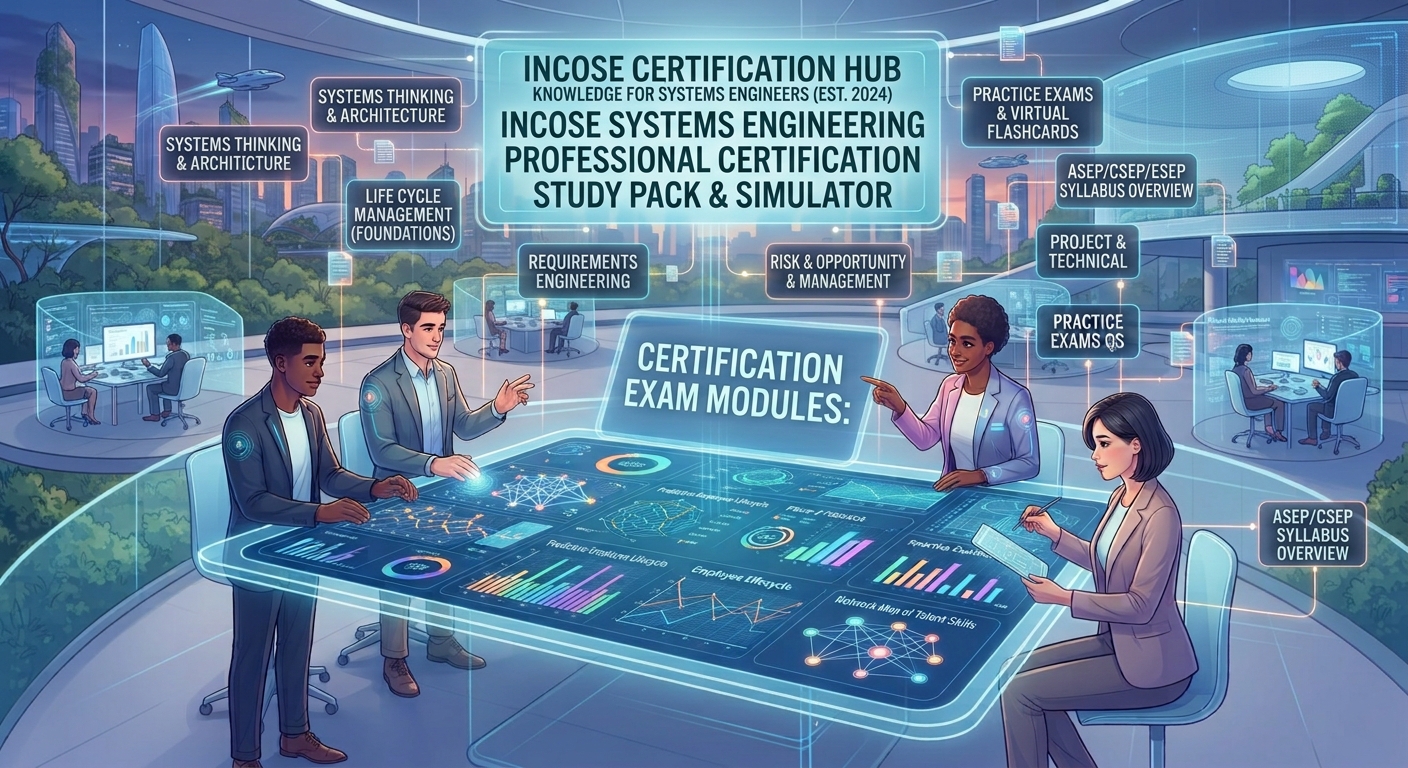
Infoshelves High-Yield Formula Glossary & Process Matrix for INCOSE
Infoshelves High-Yield Formula Glossary & Process Matrix for INCOSE – Exam Prep Package with Online Exam Simulator
This comprehensive exam preparation bundle is designed to help you efficiently revise essential Systems Engineering concepts, lifecycle processes, commonly confused terminology, and high-value examination topics. It includes 1 set of High-Yield Revision Notes & 31-Process Matrix, 1 set of Top 100 Confusing Terminology Distinctions, and 5 sets of High-Probability Exam Concept Drill practice questions.
These carefully structured revision resources are designed to strengthen your understanding of Systems Engineering fundamentals, process relationships, technical terminology, lifecycle activities, and scenario-based engineering decisions. The package emphasizes rapid knowledge retrieval, process identification, conceptual clarity, and practical application of Systems Engineering principles.
This package is ideal for systems engineers, engineering consultants, technical managers, and professionals preparing for INCOSE-related certification assessments who want a focused, practice-driven revision toolkit to consolidate their knowledge and improve examination readiness.
Course Overview
- Revise essential Systems Engineering concepts through concise, high-yield study notes.
- Develop a structured understanding of the 31-process matrix and the relationships among lifecycle processes.
- Improve your ability to distinguish commonly confused Systems Engineering terminology and definitions.
- Understand how technical processes, technical management processes, agreement processes, and organizational project-enabling processes work together.
- Strengthen your ability to identify the appropriate process for a given engineering situation.
- Practice applying Systems Engineering concepts to realistic scenarios involving requirements, architecture, integration, verification, validation, risk, and configuration management.
- Reinforce your understanding through five sets of high-probability exam concept drill questions.
- Identify knowledge gaps and prioritize revision before your intended certification assessment.
This Package Covers Major Systems Engineering Revision Topics
1. High-Yield Revision Notes & 31-Process Matrix
Build a consolidated understanding of Systems Engineering fundamentals and the major lifecycle processes used to plan, develop, integrate, verify, validate, operate, and maintain complex systems.
Systems Engineering Fundamentals
- Systems Thinking and Systems Engineering Principles
- System-of-Interest Definition and System Boundaries
- Stakeholder Needs and Expectations
- System Context and External Interfaces
- Functional and Nonfunctional Requirements
- Requirements Allocation and Traceability
- System Architecture and Design
- System Decomposition and Integration
- Verification, Validation, and Acceptance
- Technical Risk and Uncertainty Management
- Lifecycle Models and Lifecycle Stages
- Technical Reviews and Decision Gates
- Configuration Management and Change Control
- Technical Performance and Measurement
- Engineering Trade-Offs and Decision Analysis
- Technical Management and Organizational Coordination
- Systems Engineering Tailoring and Continuous Improvement
The 31-Process Matrix
The process matrix is designed to help you organize and revise major Systems Engineering lifecycle processes, understand their purposes, and recognize their relationships in practical engineering situations.
A. Technical Processes — 14 Processes
- Business or Mission Analysis
- Stakeholder Needs and Requirements Definition
- System Requirements Definition
- Architecture Definition
- Design Definition
- System Analysis
- Implementation
- Integration
- Verification
- Transition
- Validation
- Operation
- Maintenance
- Disposal
B. Technical Management Processes — 8 Processes
- Project Planning
- Project Assessment and Control
- Decision Management
- Risk Management
- Configuration Management
- Information Management
- Measurement
- Quality Assurance
C. Agreement Processes — 2 Processes
- Acquisition
- Supply
D. Organizational Project-Enabling Processes — 6 Processes
- Life Cycle Model Management
- Infrastructure Management
- Portfolio Management
- Human Resource Management
- Quality Management
- Knowledge Management
Process Relationships and Application
- Purpose and Scope of Each Process
- Major Process Activities and Expected Outcomes
- Process Inputs, Outputs, and Supporting Information
- Relationships Between Technical and Technical Management Processes
- Requirements-to-Architecture Traceability
- Design-to-Implementation Relationships
- Integration, Verification, and Validation Dependencies
- Risk Management Across the System Lifecycle
- Configuration and Information Management Interactions
- Acquisition and Supply Process Relationships
- Organizational Enablers and Project Execution
- Process Selection Based on Engineering Scenarios
- Lifecycle Iteration and Process Dependencies
- Common Process Identification Mistakes
- Scenario-Based Process Mapping
2. Top 100 Confusing Terminology Distinctions
Strengthen your understanding of commonly confused Systems Engineering concepts through a focused glossary designed to improve conceptual clarity and reduce terminology-related errors in examination questions.
The resource emphasizes distinctions across requirements engineering, architecture, testing, lifecycle management, technical management, risk, and system performance.
Systems Engineering Fundamentals
- System vs. System Element
- System vs. System of Systems
- System Boundary vs. System Context
- Functional Requirement vs. Nonfunctional Requirement
- Requirement vs. Constraint
- Stakeholder Need vs. System Requirement
- Function vs. Structure
- Functional Architecture vs. Physical Architecture
- Decomposition vs. Allocation
- Lifecycle Stage vs. Lifecycle Process
Requirements and Architecture
- Stakeholder Requirement vs. System Requirement
- Requirement Derivation vs. Requirement Decomposition
- Requirement Traceability vs. Requirement Coverage
- Requirement Verification vs. Requirement Validation
- Interface Requirement vs. Interface Specification
- Logical Architecture vs. Physical Architecture
- Architecture Definition vs. Design Definition
- Requirement Baseline vs. Proposed Requirement
- Requirement Change vs. Requirement Clarification
- Functional Analysis vs. System Analysis
Verification, Validation, and Testing
- Verification vs. Validation
- Verification vs. Inspection
- Inspection vs. Test
- Test vs. Demonstration
- Qualification vs. Acceptance
- Verification Method vs. Verification Procedure
- Validation Criteria vs. Acceptance Criteria
- Test Case vs. Test Procedure
- Test Result vs. Verification Evidence
- Integration Testing vs. System Testing
Risk and Decision Management
- Risk vs. Issue
- Risk vs. Uncertainty
- Threat vs. Opportunity
- Risk Probability vs. Risk Consequence
- Risk Exposure vs. Risk Severity
- Risk Mitigation vs. Risk Avoidance
- Risk Acceptance vs. Risk Transfer
- Residual Risk vs. Secondary Risk
- Corrective Action vs. Preventive Action
- Decision Criteria vs. Decision Alternatives
Technical Management and Configuration
- Configuration Item vs. Configuration Baseline
- Functional Baseline vs. Allocated Baseline
- Configuration Control vs. Change Management
- Configuration Status Accounting vs. Configuration Audit
- Version vs. Revision
- Change Request vs. Change Approval
- Project Assessment vs. Project Control
- Technical Review vs. Formal Audit
- Measurement vs. Metric
- Quality Assurance vs. Quality Control
System Performance and Reliability
- Reliability vs. Availability
- Availability vs. Maintainability
- Reliability vs. Safety
- Mean Time Between Failures (MTBF) vs. Mean Time to Repair (MTTR)
- Failure Mode vs. Failure Cause
- Failure Effect vs. Failure Mechanism
- Fault vs. Error
- Fault Tolerance vs. Fault Avoidance
- Redundancy vs. Diversity
- Reliability Prediction vs. Reliability Demonstration
Lifecycle and Engineering Activities
- Process vs. Procedure
- Process Tailoring vs. Process Noncompliance
- Operation vs. Maintenance
- Transition vs. Deployment
- Implementation vs. Integration
- Integration vs. Verification
- Validation vs. Operational Acceptance
- Acquisition vs. Supply
- Project Management vs. Systems Engineering Management
- Model vs. Simulation
Additional High-Value Distinctions
- Model-Based Systems Engineering vs. Document-Based Engineering
- Trade Study vs. Cost-Benefit Analysis
- Sensitivity Analysis vs. Uncertainty Analysis
- Performance Measure vs. Measure of Effectiveness
- Measure of Performance vs. Technical Performance Measure
- Technical Performance Measure vs. Key Performance Indicator
- Concept of Operations vs. Operational Scenario
- Interface vs. Interaction
- Capability vs. Function
- System Effectiveness vs. System Efficiency
- Hazard vs. Risk
- Safety vs. Security
- Human Factors Engineering vs. Human Systems Integration
- Maintainability vs. Supportability
- Reliability Growth vs. Reliability Prediction
- Quality Management vs. Quality Assurance
- Knowledge Management vs. Information Management
- System Validation vs. Operational Evaluation
The distinctions above illustrate the types of terminology covered by this resource. The complete package contains the Top 100 Confusing Terminology Distinctions study set.
3. High-Probability Exam Concept Drill Question Sets
Reinforce your knowledge through five sets of independently developed practice questions designed to test conceptual understanding, process selection, terminology accuracy, and situational reasoning.
Topics include:
- Identifying the appropriate Systems Engineering process for a given scenario
- Distinguishing verification from validation
- Understanding relationships between requirements, architecture, design, and testing
- Recognizing technical management responsibilities
- Differentiating risks, issues, and opportunities
- Applying configuration management principles
- Selecting suitable decision analysis approaches
- Understanding reliability and availability concepts
- Interpreting system performance indicators
- Identifying appropriate lifecycle activities
- Understanding interfaces and system integration
- Evaluating risk mitigation and corrective actions
- Recognizing common terminology traps
- Connecting process inputs, outputs, and dependencies
- Selecting suitable verification and validation methods
- Applying Systems Engineering principles to realistic project situations
Key Features
High-Yield Revision Notes & 31-Process Matrix
- A structured revision resource that summarizes essential Systems Engineering principles and organizes lifecycle process knowledge into a practical reference for rapid review.
Top 100 Confusing Terminology Distinctions
- A focused glossary designed to help you distinguish similar concepts, avoid common misunderstandings, and improve precision when answering multiple-choice and scenario-based questions.
Five High-Probability Exam Concept Drill Sets
- Five practice question sets designed to reinforce foundational knowledge, test process identification, strengthen conceptual reasoning, and identify areas requiring further revision.
Process-Oriented Learning
- Understand how individual processes interact across the system lifecycle, including requirements development, architecture, implementation, integration, verification, validation, and technical management.
Scenario-Based Practice
- Apply concepts to realistic engineering situations rather than relying exclusively on memorization. Build the ability to identify the underlying problem, select an appropriate process, and evaluate the reasoning behind a potential solution.
Self-Paced Learning
- All study notes and practice exam sets are intended for flexible, independent study, allowing you to review key concepts, revisit difficult terminology, and prepare at your own pace.
Complete INCOSE High-Yield Formula Glossary & Process Matrix Exam Prep Kit
Includes the following study materials and practice exams:
- 1 × High-Yield Revision Notes & 31-Process Matrix
Covering Systems Engineering fundamentals, lifecycle process categories, process relationships, technical management, and rapid-review reference material.
- 1 × Top 100 Confusing Terminology Distinctions
Covering important differences across requirements, architecture, verification, validation, risk management, configuration management, reliability, and lifecycle concepts.
- 5 × High-Probability Exam Concept Drill Question Sets
Designed to reinforce Systems Engineering knowledge, improve process identification, test terminology understanding, and develop scenario-based reasoning.
Total package: 2 focused revision resources and 5 practice question sets.
Note: All practice questions and study materials are independently developed and are not official INCOSE certification examination questions.
Suggested Study Plan
1. Review the High-Yield Revision Notes
Begin with the High-Yield Revision Notes & 31-Process Matrix. Review the purpose of each process, its major activities, and its relationships with other lifecycle processes.
Focus on identifying which process applies to a particular activity and understanding how processes work together throughout the system lifecycle.
2. Master the Confusing Terminology Distinctions
Study the terminology glossary in manageable sections. Focus on distinctions that frequently arise in Systems Engineering discussions and examination-style scenarios.
Practice explaining each distinction in your own words and identifying an example of when each term applies.
3. Attempt the Five Exam Concept Drill Sets
Complete the five practice sets under timed conditions where appropriate.
Focus on process identification, terminology accuracy, scenario interpretation, and the application of Systems Engineering principles. Treat each question as an opportunity to understand the underlying concept rather than simply memorize an answer.
4. Review Incorrect and Uncertain Answers
Analyze your answers and identify the reasons for mistakes. Determine whether the problem involved terminology, process selection, lifecycle relationships, or scenario interpretation.
Revisit the relevant study notes and practice explaining the correct reasoning.
5. Complete a Final High-Yield Revision
Before your intended assessment, revisit the process matrix, challenging terminology distinctions, and concepts that caused repeated errors.
Use your practice results to prioritize revision and strengthen your confidence across the major subject areas.
Ideal For
- Systems engineers preparing for INCOSE-related certification assessments
- Professionals pursuing the INCOSE Systems Engineering Professional (SEP) certification pathway
- Systems Engineering practitioners seeking a structured revision resource
- Engineering consultants strengthening their understanding of lifecycle processes
- Technical managers reviewing process responsibilities and relationships
- Requirements engineers revising requirements and verification terminology
- Professionals seeking to improve their understanding of risk and configuration management
- Experienced practitioners refreshing foundational Systems Engineering knowledge
- Learners who prefer concise revision notes, process matrices, glossaries, and practice questions
- Organizations supporting internal Systems Engineering knowledge development
Certification note: This package is intended as a supplementary revision resource. Use it alongside the official requirements, examination guidance, and reference materials for your specific INCOSE certification. It is not represented as a complete preparation course for every INCOSE certification examination.
Benefits
- Build confidence in your Systems Engineering knowledge through structured, high-yield revision.
- Improve your ability to recognize and relate major Systems Engineering processes.
- Strengthen your understanding of lifecycle process dependencies and interactions.
- Reduce confusion between commonly misunderstood engineering terms.
- Improve your understanding of requirements, architecture, testing, risk, and technical management concepts.
- Develop faster and more systematic reasoning for scenario-based questions.
- Identify knowledge gaps through five practice question sets.
- Build a reusable reference resource for professional development and ongoing Systems Engineering work.
- Complement your broader certification preparation with targeted revision and practice.
Prepare Smarter. Revise Faster. Practice with Confidence.
Access your INCOSE High-Yield Formula Glossary & Process Matrix preparation resources and use the online exam simulator at:
https://incose.infoshelves.store
With the online simulator, you can:
- Practice under timed conditions to develop confidence in answering Systems Engineering concept questions.
- Repeat practice sessions to reinforce process knowledge and terminology.
- Identify improvement areas using available scoring and performance analytics.
- Review challenging questions and revisit the relevant study resources.
- Study at your own pace with a flexible, self-directed preparation approach.
The online exam simulator complements your revision toolkit by helping you reinforce core concepts, evaluate your readiness, and practice applying Systems Engineering knowledge to realistic examination-style scenarios.
Important Disclaimer
- These materials are independently developed for educational and exam preparation purposes and are not affiliated with, endorsed by, or sponsored by INCOSE, ISO, IEC, IEEE, or any certification authority.
- All practice questions are independently created and are not official INCOSE certification examination questions.
- The 31-process matrix is a study aid. Process naming, organization, and counts may differ according to the Systems Engineering Handbook edition, applicable standard, or framework being used.
- Learners should consult the latest official INCOSE certification handbook, applicable examination syllabus, and relevant Systems Engineering references when preparing for a specific assessment.
- Certification content, examination requirements, and referenced standards may change over time.
- This package is intended for educational and exam preparation purposes only. It does not replace official standards, authoritative guidance, or professional engineering judgment.
- The provider does not guarantee certification success or any particular examination outcome.
Revise the Processes. Clarify the Terminology. Strengthen Your Systems Engineering Knowledge. Practice with Confidence.