
The Ultimate Buyer's Guide to an At Home Cold Plunge: Science, Benefits, and Setup
What started as a grueling, niche ritual reserved for elite locker rooms, Olympic training centers, and high-performance athletic facilities has officially moved into suburban backyards, garage gyms, and wellness spaces worldwide. From high-profile tech executives seeking mental optimization to professional athletes and wellness celebrities, it seems practically everyone is willingly stepping into freezing water to start their day.
The sustained, exponential surge in the at home cold plunge movement is far more than a passing, viral social media trend; rather, it is driven by a growing global recognition of the profound, immediate mental and physical impacts that deliberate cold exposure delivers. Whether you are aiming to drastically accelerate your muscle recovery after intense workouts, reduce systemic bodily inflammation, or build unshakeable mental resilience against daily stress, bringing professional-grade cold water therapy into your daily routine represents one of the most impactful, high-return upgrades you can make to your personal wellness infrastructure.
The Science-Backed Benefits of Cold Plunging
Submerging your body into an ice bath at home triggers an instantaneous, systemic survival response that forces your physiological systems to adapt in real time. While the initial sensation is undeniably intense and requires significant mental fortitude, the long-term rewards are deeply rooted in peer-reviewed clinical research.
1. Accelerated Muscle Recovery & Inflammation Reduction
When you submerge your body into cold water, your peripheral blood vessels undergo an immediate and dramatic constriction process known as vasoconstriction. This physiological reaction shunts blood away from your extremities and moves it toward your vital organs, effectively helping to flush metabolic waste products and lactic acid out of your hard-worked muscle tissues.
Once you step out of the tank, your vessels rapidly dilate (vasodilation), causing a rush of fresh, highly oxygenated, nutrient-rich blood to flood back into your muscles. Clinical reviews consistently suggest that this regular cycle of cold water immersion significantly minimizes the severity of Delayed Onset Muscle Soreness (DOMS) while simultaneously suppressing the body's acute inflammatory response pathways post-exercise.
2. Powerful Neurological & Dopamine Boost
The intense mental clarity and euphoria you experience immediately following a plunge is not a placebo effect. Rigorous neurobiological research demonstrates that a single, deliberate session of cold immersion can elevate blood plasma concentrations of dopamine—the primary neurotransmitter responsible for regulating focus, intrinsic motivation, and overall mood—by up to 250%.
Unlike the sharp, volatile spike and subsequent crash typically associated with stimulants like caffeine or sugar, this cold-induced dopamine release occurs gradually and remains elevated for several hours. This provides you with a sustained, level-headed sense of mental clarity, heightened alertness, and a resilient energetic lift that carries through the rest of your workday.
Buying Guide: Choosing Your Cold Plunge Setup
Investing in dedicated cold plunge tanks requires balancing your budget constraints, available home footprint, and how much manual, daily maintenance you are genuinely willing to handle.
Here is an in-depth breakdown of how the three primary equipment categories stack up against one another:
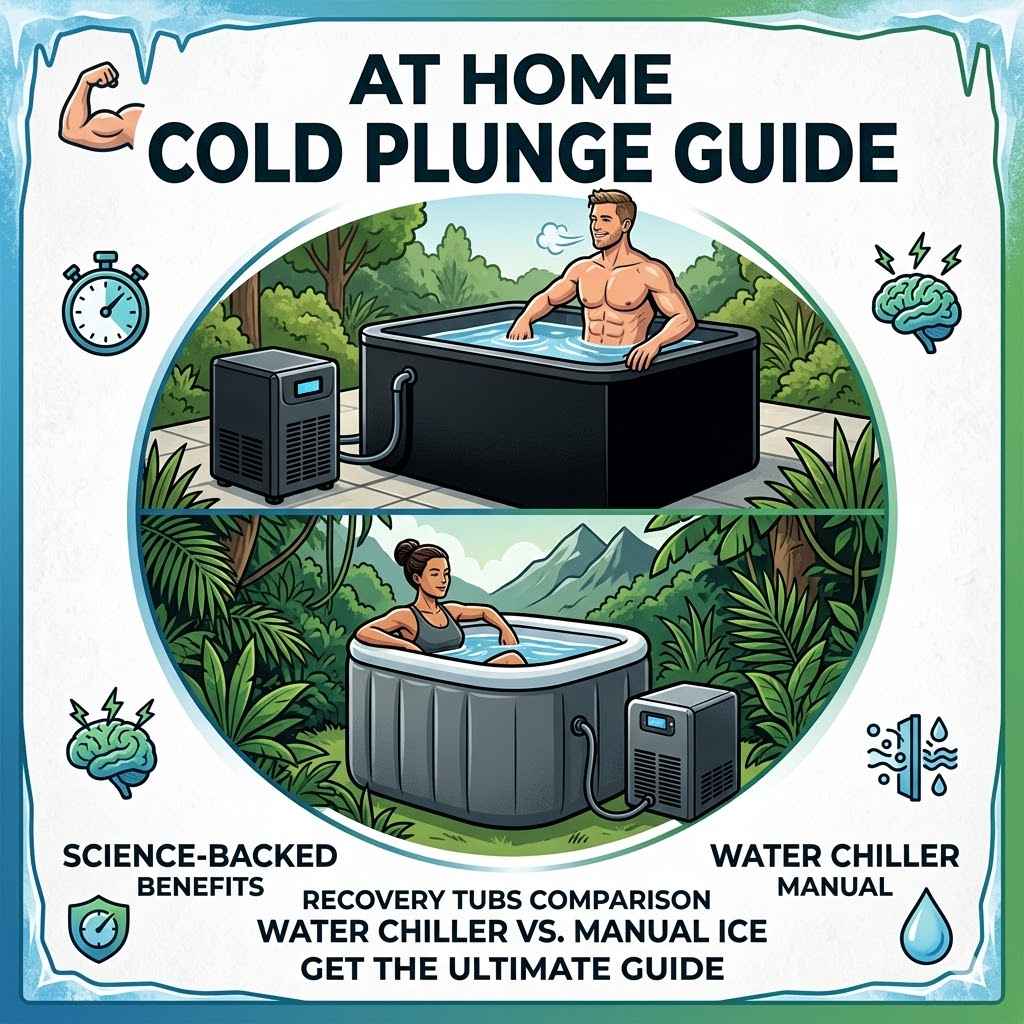
1. Inflatable & Portable Tubs (Budget-Friendly Entry)
Typically constructed from premium, highly durable drop-stitch materials—the exact same rugged engineering used to build stand-up paddleboards—or multi-layered insulated PVC, these inflatable setups serve as an exceptional entry point into the practice.
- Pros: They offer a highly affordable upfront cost, are incredibly easy to deflate and transport for travel, and are ideal if you have restricted backyard or balcony space and want to thoroughly test your commitment to the routine before investing thousands of dollars.
- Cons: Because they lack active cooling mechanisms out of the box, they require a constant, manual source of physical ice or frozen blocks unless you eventually decide to purchase a separate chiller unit down the road.
2. Chiller-Integrated Tanks (Premium & Automatic)
Widely recognized as the definitive best commercial cold plunge for home gym applications, these are comprehensive, commercial-grade systems that arrive equipped with integrated refrigeration, circulation, and filtration units.
- Pros: They provide a true "set-and-forget" user experience, giving you precise digital temperature control down to the degree, continuous water purification, and the absolute elimination of ever needing to drive to the store for heavy bags of ice again.
- Cons: They require a substantial upfront financial investment and necessitate proximity to a dedicated, grounded electrical outlet to safely power the cooling machinery.
3. DIY Chest Freezers (The Enthusiast Route)
This has become an incredibly popular route for hands-on, budget-conscious enthusiasts who purchase a standard appliance freezer, meticulously seal all the internal seams with marine-grade silicone or pond liner, and connect it to an external temperature controller.
- Pros: Standard chest freezers are naturally heavily insulated appliance boxes, which allows them to retain freezing temperatures incredibly efficiently while keeping your initial DIY build costs relatively low.
- Cons: They require strict, non-negotiable safety precautions—such as completely disconnecting the unit from the wall outlet before stepping inside to entirely eliminate the risk of catastrophic electric shock. Additionally, you must manage water sanitization entirely on your own, and the units carry an ongoing risk of structural leaks or rust over time.
Technical Comparison: Water Chiller vs. Manual Ice
If you are currently debating whether to rely on buying ice manually or to invest in a dedicated, automated mechanical cooling unit, it helps to analyze the long-term operational and lifestyle differences over a multi-month period:
FeatureChiller-Integrated SystemManual Ice & Portable TubTemperature ConsistencyDigitally maintains your exact target temperature 24/7, regardless of whether the tank is sitting in a hot garage or a sunny yard.Cold levels quickly degrade; the water temperature is highly volatile and entirely dependent on ambient weather conditions.Convenience FactorAlways ready for immediate entry; fully automated scheduling allows you to plunge the second you wake up.High daily effort required; demands that you constantly buy, haul, store, and dump dozens of pounds of ice blocks before every session.Water Quality & LifecycleActive mechanical filtration and sanitization cycles keep the exact same water sparkling clean and safe for months at a time.Lacks filtration; requires you to frequently drain, scrub, and entirely refill the tub to prevent bacteria buildup and stagnant water.Upfront CostModerate to High baseline financial investment.Low, highly accessible baseline financial investment.Ongoing CostMinimal long-term costs, resulting only in a minor, predictable increase to your monthly residential electricity bill.Deceptively high; the cumulative financial cost of purchasing daily bags of commercial ice quickly surpasses the price of a chiller.
Key Features to Look For Before You Buy
When evaluating various recovery tubs online, it is essential to look closely at the underlying technical specifications rather than just the aesthetic design to ensure your unit lasts for years:
- Temperature Range and Reliability: Verify that the system can easily drop down to—and maintain—a true range of 39°F to 45°F ($3.8^\circ\text{C}$ to $7.2^\circ\text{C}$). Premium units utilize heavy-duty compressors that can easily hold these freezing benchmarks even when placed in blistering hot, outdoor summer environments.
- Advanced Filtration Systems: Prioritize setups that feature a multi-stage sanitation loop, combining mechanical micron sediment filters with an active Ozone or UV sterilization system. This continuous purification process actively destroys organic matter, microscopic debris, and bacteria, allowing you to minimize your reliance on harsh chemicals while keeping the water pristine.
- Insulation Integrity: High-density, closed-cell foam injection or triple-layered thermal structural walls are crucial. They work to completely block ambient external heat from penetrating the tank, which ultimately protects your water chiller for cold plunge unit from constantly overworking and spikes your energy efficiency.
- Internal Ergonomics & Footprint: You must carefully cross-reference the internal dimensions against your height and body type. A quality tub should allow you to sit comfortably and fully submerge up to your collarbones without feeling cramped, while the exterior footprint must safely align with the weight-bearing capacity of your deck, garage, or gym flooring.
Step-by-Step Guide for First-Time Plungers
If you are stepping into near-freezing water for the absolute first time, managing your psychological panic response and establishing controlled breathing patterns are your absolute highest priorities.
Step 1: Establish a Moderate Starting Temperature
Do not make the classic mistake of dropping the water straight down to 39°F on day one. Start conservative and highly manageable by aiming for a baseline temperature between 50°F and 55°F ($10^\circ\text{C}$ to $12.7^\circ\text{C}$), which allows your nervous system to safely adapt to the novel stressor.
Step 2: Calm Your Mind and Control Your Breath Before Entry
Before your skin even touches the water, stand beside the tub and take 3 to 5 deep, intentional, grounding diaphragmatic breaths. The second you submerge, your body will instinctively trigger a cold-shock response, causing you to gasp rapidly; counter this by forcing a long, slow, controlled exhalation through your mouth to immediately regain voluntary control over your autonomic nervous system.
Step 3: Submerge Completely Up to Your Collarbones
Carefully lower yourself into the tank until the water line reaches the base of your neck. Submerging your shoulders and upper chest maximizes the stimulation of your vagus nerve and activates highly concentrated clusters of brown adipose tissue (BAT), which accelerates the down-regulation of your fight-or-flight response. If the aching cold feels too overwhelming at first, keep your hands entirely out of the water.
Step 4: Keep the Session Short and Monitored (Under 3 Minutes)
You do not need to sit in the cold for a long time to extract the vast majority of its clinical benefits. A duration of just 1 to 3 minutes is more than enough time to unlock a comprehensive metabolic, vascular, and neurological boost, and you should actively avoid staying inside past 5 minutes to prevent your core body temperature from dropping into unsafe zones.
Summary: Is the Investment Worth It?
When you add up the long-term advantages, investing in a dedicated home setup is undeniably worth it for anyone serious about optimizing their physical recovery and sharpening their mental health. While purchasing a premium system demands a thoughtful upfront financial plan, the massive amount of time saved—combined with the sheer convenience of having a pristine, freezing tank ready at a moment's notice—makes it an absolute cornerstone piece of modern fitness and longevity technology.