
My Child Has Meltdowns Every Day and Nothing I Do Helps — Here's Why
You've tried everything — the reward charts, the consequences, the counting to ten.
Nothing works when your child is truly falling apart.
That's not a parenting failure. That's biology.
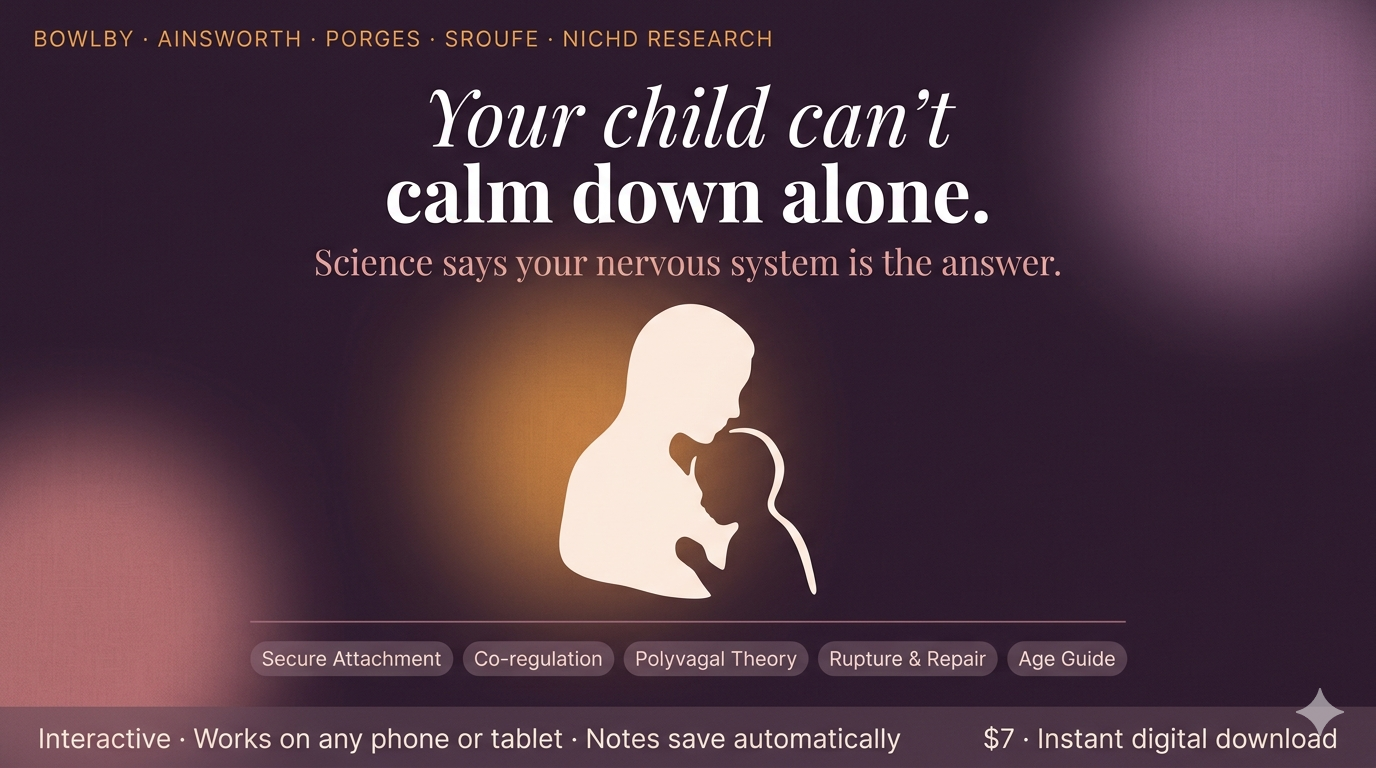
Research from Bowlby, Ainsworth, Porges, and the largest child development study in history (NICHD) all point to the same truth: your child cannot calm down alone. Their nervous system is not built for it yet. They need a regulated adult nearby — and that adult's calm physically settles the child's stress response.
Your nervous system is the tool. This toolkit teaches you how to use it.
─────────────────────
📦 WHAT YOU GET — 3 FILES
─────────────────────
📱 THE INTERACTIVE TOOLKIT
Open on any phone, tablet, or laptop. No app, no printing.
🔵 Attachment Style Explorer
Tap your child's pattern — Secure, Anxious, Avoidant, or Disorganised. See what it looks like, what they need most, and the exact words to use.
🎚️ Nervous System Gauge (interactive)
Slide to describe where your child is right now — Shutdown, Activated, or Flooded. The tool tells you what's happening in their body and what to do this minute.
🫂 5 Co-regulation Technique Cards
Regulated Presence · Attuned Touch · Voice as Regulator · Movement Together · Gradual Handover. Each with the science, step-by-step guide, and a parent script.
🔄 Rupture & Repair Scenarios ×6
What to do after you've snapped, gone cold, or lost it. Because repair matters more than perfection — the research proves it.
📅 Age-by-Age Co-regulation Guide
What works at 0–2, 3–6, 7–11, and 12–18 — including why teenagers still need co-regulation even if they'd never admit it.
📓 Parent Journal
8 editable prompts that save automatically to your device.
─────────────────────
📄 THE PARENT FAQ — PDF
10 questions parents most commonly ask about co-regulation and attachment theory — answered thoroughly in plain language. No academic jargon.
Includes answers to:
→ Is this the same as permissive parenting?
→ What if my child escalates when I try this?
→ Does attachment style change over time?
→ My child is a teenager — is it too late?
→ What do I do during the peak of a meltdown?
→ And 5 more questions parents ask before they trust the research.
Print it, save it, or read it first — many parents say this is the piece that made everything else click.
─────────────────────
🖼️ THE SCIENCE INFOGRAPHIC — PDF
A single-page visual summary of the core research — co-regulation, attachment styles, polyvagal theory, and the rupture-repair cycle — designed to be pinned to a wall, saved to your phone, or shared with a co-parent or caregiver.
Visual, scannable, and reference-ready in under 2 minutes.
─────────────────────
WORKS ON ANY DEVICE
─────────────────────
All three files download instantly after purchase. The toolkit opens in any browser — no app required. The FAQ and infographic are print-ready PDFs. Journal notes save automatically to your device.
─────────────────────
⭐ Part of the Emotional Intelligence Bundle Series — collect all four science-based parent toolkits.