
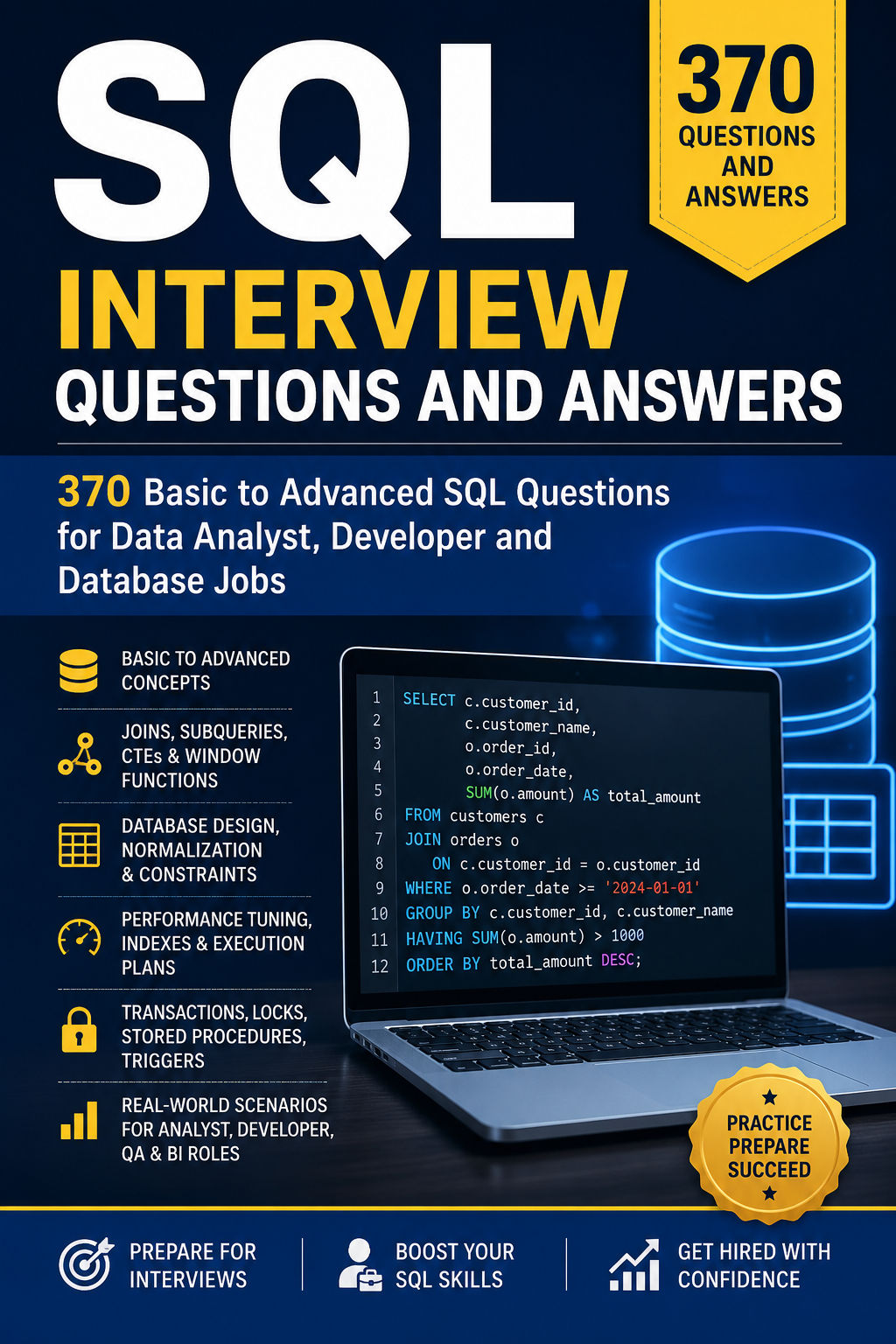
SQL Interview Questions and Answers: 370 Basic to Advanced SQL Questions for Data Analyst, Developer and Database Jobs
Prepare confidently for SQL interviews with this practical and detailed interview guide covering 370 SQL interview questions and answers from basic to advanced level.
This guide is designed for freshers, students, data analysts, SQL developers, database professionals, QA testers, business analysts, MIS executives, finance professionals, and job seekers preparing for roles where SQL knowledge is required.
The ebook covers:
✅ SQL basics and database concepts
✅ Tables, rows, columns, keys, and constraints
✅ SQL commands, clauses, and operators
✅ Aggregate functions and grouping
✅ Joins and relationships
✅ Subqueries and nested queries
✅ Views, indexes, and normalization
✅ Window functions and analytical SQL
✅ CTEs, recursive queries, pivot, and dynamic SQL
✅ Transactions, locks, concurrency, and ACID properties
✅ Performance tuning and execution plans
✅ Stored procedures, functions, and triggers
✅ Data cleaning and real-world SQL scenarios
✅ SQL testing, ETL validation, and migration checks
✅ SQL for banking, finance, fund accounting, risk reporting, and business analysis
Each answer is written in a clear, detailed, interview-ready format to help you understand concepts, explain logic confidently, and handle practical SQL questions in interviews.
Whether you are preparing for a Data Analyst, SQL Developer, Database Developer, BI Analyst, QA Tester, MIS Executive, Business Analyst, or Finance Data Analyst role, this guide gives you a structured way to revise and prepare.
SQL interviews are not just about writing SELECT * FROM table.
They test whether you can think with data, join logic correctly, find errors, clean records, validate reports, optimize queries, and explain business results clearly.
This guide helps you prepare for exactly that.
Sample Questions
- What is a relational database?
- What happens if you run an UPDATE statement without a WHERE clause?
- Why can’t we use aggregate functions directly in the WHERE clause?
- What is the difference between inner join and left join?
- What is a correlated subquery?
- What is a covering index?
- What is Boyce-Codd Normal Form?
- How do you calculate moving averages in SQL?
- What is a recursive CTE?
- What is a deadlock?
- Why should functions on indexed columns be avoided in WHERE clauses?
- What are the disadvantages of triggers?
- How do you identify orphan records?
- You have a login table. How will you find users who logged in for 7 consecutive days?
- How do you calculate year-over-year growth?
- How do you reconcile two transaction tables?
- What is cardinality estimation?
- How do you test whether business rules are correctly applied in SQL output?
- How would you use SQL to calculate loan delinquency?
- A table contains historical status changes. How will you find the latest status for each record?
- A database has slow inserts after adding many indexes. What could be the reason?