

Earn Value Management Course
Earned Value Management — A Complete Field Course
What it is. Why it exists. Which standard applies in Australia. How to set it up, every formula and what it actually means, and what changes in your project once you use it.
Nine parts
One — What earned value actually is. Every project tracks time spent and money spent, and both keep moving whether or not any work is being done. Earned value adds the number that was missing: how much of the work is finished, in dollars, so progress and cost can finally be compared.
Two — Why we use it. The four things it fixes — the ninety-per-cent problem, the status-colour problem, the disagreement between client and contractor, and forecasts that are just the budget repeated back. Plus the real benefit, which is timing: a fifteen per cent overrun is visible in the first quarter, while rescoping is still an option.
Three — Which standard applies in Australia. AS 4817, what it requires of you, and how it relates to ANSI/EIA-748 and ISO 21508.
Four — How to set it up. Work breakdown, control accounts, the performance measurement baseline, and choosing an earning method for each work package — with the full table of methods and the level-of-effort trap that makes SPI meaningless.
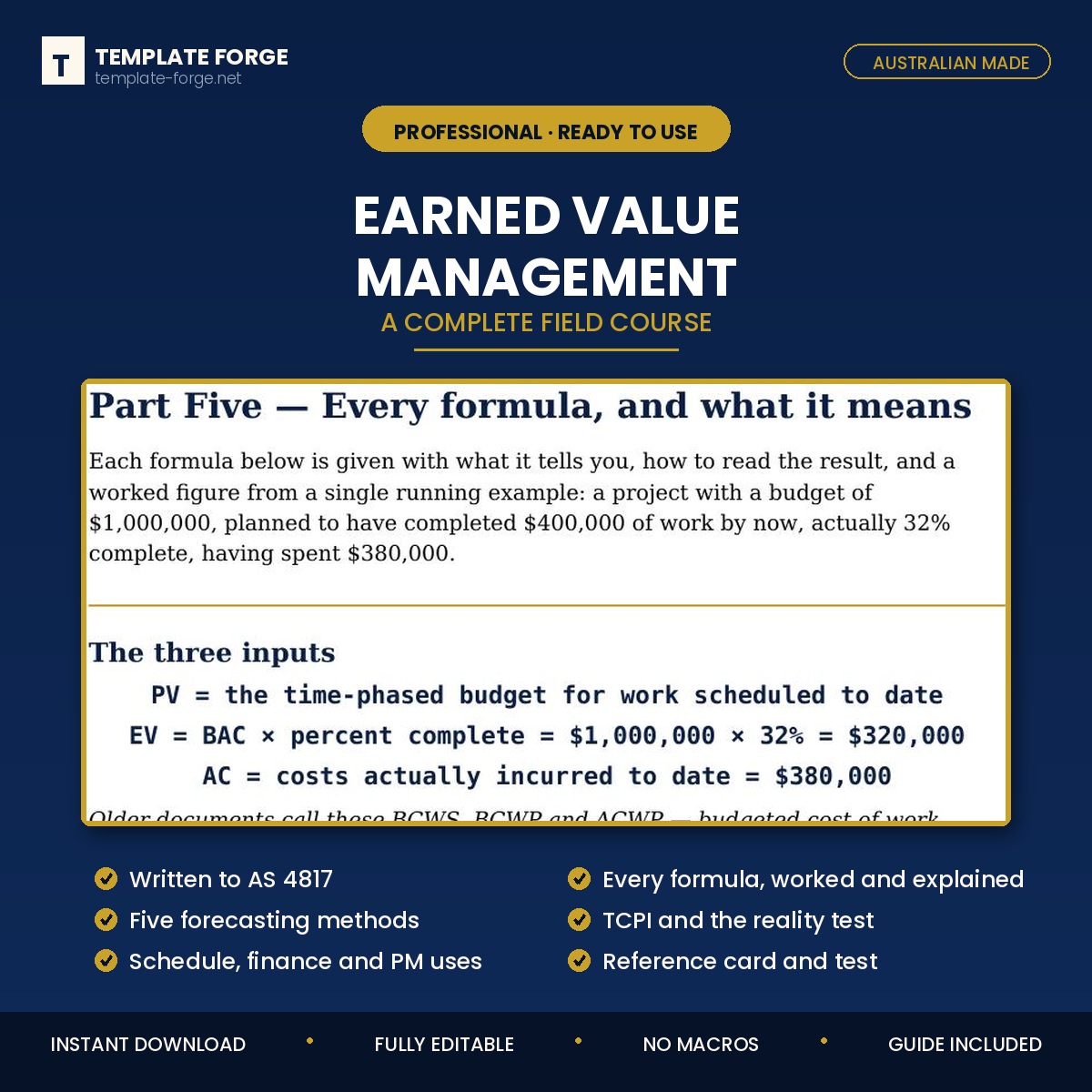
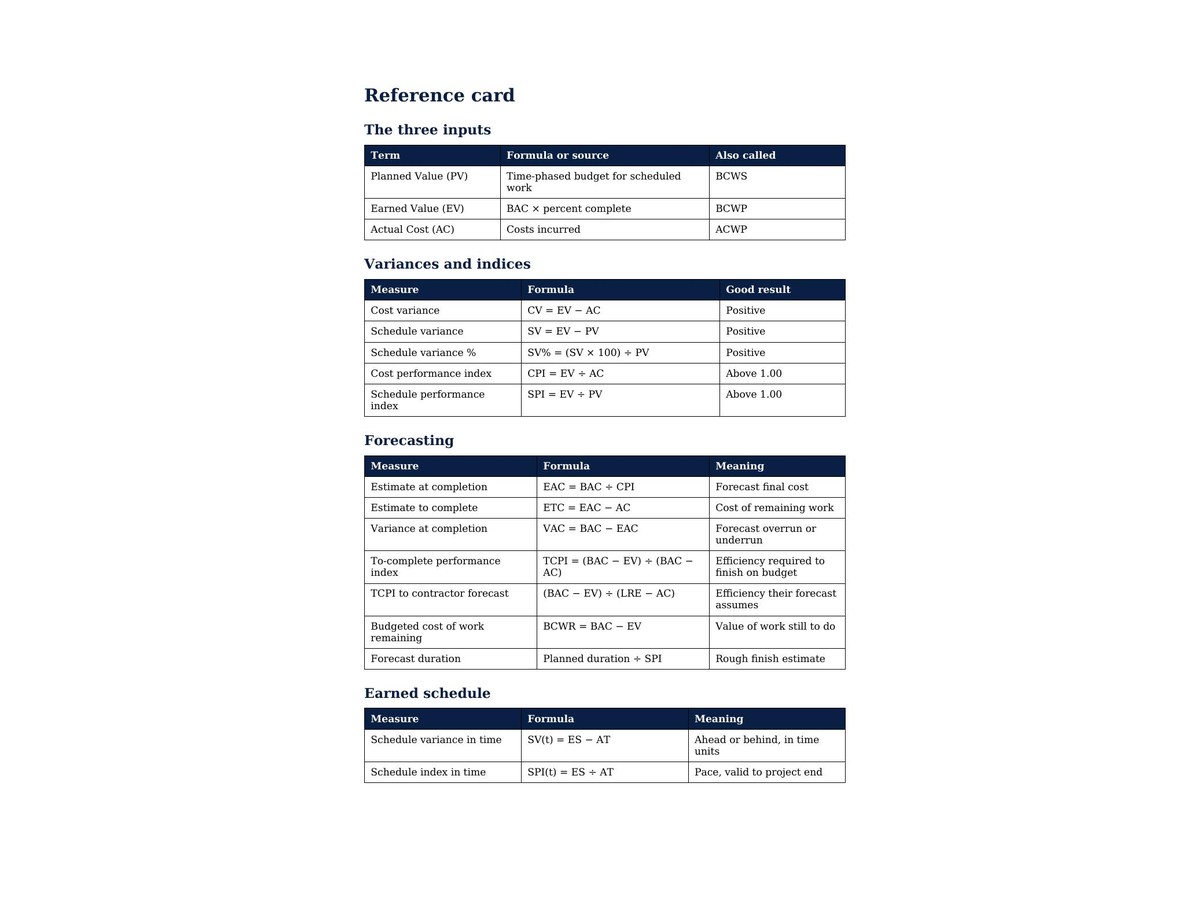
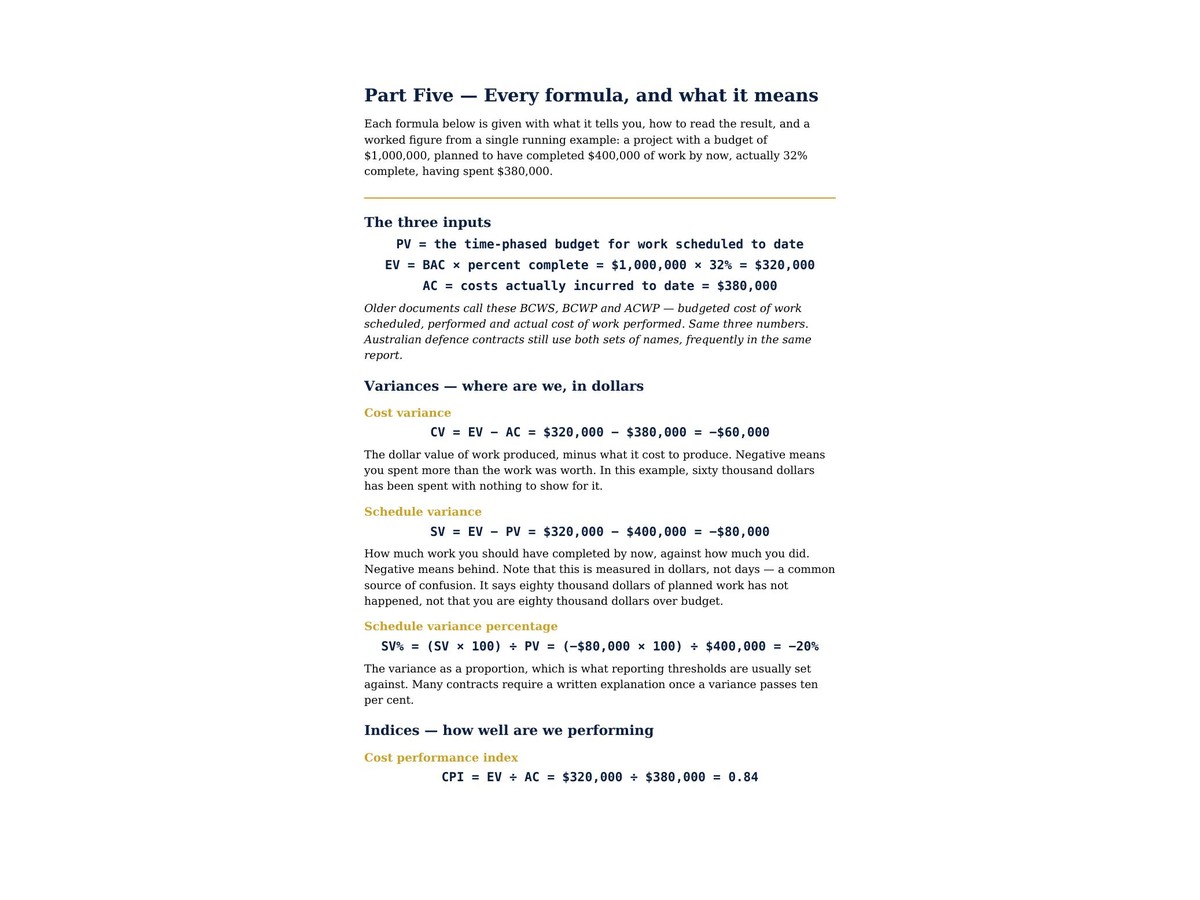
Five — Every formula, and what it means. Each one with the formula, a worked figure from a single running example, and a plain-English reading. PV, EV, AC. CV, SV, SV%. CPI and SPI. Five independent estimates at completion. ETC, VAC, BCWR. TCPI, and TCPI against the contractor's own forecast. Earned schedule.
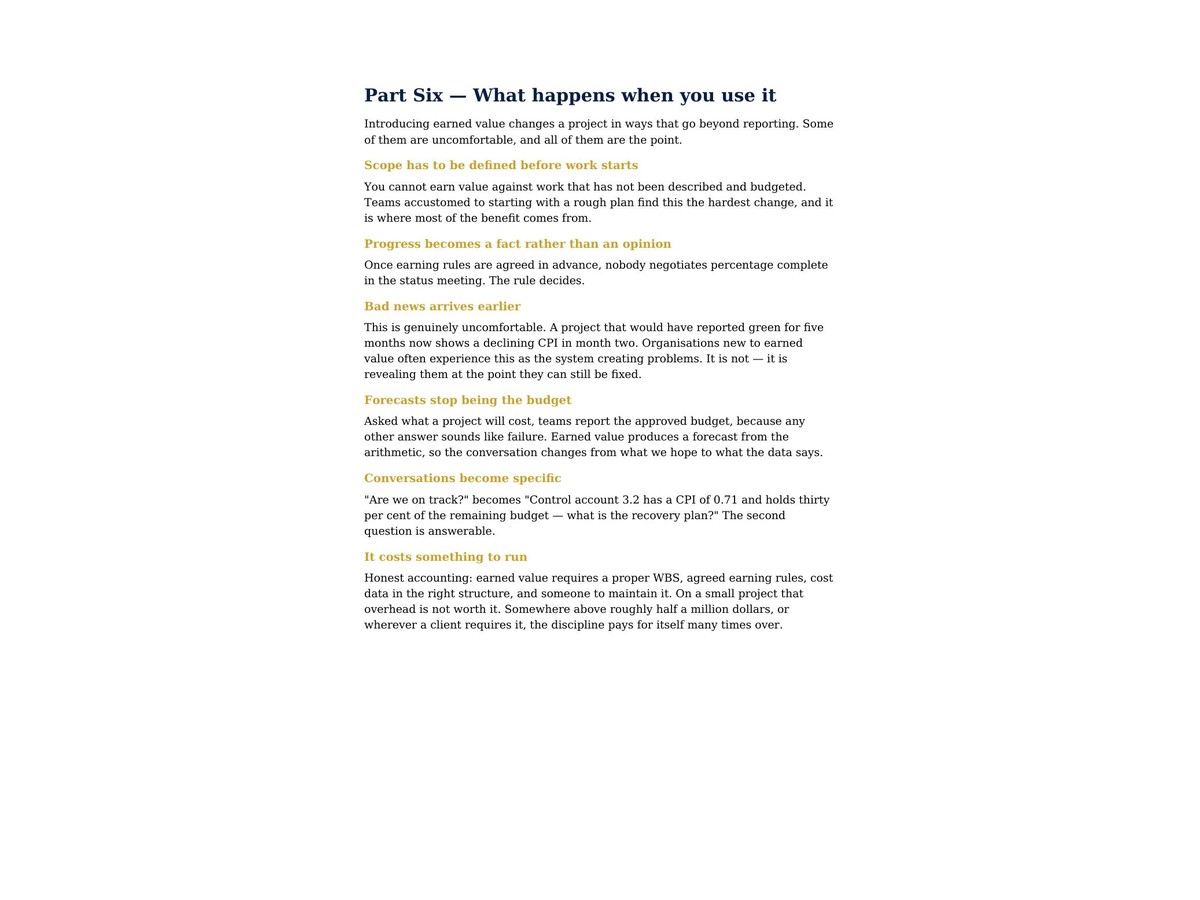
Six — What happens when you use it. Six honest changes, including that bad news arrives earlier — which is uncomfortable and is the entire point.
Seven — Where you use it. Split three ways: schedule management, finance and cost control, and project management. What it tells you in each, and what it does not.
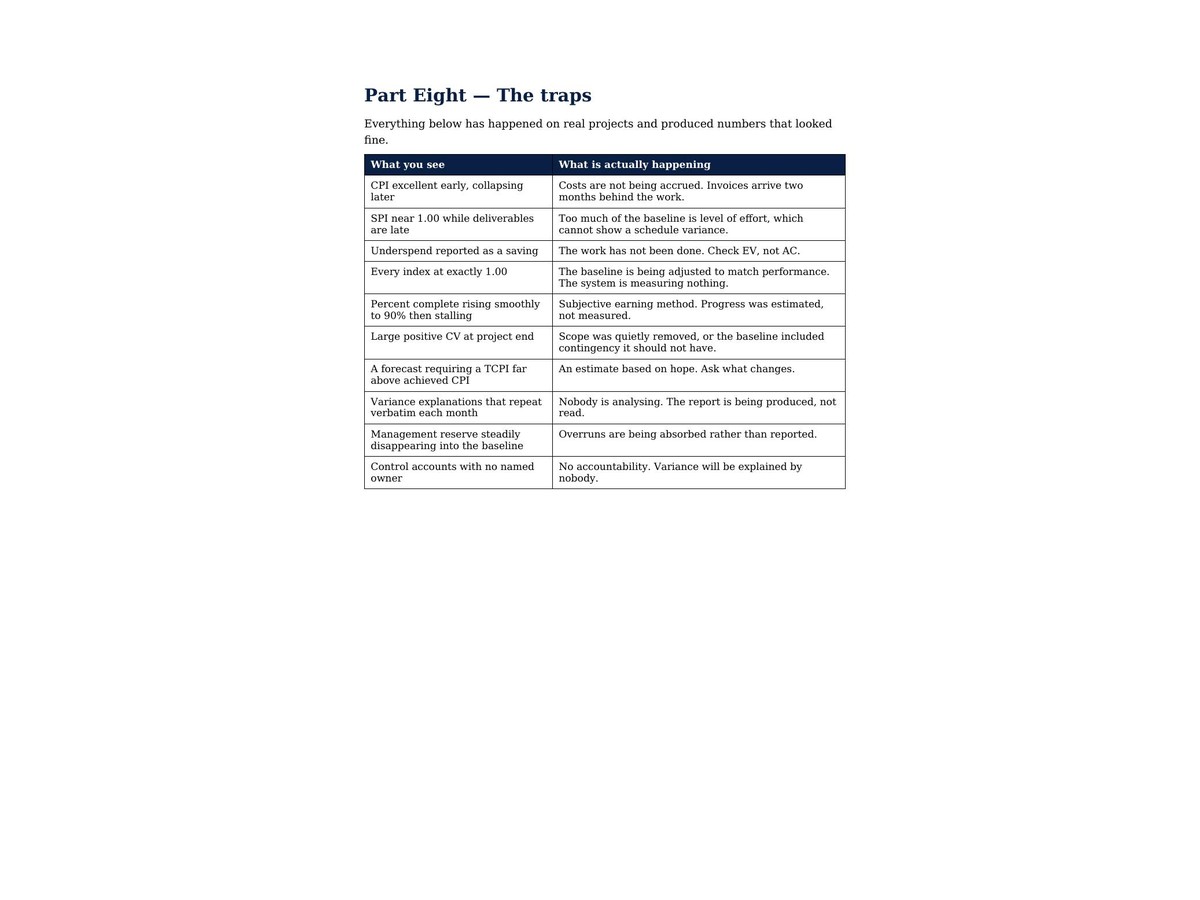
Eight — The traps. Ten of them, as what-you-see against what-is-really-happening.
Nine — A worked project, end to end. A depot upgrade at month three, with the reading, the four options available, and what would have happened without earned value: the same $130,000 problem discovered at month six, when only the worst option remains.
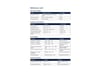
Plus a reference card with every formula, and eight test questions with worked answers.
The idea at the centre of it
TCPI. Your project has achieved a CPI of 0.84 and the forecast requires 1.10 for the remaining work. That is a thirty-one per cent improvement in efficiency, and it turns "I don't believe your forecast" into a question that has to be answered with a plan: what specifically changes?
Who it's for
Project controls staff, planners, project and program managers, finance teams reviewing project forecasts, and anyone working on a contract that requires earned value reporting. Useful before an EVM role, and more useful in one.
20 pages. Supplied as PDF and editable Word. Yours to keep, no login, no expiry.
Written in Australia by Christine de Vries, Port Jackson Group, to AS 4817. Educational material, not professional advice; nothing here excludes any consumer guarantee under the Australian Consumer Law.
Pairs with the Earned Value Calculator (A$39), which does this arithmetic for you, the EVPR Worked Example (A$29), and the EVM Dashboard (A$19).