
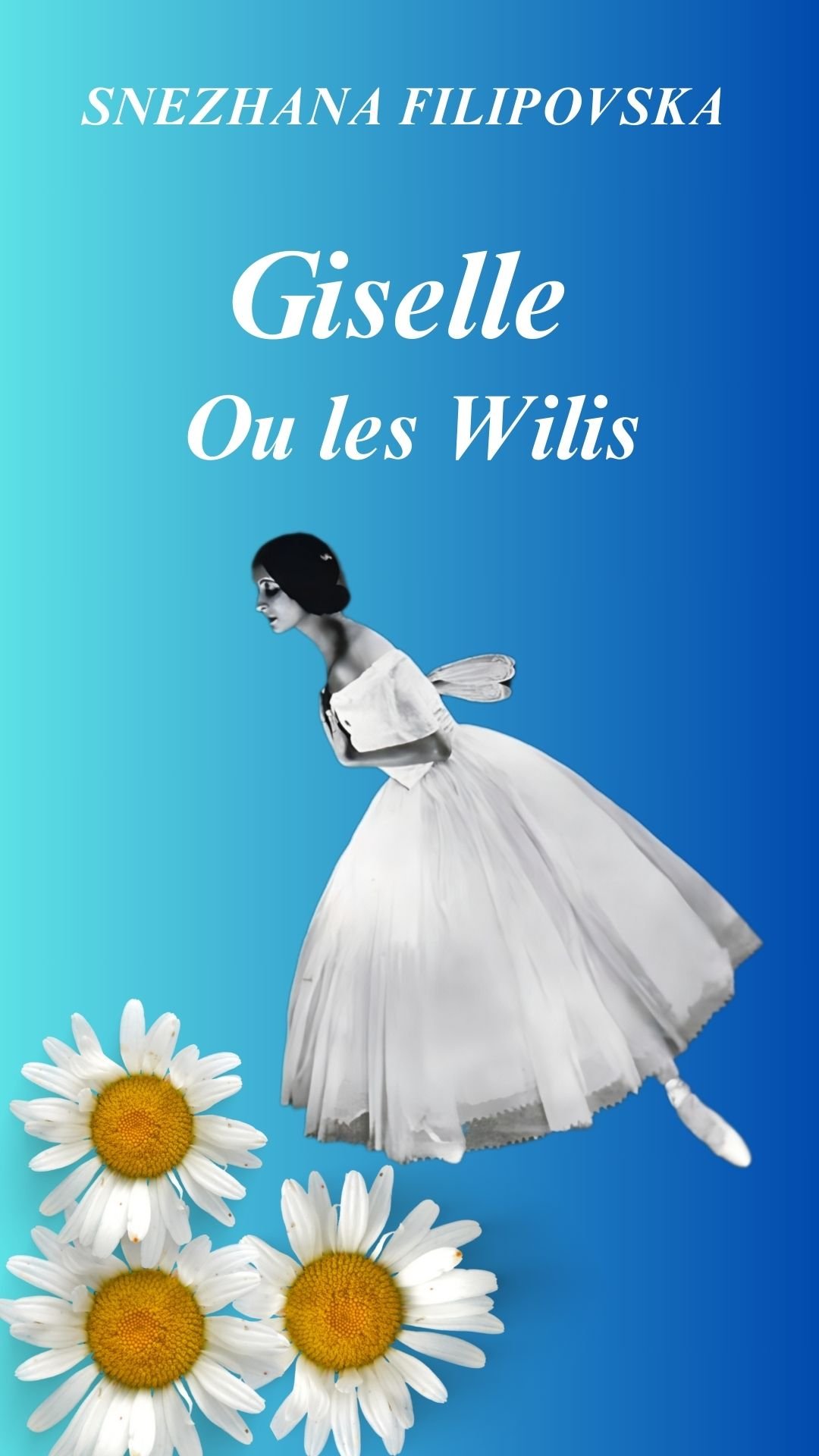
Giselle Ou les Wilis
In a complex interplay of circumstances, the ballet "Giselle" was born during one of the most beautiful periods in ballet history - the era of Romanticism. This French ballet masterpiece immediately reflects the values and significance of the great Romantic era for the further evolution of choreographic art.
The intricate web of mysterious circumstances in theatrical scientific thought continues to pose a significant challenge to this day. This challenge is primarily linked to a rich wellspring of profound dance obligations, which flow into the choreographic imagination of its creators (Jean Coralli, Jules Perrot, Marius Petipa) like pure spring water.
The enduring allure of the ballet "Giselle" lies in the treasury of artistic values embedded within it. It houses a profound choreographic thought, possessing a tremendous artistic power that influences the historical trajectory, implementation, and continuation of the tradition of choreographic creativity.
The author's exploration of the ballet "Giselle" in this concise book represents a priceless challenge on the path to uncovering the roots and power of dance. The role and significance of dance's expressive possibilities in a ballet performance represent an urgent necessity for the new generation of ballet creators.
The ballet "Giselle" is an irreplaceable, brilliant example where dance, along with other components - music and the ballet's libretto - are in a strong harmonious relationship. The focused development of the action, free from extraneous details, provides space for music and choreography.
In addition to being a classic example of ballet dramaturgy, the ballet "Giselle" is primarily defined as a masterpiece where music harmonizes fully with choreography. Thus, the three main components of expressiveness in a ballet performance (dramaturgy, music, and choreography) complement each other on the theatrical stage, creating a perfect artistic whole.
The creators of the ballet "Giselle" are deeply respected by connoisseurs of theatrical art. The great composer Pyotr Ilyich Tchaikovsky, for instance, highly appreciated the music in the ballet by the French composer Adolphe Adam. According to the recollections of Tchaikovsky's brother, Modest Ilyich Tchaikovsky, the ballet "Giselle" was the great composer's most beloved ballet, calling it a pearl of poetry, music, and choreography. The artistic value of "Giselle" lies precisely in the union of poetry, music, and choreography.
The connection of urban music and theater, a characteristic of the music in the era of Romanticism, is strongly felt in Adam's compositions, in easily perceived musical motifs. Music also dictates the way of a strong connection of expressive and descriptive elements in choreography. Therefore, the greatest value and beauty of choreography lie in the organic connection of dance and pantomime.
The program of the symphonic ballet can be seen in the choreographic text of "Giselle". The leitmotif of choreographic characters is developed in all episodes. Dance monologues and dialogues are connected with mass dances. In the ballet, the rare abilities of the choreographer Jules Perrot to organically combine dance and pantomime, to emphasize action and psychological moments in duets, to create dance mise-en-scenes are clearly visible. However, his work in the performance at the time of the premiere was overshadowed. Later, in theater studies with a deeper choreographic analysis, the merits of Jules Perrot are clearly outlined.
The ballet "Giselle" remained on the French stage until 1868. Then this ballet disappears from the repertoire not only of France but also of other European countries, which in the second half of the 19th century experienced a crisis of choreographic art, up to the possibility of complete disappearance of classical dance.
The stage history of the ballet continues on the Russian stage. Soon after the Paris premiere, in 1842 it was established in St. Petersburg, and in 1843 - in Moscow. In 1848-1859, Jules Perrot himself worked as a performer and chief ballet master in St. Petersburg. On the St. Petersburg stage, he edited and perfected the ballet together with the artists of the Russian ballet. The creativity of the last romantic of the Russian ballet in St. Petersburg, Jules Perrot, has invaluable significance for the further historical development of the ballet "Giselle".
It is inevitable to underline the fact of careful attitude to the wealth of choreographic achievements of Perrot in Russia. First of all, this is the attitude of the brilliant Marius Petipa to the creativity of his compatriot on the St. Petersburg stage. When reconstructing the ballet "Giselle", he directs all his thoughts to the author's idea. The life motto, which the great choreographer follows in life and on stage: "The most difficult thing is to respect someone else's creativity as your own". His full commitment to the cause of his predecessors allows us today to admire the captivating beauty of classical dance - the main means of expressiveness in this ballet performance.
At the beginning of the 20th century, the ballet "Giselle" was included in the repertoire of the "Paris Seasons" in the West. The season of 1910-1911 from the "Russian Seasons" passes triumphantly. Of particular interest is the performance of "Giselle" - a French national ballet, preserved in the Russian Imperial Theater. The performance of the long-forgotten ballet was unexpected and enthusiastically met by the French audience. The main roles are performed by Tamara Karsavina in the role of Giselle and Vaslav Nijinsky in the role of Albert. The plays shown in 1911 were also successfully demonstrated in Rome, London, and Monte Carlo.
In 1924, the best ballet of French choreography was restored in Paris by ballet master N. Sergeev. The main role is performed by the Russian ballerina O. Spesivtseva. Since then, the ballet "Giselle" lives on the ballet stages of many theaters in Europe, as well as on the stages of theaters around the world. In the ballet "Giselle", the authors' imagination is fertilized by the feeling of the new, the feeling of modernity, thanks to which the principle of innovation and originality is realized, a kind of guiding thread in artistic creativity.
The great theater critic Yuri Slonimsky in his book dedicated to the ballet "Giselle", says: "The feeling of modernity gives the work a rich inner life, infecting it with the 'excitements of the century'. Isn't this the solution to the 'immortality' of 'Giselle'? Modernity has made it a classic 'drama of the heart', capable of standing in line with the best creations of literature and art of that era".
The ballet "Giselle" exemplifies the most intricate form of choreographic dramaturgy. During pivotal moments of choreographic action, there is no clear separation between "scenes" and "dances" - dance episodes and pantomime. Instead, there is a remarkable freedom in blending a spectrum of elements, with dance taking precedence. The authors' artistic vision is conveyed through ballet forms, where even simple dance steps are imbued with purpose and significance, seamlessly continuing the dramatic narrative through dance.
The choreographic dramaturgy in the classical heritage ballet "Giselle" serves as an excellent study of the nuances of choreographic principles. It enhances understanding in the realm of choreographic composition, allowing for a more precise insight into the core of ballet art. To affirm this notion about choreographic dramaturgy in "Giselle", we cite Theophile Gautier, the playwright to whom the ballet's concept is attributed: "Ballet is a distinct art form, necessitating unique plots, where dance naturally emerges, powerfully guiding the direct unfolding of the narrative".
The forthcoming book aims to guide professional performers along the creative journey of this gem of dance literature - the ballet "Giselle". Owing to the diverse presentation of the material, the book is accessible to the emerging generation of ballet artists, educators, mentors, choreographers, and other ballet enthusiasts. We anticipate that by making this genre of literature available to a broad audience, interest in ballet as an integral part of cultural artistic value will be heightened among all communities.