


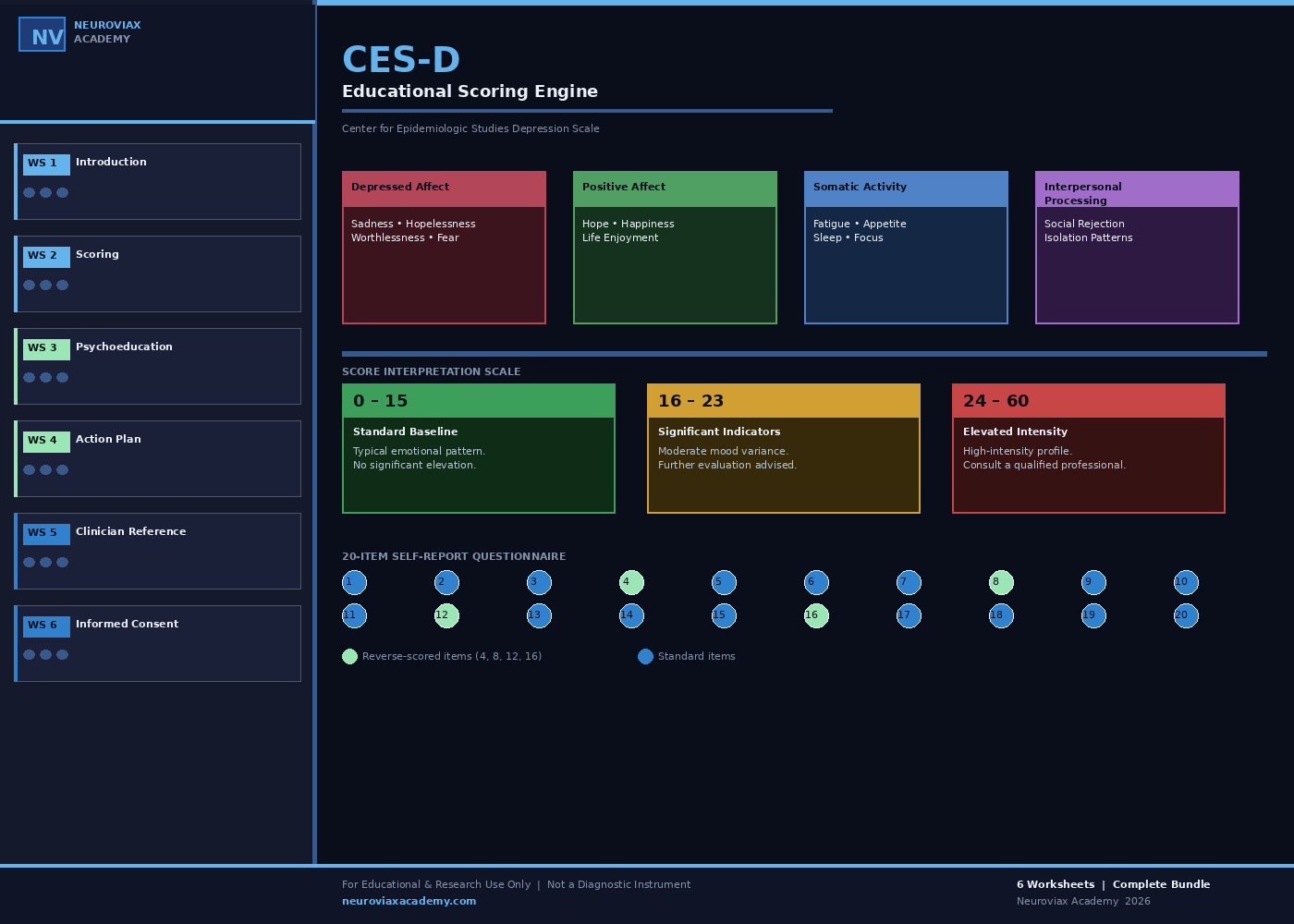
CES-D Educational Scoring Engine — Complete 6-Worksheet Bundle
Do You Actually Know What's Happening Inside You Emotionally — or Are You Just Guessing?
Most people move through weeks of low energy, broken sleep, and emotional fog without ever stopping to map what's actually going on. The CES-D Educational Scoring Engine gives you a structured, research-backed way to do exactly that — measure the frequency and pattern of depressive symptoms across four distinct emotional domains, so you stop guessing and start understanding.
Built around the Center for Epidemiologic Studies Depression Scale (CES-D) — one of the most widely validated self-report instruments in behavioral research, developed at the National Institute of Mental Health and used globally since 1977 — this 6-worksheet bundle translates a clinical-grade framework into an accessible educational tool for personal insight, academic study, and structured self-reflection.
What's Inside the Bundle
WS 1 — Introduction & Item Questionnaire: A full 20-item CES-D questionnaire with clear instructions, a rating scale legend (0–3 frequency scoring), and context on what each domain measures. You walk away with a complete set of raw scores ready for analysis.
WS 2 — Scoring Worksheet: A step-by-step scoring guide that handles reverse-scored items (4, 8, 12, 16), calculates four subscale totals — Depressed Affect, Positive Affect, Somatic Activity, and Interpersonal Processing — and interprets your total score across three meaningful ranges: 0–15 (Standard Baseline), 16–23 (Significant Indicators), and 24–60 (Elevated Intensity Profile). Includes a hand-draw score profile chart.
WS 3 — Psychoeducation Module: Goes beyond the numbers. Explains the science behind the four-factor structure, discusses how depressive symptoms manifest in daily situations (morning routines, work, social interactions, sleep), corrects common myths about depression screening, and provides five guided self-reflection questions to deepen personal insight.
WS 4 — Action Plan: Converts your results into forward momentum. Includes SMART goal templates (three full goal structures), a weekly implementation planner broken down by morning, afternoon, and evening, an obstacle-and-solution mapping table, a support system log, and a 4-week daily progress tracker with a 30-day review prompt.
WS 5 — Clinician Reference: A professional-grade companion sheet documenting the CES-D's theoretical framework, psychometric properties (Cronbach's alpha .85–.90), validity data, differential considerations for elevated scores, and a full evidence base with peer-reviewed citations. Designed for researchers, educators, and mental health professionals using this tool in academic or caregiving contexts.
WS 6 — Informed Consent Form: A clear, structured consent document outlining the educational purpose of the tool, confidentiality terms, voluntary participation rights, benefits and risks, and a signature block — including a parent/guardian field for users under 18.
Who This Bundle Is For
This bundle is designed for adults who want a structured, evidence-based framework for emotional self-awareness — not a vague wellness journal or a generic mood tracker. It is particularly well suited for psychology students and researchers using the CES-D in coursework or community studies, mental health educators building structured psychoeducation programs, coaches and practitioners who want a validated screening reference for non-clinical settings, and individuals with an analytical mindset who want to track emotional patterns over time with real data, not just feelings.
This is not a diagnostic tool. It does not replace professional evaluation. If you are experiencing significant distress, please consult a qualified mental health professional.
Why the CES-D Framework
Unlike generic mood checklists, the CES-D separates your emotional experience into four measurable subscales. This means you can identify whether your distress is primarily emotional (Depressed Affect), physical (Somatic Activity), social (Interpersonal Processing), or related to the absence of positive emotion (Positive Affect) — a distinction that changes what kind of support is actually useful. The scale has been validated across dozens of cultures and languages, with strong psychometric reliability documented across more than four decades of research.
What You Get
Six print-ready PDF worksheets forming a complete self-assessment and reflection system. The bundle moves logically from intake and scoring through psychoeducation, planning, professional reference, and ethical consent — covering every stage of a structured emotional assessment experience.
If you've been looking for a rigorous, research-grounded way to understand your emotional baseline — not a quick quiz, not a symptom list, but a real framework with depth — this is the bundle built for that.