

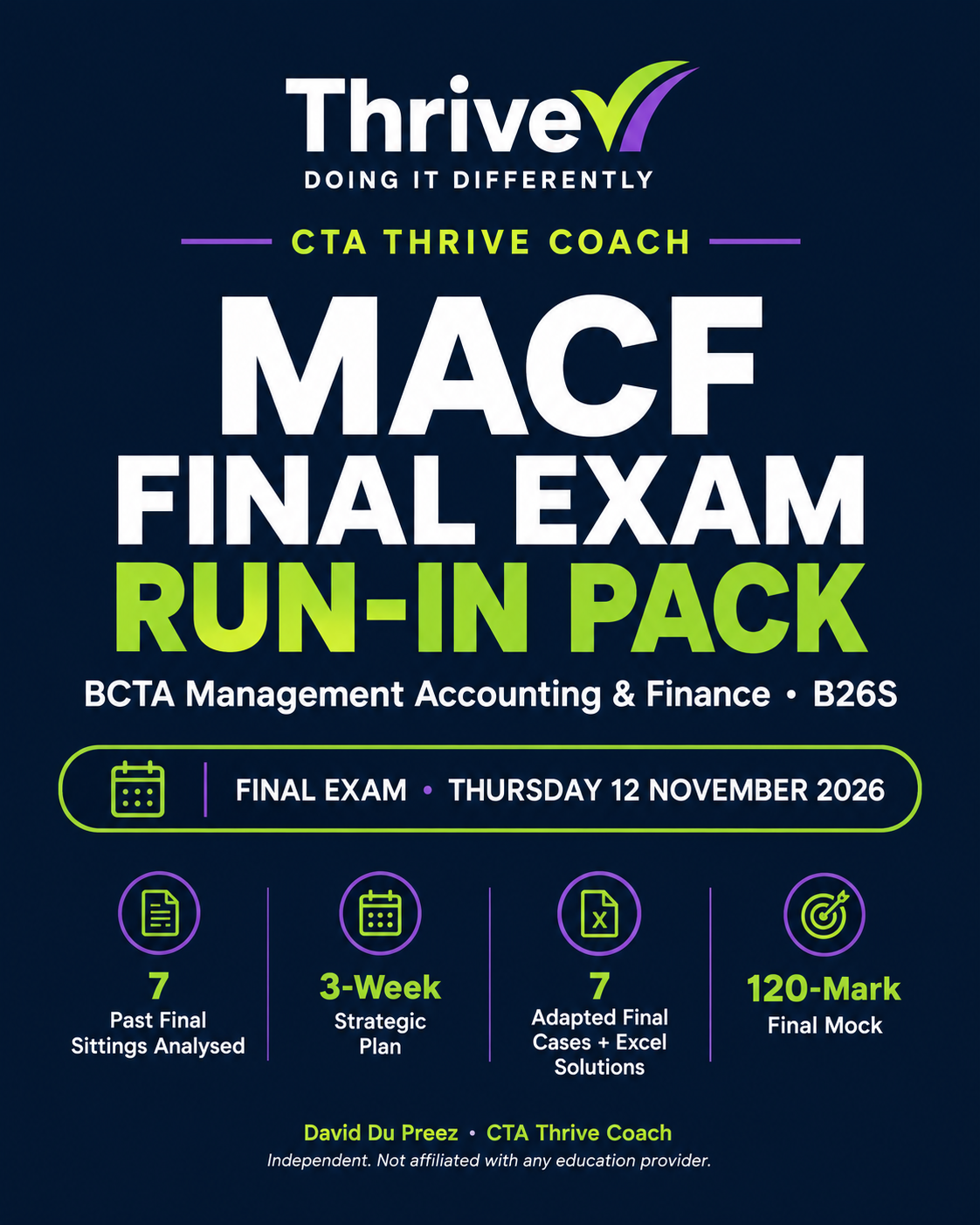
MACF Final Exam B26S Strategic Blueprint
MACF Final Exam Preparation Bundle — BCTA Management Accounting and Finance (MACF) · B26S
Final Exam on Thursday, 12 November 2026
Built backwards from one question: what does this examiner actually set at the Final, and what does the mark plan actually reward?
Every topic, mark weighting and question shape in this pack comes from seven past MACF Final sittings (B21S to B26F). On top of that sit two signals from this semester: what the B26S Test 1 and Test 2 have already examined, and what three earlier cohorts show about which Test topics come back at the Final and which do not.
What’s inside
Strategic Blueprint (14 pages). What is likely to be examined, what is not, and why. It shows how often each topic has appeared at the Final, which Test topics have already been spent, and the traps the markers keep reporting. Read it once, all the way through, before you plan anything.
Week 1 — Valuation (~33 of the 120 marks)
- Free cash flow from EBIT.
- Terminal value, and remembering to discount it.
- The equity bridge: surplus cash, non-operating assets, debt at market value including the current portion, and debentures.
- Partial stakes and the qualitative factors around a valuation.
- Valuation is never examined at a Test, so the Final is the only place it can appear, and it is where marker reports are harshest.
Week 2 — Costing Engine and Breakeven (~48 marks)
- Absorption rates, under- and over-recovery, and the absorption profit statement.
- ABC on practical capacity, with unused capacity shown separately.
- Critique of the costing system, and discontinuing a product.
- Multi-product breakeven using all fixed costs, and target profit grossed up for tax.
Week 3 — Funding, Performance and Strategy (~39 marks)
- The effective after-tax cost of debt as an IRR, not a headline rate multiplied by 0.73.
- Funding options and covenants.
- Ratio and profitability analysis applied to the facts.
- Porter and business risks, plus how to critically evaluate a manager’s comments for marks.
Question Pack — seven adapted Finals (459 marks). Every past Final part the programme sets, rewritten as seven cases with new names, figures and wording. The business, structure, traps and mark allocation stay the same. Each week has its own Excel solutions workbook for that week’s cases.
Final Mock (120 marks, 240 minutes). One integrated scenario across all three weeks. It is released at 09:00 on Sunday 1 November and sat unseen, because a paper you have already glanced at cannot measure anything. The full solution follows the same evening, with a reflection sheet that turns your mock result into a Week 3 plan.
Singles weekend (7–8 November). A 40-mark set of four short questions, one on each core calculation, plus a two-page cheat sheet for the final days.
Each week carries:
- a diagnostic to show you where you stand;
- a topic guide with a fully worked example;
- a drill pack that combines adapted past Final parts with three original 44-mark questions.
Every solution is a multi-tab Excel workbook. It opens on a Navigator, shows the workings with live formulas, sets out a mark plan for every part with more points than marks (as an official mark plan does), and ends with Marker Notes that price the most common errors in marks.
Format
One ZIP, foldered by week. PDFs and Excel workbooks only, so you need nothing beyond a PDF reader and Excel, Google Sheets or LibreOffice. The mock is released separately on Sunday 1 November.
Prepared by David Du Preez, CTA Thrive Coach. Independent — not affiliated with Milpark Education.