Warehouse Management Mastery
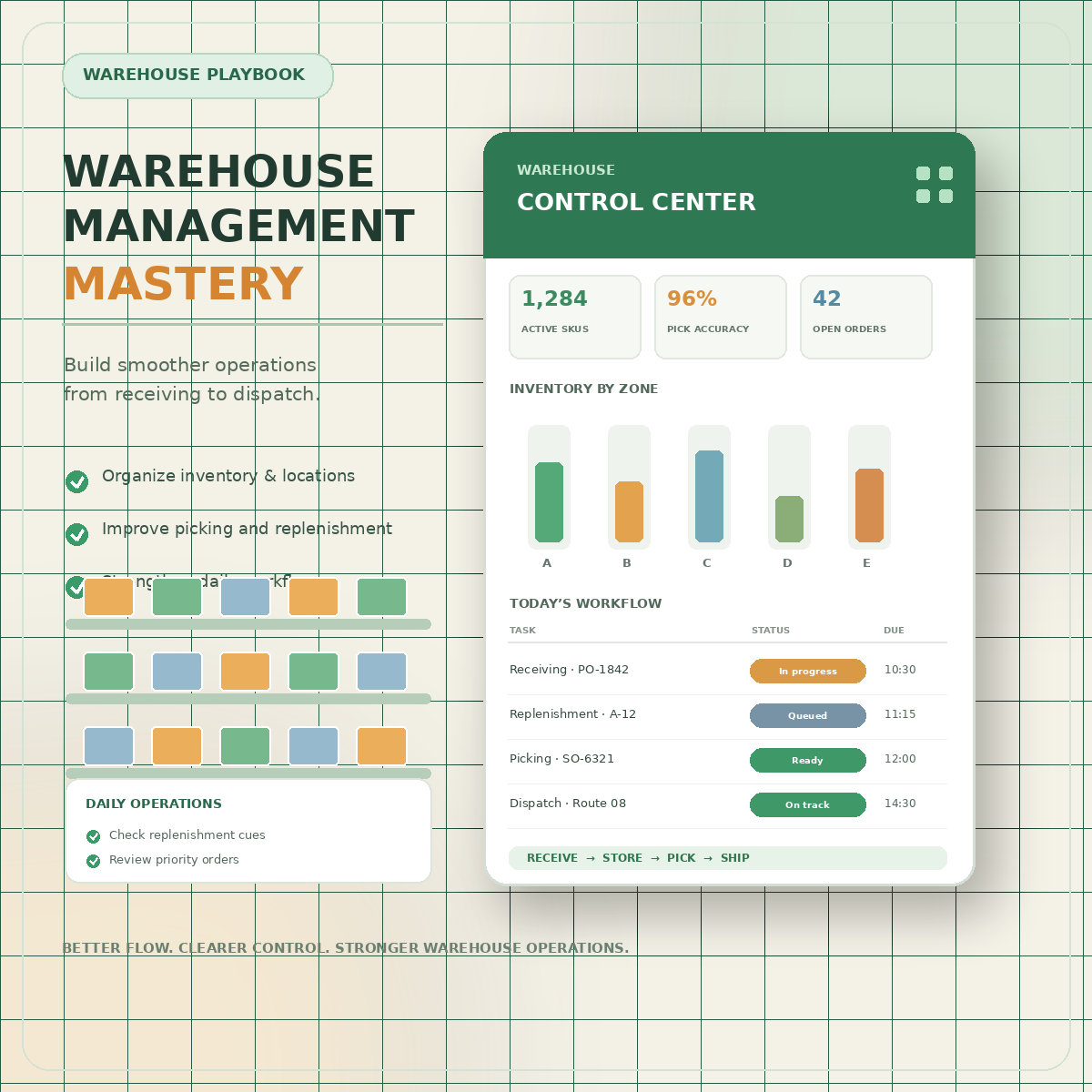
WAREHOUSE MANAGEMENT MASTERY
Build a Smarter, Safer, More Efficient Warehouse
A Practical Guide to Warehouse Layout, Inventory Control, Order Fulfillment, and Operational Performance
A high-performing warehouse is not built on speed alone. It depends on the right layout, organized inventory, efficient picking processes, safe material movement, and performance measures that help teams identify where improvements are needed.
Warehouse Management Mastery is a practical operations ebook designed to help you understand how these elements work together.
Through 10 structured chapters, 20 diagrams, and a 4,000-SKU distribution-centre case study, you will explore the principles behind warehouse design, receiving, storage, picking, dispatch, automation, safety, and continuous improvement.
Whether you manage a warehouse, work in logistics, supervise fulfillment operations, or want to strengthen your supply chain knowledge, this guide provides a structured foundation for understanding warehouse performance.
10 Chapters. 20 Diagrams. One Complete Warehouse Improvement Framework.
GET WAREHOUSE MANAGEMENT MASTERY — $10.99
Digital download · 50 pages · A4 PDF
UNDERSTAND THE WHOLE WAREHOUSE, NOT JUST INDIVIDUAL TASKS
Warehouse performance depends on how well different activities work together.
Poorly planned storage can increase travel distances. Inaccurate inventory records can disrupt picking. Inefficient dispatch processes can create bottlenecks. Inadequate safety controls can expose people and operations to unnecessary risk.
Warehouse Management Mastery examines these interconnected challenges and explains how to approach them systematically.
The objective is to help you develop a clearer understanding of warehouse operations, recognize opportunities for improvement, and make more informed decisions about processes, resources, and performance.
EXPLORE THE 10 CHAPTERS
CHAPTER 1 — THE MODERN WAREHOUSE
Understand the role of the warehouse in the wider supply chain and explore the key activities involved in managing a modern distribution operation.
CHAPTER 2 — WAREHOUSE LAYOUT DESIGN
Explore how storage zones, movement paths, picking areas, and dispatch locations influence warehouse efficiency.
Learn why layout decisions should reflect product characteristics, order patterns, and operational requirements.
CHAPTER 3 — RECEIVING AND PUTAWAY
Understand the activities involved in receiving incoming goods, checking information, and assigning products to appropriate storage locations.
Explore how a structured receiving process supports better inventory visibility and smoother downstream operations.
CHAPTER 4 — STORAGE AND INVENTORY CONTROL
Discover how storage strategies and inventory management practices contribute to space utilization, stock accuracy, and product accessibility.
Explore ABC slotting as an approach to organizing inventory according to its operational importance or movement characteristics.
CHAPTER 5 — PICKING STRATEGIES
Understand the role of order picking in warehouse productivity.
Explore how picking methods, product placement, and travel distances can affect fulfillment operations and the workload of warehouse teams.
CHAPTER 6 — PACKING AND DISPATCH
Follow the process from completed picking through packing and outbound dispatch.
Understand why accurate order preparation, shipment verification, and coordinated dispatch activities matter.
CHAPTER 7 — WAREHOUSE AUTOMATION
Explore the potential role of technology and automation in warehouse operations.
Learn to approach automation as an investment decision that should be evaluated against operational needs, implementation requirements, and expected payback.
CHAPTER 8 — WAREHOUSE SAFETY
Understand why safe movement, organized work areas, appropriate traffic management, and clear operational procedures are essential to warehouse management.
Explore the importance of separating pedestrian and equipment movement where appropriate.
CHAPTER 9 — WAREHOUSE KPIs
Discover how performance indicators can help teams understand warehouse operations and identify areas that need attention.
Explore measures related to inventory accuracy, picking efficiency, productivity, and operational performance.
CHAPTER 10 — THE HIGH-PERFORMANCE WAREHOUSE
Bring the concepts together through a structured approach to continuous improvement.
Understand how measurement, operational discipline, and regular review can help warehouse teams identify problems and evaluate changes over time.
SEE WAREHOUSE IMPROVEMENT IN ACTION
Theory becomes easier to understand when you can follow an operational example.
The ebook uses a 4,000-SKU distribution-centre scenario to illustrate how changes in layout, storage organization, safety, and improvement practices can influence warehouse operations.
The case study includes the following illustrative measures:
Pick Travel per Order
The example compares a starting distance of 412 metres with a redesigned distance of 96 metres, demonstrating how layout and slotting decisions can influence picking travel.
Inventory Accuracy
The scenario uses an inventory accuracy figure of 99.2% to illustrate the importance of reliable stock records and inventory control.
Storage Strategy
Explore the transition from mixed storage toward ABC-based slotting.
Warehouse Safety
Understand the operational value of separating movement areas where appropriate.
Continuous Improvement
Explore a structured daily improvement routine rather than relying entirely on ad hoc problem-solving.
Automation Investment
Consider automation step by step, with investment justification and potential payback evaluated before implementation.
These figures describe the ebook's illustrative case study. They are not guaranteed outcomes, and actual results depend on the warehouse, products, processes, workforce, equipment, and implementation.
WHAT YOU WILL LEARN
By working through Warehouse Management Mastery, you will develop a clearer understanding of:
- How warehouse activities fit together across the operational lifecycle.
- How layout and storage decisions influence product movement.
- How receiving and putaway support inventory control.
- How picking methods affect order fulfillment.
- How packing and dispatch processes connect with outbound logistics.
- How automation should be evaluated as an operational investment.
- Why warehouse safety requires structured controls.
- How KPIs support operational monitoring and improvement.
- How to approach warehouse performance as a continuous improvement process.
The emphasis is on understanding the relationships between warehouse processes rather than treating each activity as an isolated task.
WHO SHOULD READ THIS EBOOK?
Warehouse Managers and Supervisors
Develop a structured perspective on layout, inventory, picking, dispatch, safety, and operational performance.
Logistics and Supply Chain Professionals
Strengthen your understanding of warehouse operations and how they connect with transportation, inventory management, and fulfillment.
Distribution Centre Team Leaders
Explore practical concepts that can support process reviews, operational discussions, and improvement initiatives.
E-Commerce and Fulfillment Professionals
Understand the warehouse activities that influence order processing, product availability, and dispatch performance.
Students and Aspiring Warehouse Professionals
Build foundational knowledge of warehouse management through structured explanations and illustrated examples.
Business Owners and Operations Managers
Develop a clearer framework for evaluating warehouse processes, identifying operational constraints, and considering improvement opportunities.
Whether you are developing your knowledge or reviewing an existing operation, this guide provides a practical starting point.
WHY CHOOSE WAREHOUSE MANAGEMENT MASTERY?
A Complete Operational Perspective
Explore the warehouse from receiving and storage through picking, packing, and dispatch.
Clear Visual Explanations
Use 20 diagrams to help understand layouts, processes, and operational relationships.
A Practical Case Study
Follow a distribution-centre example that connects warehouse management concepts with measurable operational changes.
Performance-Focused Thinking
Understand how inventory accuracy, picking travel, safety, and continuous improvement relate to warehouse effectiveness.
A Balanced Approach to Technology
Explore automation without assuming that every warehouse needs the same technology investment.
A Structured Learning Resource
Work through 10 chapters in sequence or revisit individual topics as needed.
WHAT YOU RECEIVE
Your purchase includes:
- A 50-page warehouse management ebook.
- 10 structured chapters.
- 20 diagrams.
- A 4,000-SKU distribution-centre case study.
- Warehouse layout and storage concepts.
- Receiving, putaway, and inventory control guidance.
- Picking, packing, and dispatch concepts.
- Warehouse automation and safety discussions.
- Warehouse KPI and continuous improvement concepts.
- A digital PDF version and an HTML version.
PRODUCT: Warehouse Management Mastery
FORMAT: Digital PDF and HTML files
LENGTH: 50 pages
VISUAL CONTENT: 20 diagrams
PRICE: $10.99
DELIVERY: Digital download through Payhip.
No physical book will be shipped.
FREQUENTLY ASKED QUESTIONS
What is Warehouse Management Mastery?
It is a practical educational ebook covering the core principles of warehouse management, illustrated through a 4,000-SKU distribution-centre case study.
What topics does it cover?
The 10 chapters cover modern warehouse operations, layout design, receiving, putaway, inventory control, picking, packing, dispatch, automation, safety, KPIs, and continuous improvement.
Is the ebook suitable for beginners?
Yes. It provides a structured introduction to warehouse management and can also serve as a reference for professionals reviewing their operational knowledge.
What file formats are included?
The product includes PDF and HTML versions. The PDF is suitable for reading and printing, while the HTML version provides an alternative digital reading format.
Are the case-study results guaranteed?
No. Figures such as the reduction in pick travel from 412 metres to 96 metres and the example's 99.2% inventory accuracy relate to the illustrative case study. Actual results depend on your operating environment and implementation.
Does the ebook recommend automation for every warehouse?
No. It presents automation as something to assess according to operational requirements, investment costs, feasibility, and potential payback.
Can I use the ebook to redesign my warehouse?
The material can help you understand relevant principles and identify questions to investigate. A real warehouse redesign should also account for site dimensions, product characteristics, equipment, safety requirements, local regulations, and professional assessment.
How will I receive my purchase?
After completing your purchase through Payhip, you can access the digital files through the platform's download process.
START BUILDING A BETTER UNDERSTANDING OF WAREHOUSE OPERATIONS
An efficient warehouse is the result of coordinated decisions about space, inventory, movement, people, technology, and performance.
Warehouse Management Mastery brings these elements together in one illustrated guide, helping you understand how they interact and how structured improvement can support better operations.
Explore the principles. Understand the processes. Evaluate the opportunities.
GET YOUR COPY OF WAREHOUSE MANAGEMENT MASTERY
ONLY $10.99
50 pages · 10 chapters · 20 diagrams · PDF + HTML
A practical guide to understanding warehouse operations and performance.
Educational Disclaimer: This ebook provides general educational information. The case study and numerical examples are illustrative and do not guarantee specific operational improvements. Site-specific decisions should account for actual operating conditions, applicable safety requirements, and professional advice.