
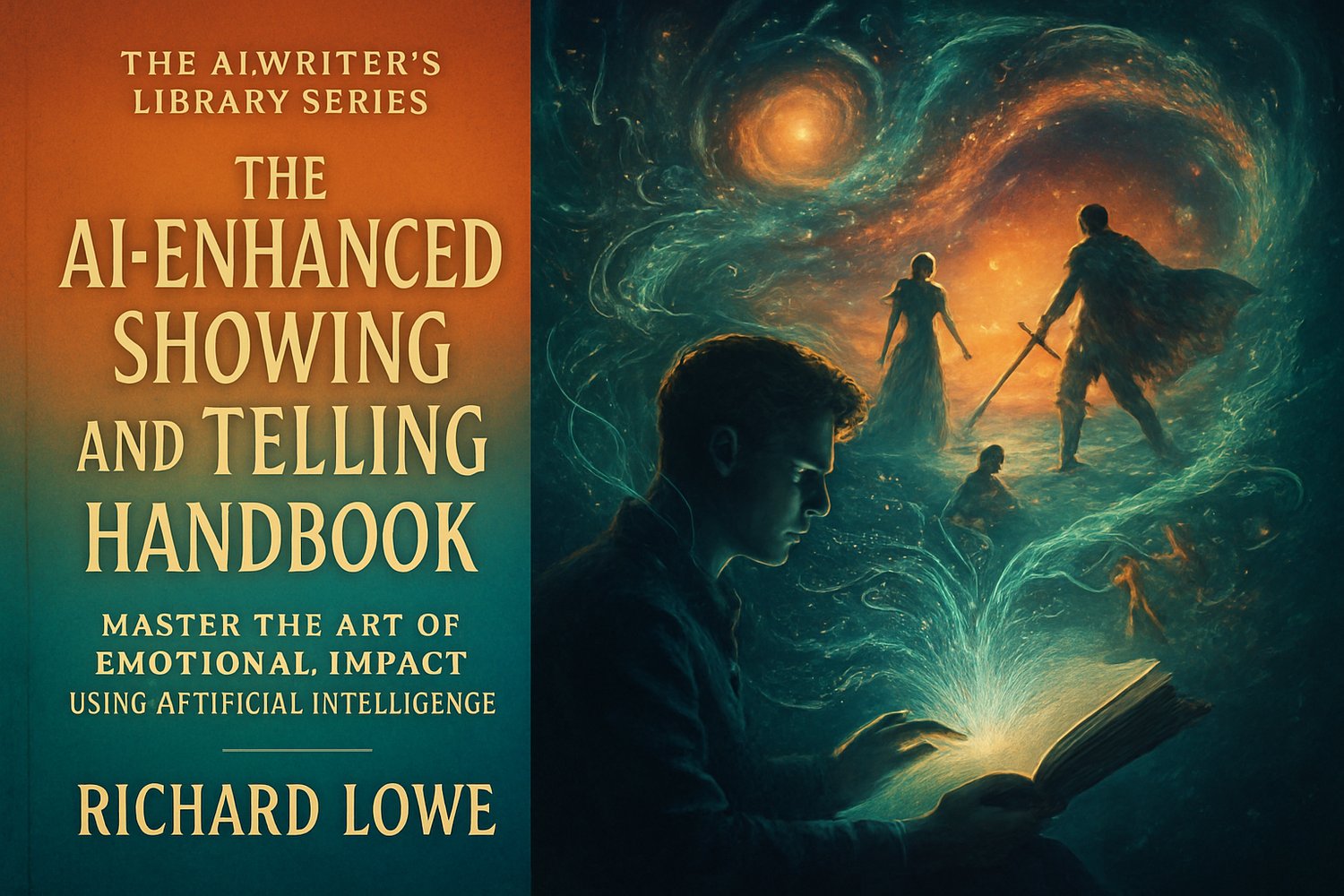
Ai-Enhanced Showing and Telling Handbook
Stop Piling On Sensory Details While Your Scenes Die of Emotional Starvation
You've built compelling characters. Crafted solid plot structure. Polished your prose. Beta readers still say it "doesn't pull me in like I expected."
English teachers drilled "show don't tell" into your head like it's the Eleventh Commandment, but they never explained why this rule exists or when it doesn't apply. You spend weeks describing characters' shoelaces while your stories die of emotional starvation because nobody taught you that piling on sensory details doesn't equal emotional engagement.
Brain research shows that reader investment depends on completely different psychological mechanisms than what writing advice teaches.
The whole show-versus-tell debate misses the point. The real issue is that most writers never learned how human brains process emotional experiences. When readers say your story "feels distant," they're describing failed neurological engagement. Your writing triggered analytical reading mode instead of embodied simulation.
The Brain Science That Changes Everything
Traditional "show don't tell" advice misses why showing works.
Embodied simulation treats fiction as real experience. You trigger it through sensation before interpretation. Mirror neurons fire during observed action. You trigger them through physical action specificity. Temporal distortion alters time perception. You trigger it through information density control. Working memory holds approximately seven pieces of information. You work with it through strategic detail selection.
Exceed working memory capacity with excessive details and brains shift to analytical mode. Provide just enough sensory specificity to trigger embodied simulation without cognitive strain. The handbook teaches you to calibrate precisely.
When someone reads about a character reaching for a coffee cup, their motor cortex fires the same neurons involved in actually reaching for coffee. When they read about heartbreak, their anterior cingulate cortex activates the same regions that process real emotional pain. Your writing either triggers this neurological mirroring or prevents it.
Four Core Techniques
The sensory gateway technique opens scenes through immediate physical sensation instead of interpretation. You trigger embodied simulation before analytical thinking kicks in. Temporal manipulation controls time perception through information density and focus management. You mirror how consciousness naturally processes time during different emotional states. Strategic sensory writing activates spatial processing systems without overwhelming working memory. You provide enough specificity for immersion without cognitive strain. Diagnostic methods give you systematic tools for identifying exactly why scenes feel flat. You target solutions instead of guessing what's wrong.
What's Inside
The handbook covers understanding reader immersion psychology, explaining how embodied simulation makes fiction feel like lived experience. The neuroscience of emotional engagement addresses mirror neurons, emotional contagion, and neurological mirroring. The sensory gateway technique teaches opening scenes through immediate physical sensation instead of interpretation. Temporal manipulation techniques covers controlling time perception through information density and focus management.
Strategic sensory writing teaches activating spatial processing systems without overwhelming working memory. Dialogue architecture addresses multiple communication levels while maintaining conversational authenticity. Environmental psychology covers setting as character and mood creator instead of decorative backdrop.
Plus chapters on genre-specific showing strategies, systematic diagnostic methods, AI collaboration for scene development, action sequence neuroscience, and practical exercises that build embodied simulation skills.
What You Get
The complete 281-page guide to neuroscience-based scene construction. A short and sweet summary guide for quick reference on core principles and common engagement failures. The AI prompts compendium with ready-to-use prompts for testing embodied simulation, emotional authenticity, and sensory effectiveness.
Built for Writers Who Use AI
Stop asking AI to "describe a sad scene." That gets you melodramatic nonsense that activates analytical reading mode. Start asking AI to help you create physical sensations that naturally produce sadness in human brains.
The handbook shows you prompts that generate responses about shallow breathing, the sensation of the floor dropping away, sounds becoming muffled when shock hits. These physical details trigger embodied simulation. Readers' bodies respond as if they're experiencing the shock themselves.
AI can help you understand the mechanics of brain hijacking, but it can't replace your instinct for what feels emotionally authentic. The handbook shows you how to use AI to enhance techniques you develop through watching real human responses to stories.
AI is your neurological testing tool, not your emotional instinct.
From an Author With 113 Published Books
My ghostwriting clients have secured over $30 million in venture capital with manuscripts that created genuine emotional engagement. Not through luck, but through understanding how brains process experience. My brain doesn't accept "show don't tell" as methodology. When I realized some fiction made readers ugly-cry in public while other technically flawless writing left them completely numb, I dug into the neuroscience until I found the systems underneath.
Italian researcher Giacomo Rizzolatti discovered mirror neurons by accident while studying monkeys. The same brain cells that fired when a monkey grabbed a peanut also fired when the monkey watched another monkey grab a peanut. Humans have even more sophisticated mirror neuron systems that respond to emotional and sensory experiences.
When you read about someone biting into a lemon, your salivary glands actually increase production. When you read about physical pain, your pain processing centers light up on brain scans. Your nervous system treats vivid fictional experiences like real events.
281-page showing and telling handbook plus 2 supplements. Neuroscience of embodied simulation, sensory gateway technique, temporal manipulation, systematic diagnostics, and AI prompts for testing neurological engagement.
The rest is application.