
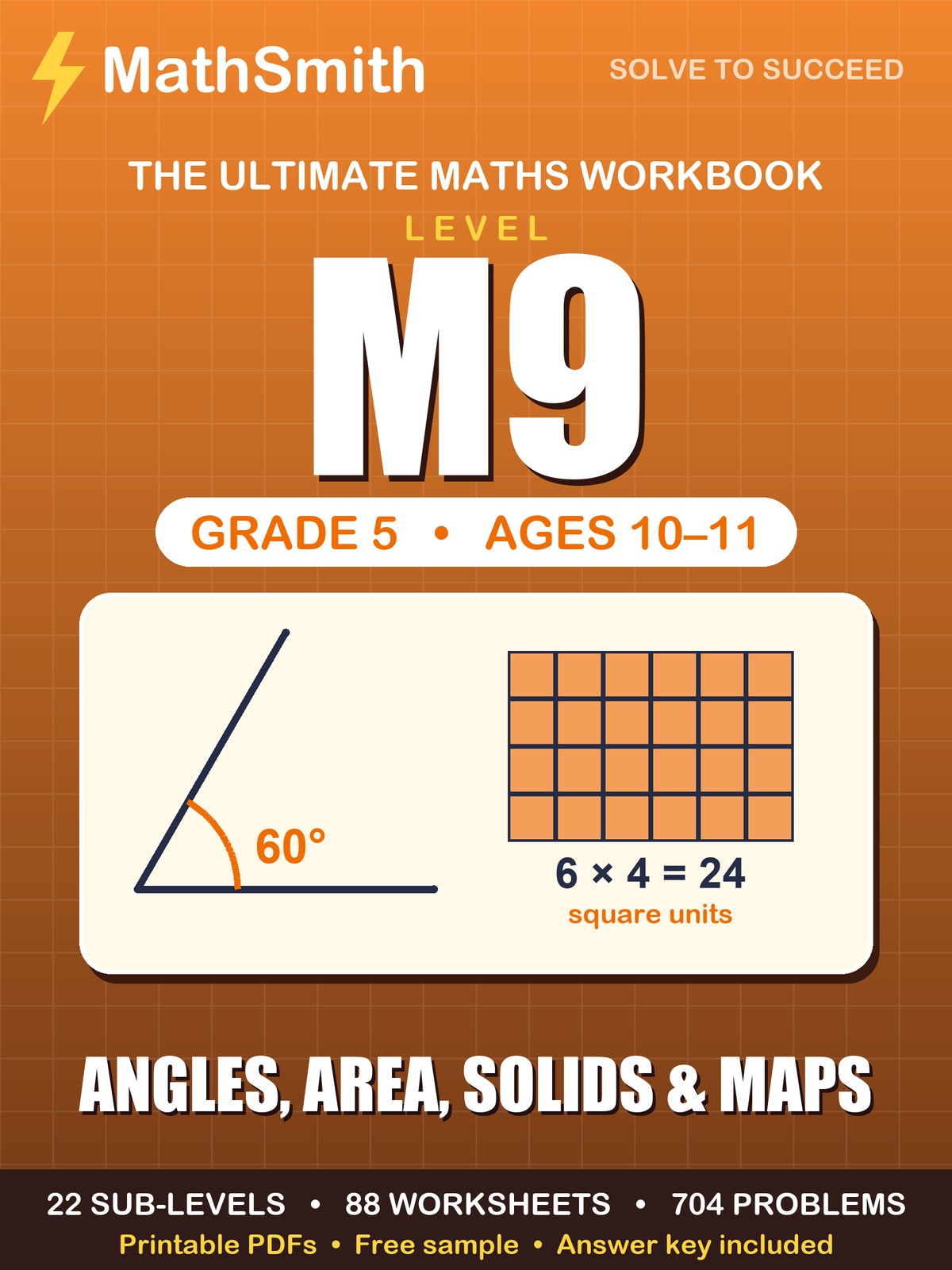
Gr 5 Maths Worksheets (Ages 10-11) | Level M9: Angles, Area, Solids & Maps
🎓 Launch offer: 80% OFF every MathSmith workbook with code LAUNCH80 (first 1000 orders). Click Add to Cart, then enter LAUNCH80 in the discount box before you pay.
Not sure which level your child needs? Take the free 40-question placement test: https://ebooks.thecodecrafters.net/placement
See free sample pages first: https://ebooks.thecodecrafters.net/
Help your child build absolute confidence and mastery in mathematics. This comprehensive workbook from MathSmith takes a highly structured, "one-rung-at-a-time" approach to Angles, Area, Solids and Maps, ensuring students fully understand concepts before moving forward.
Instead of overwhelming learners with random equations, this workbook uses a carefully scaffolded, predictable learning ladder. It is perfect for homework, structured independent study, or mastery practice.
📊 What Is Included?
1 Complete Level (Level M9)
22 Structured Sub-levels for gradual progression
88 Printable Worksheets
704 Total Problems for thorough practice
Full Answer Key online, unlocked by the order ID on your Payhip receipt, for quick, stress-free marking
🗺️ Curriculum Breakdown
This collection focuses deeply on mastering Angles, Area, Solids and Maps through a carefully curated system:
What an angle is (2 Sub-levels): Two rungs before any instrument comes out. An angle is an amount of turn, it is named with the corner in the middle, and it does not get bigger when its arms get longer - which is the misconception the whole strand is built against and the one thing here a drawing cannot ask about.
The protractor (2 Sub-levels): Reading one and then drawing with one. Both scales are printed on every instrument in this book, because reading the wrong one is not a slip a child makes once: it is what a protractor invites, and half of these angles open from the side where the outer numbers are the wrong ones.
Straight angles, full turns and the corners of a shape (2 Sub-levels): Where the degrees stop being read off an instrument and start being worked out. Two right angles make a straight line, four make a full turn, and every corner of every shape in the book is one of the three kinds named two rungs earlier.
Area: counting what is inside (3 Sub-levels): Three rungs that end in a multiplication and do not start with one. A shape's area is the number of squares it covers, counted one at a time - and the formula arrives only once a child has noticed that every row of a rectangle holds the same number.
Perimeter: going round the outside (2 Sub-levels): The other measurement of the same shape, and the reason the level draws every rectangle twice. A rectangle with a corner bitten out has the same perimeter as the whole rectangle; one with a notch in the middle of a side does not, and a child who has only seen the first draws the wrong conclusion from it.
Telling the two apart (2 Sub-levels): The point the level has been walking towards. Two rectangles that cover exactly the same can need completely different amounts of fence, and a word problem never says which of the two it wants - it says wire, tiles, grass, edging, and the cost per metre.
Symmetry: folding and turning (2 Sub-levels): The two symmetries a design can have, and they are not the same one. A design can look the same after a half turn and have no line to fold along at all, which is why the two rungs are separate and are asked about the same designs.
Solids on flat paper (1 Sub-level): Faces, edges and corners - counted off a drawing whose hidden edges are dashed in, because a child who counts what they can see of a cube gets nine edges and seven corners and is wrong in a way that looks careful.
Nets: a solid opened out (2 Sub-levels): Whether a flat shape folds back up, and what it folds into. Half the nets in the drill do not close, and the ones that do not are near misses on purpose: four squares in a row with two on the same side looks exactly as much like a cube as the cross does, until you try it.
Looking at a solid from three sides (1 Sub-level): A view is a flat outline and not a photograph, so a tower standing behind a taller one leaves no mark on it. Every view comes to fewer squares than there are cubes, and noticing that is the rung.
Maps, directions and the scale bar (3 Sub-levels): North is where the arrow says it is. Without a scale bar a map answers 'how many squares' and with one the same map answers 'how many metres', and the step between those two questions is a multiplication - which is why it is here and not with M6's charts.
🎯 Who Is This For?
Parents looking to provide structured math support at home.
Homeschoolers searching for a sequential curriculum to guarantee zero gaps in math skills.
Teachers & Tutors looking for bite-sized, scaffolded printables for classroom morning work or targeted intervention.
📖 How To Use This Workbook
Print the workbook, read each rung's method page, and let your child work inside the printed frame. Then check the answers your way: in the printable answer-key PDF included in this download, or online, one page at a time, with the order ID on your Payhip receipt (valid for six months). Please keep the answer key for the adult marking the work and do not share it with your child: the workbook only works if they have worked each answer out for themselves.
Step-by-step manual and video guide: https://ebooks.thecodecrafters.net/manual/
Check the answers: https://ebooks.thecodecrafters.net/answers
⚙️ Digital Delivery Details
Format: four instant-download PDFs (free sample, sample answers, workbook, full answer key). The answer key is also available online.
Print Ready: Easily printable on home or school printers.
Usage: Licensed for individual family or single-classroom use.