
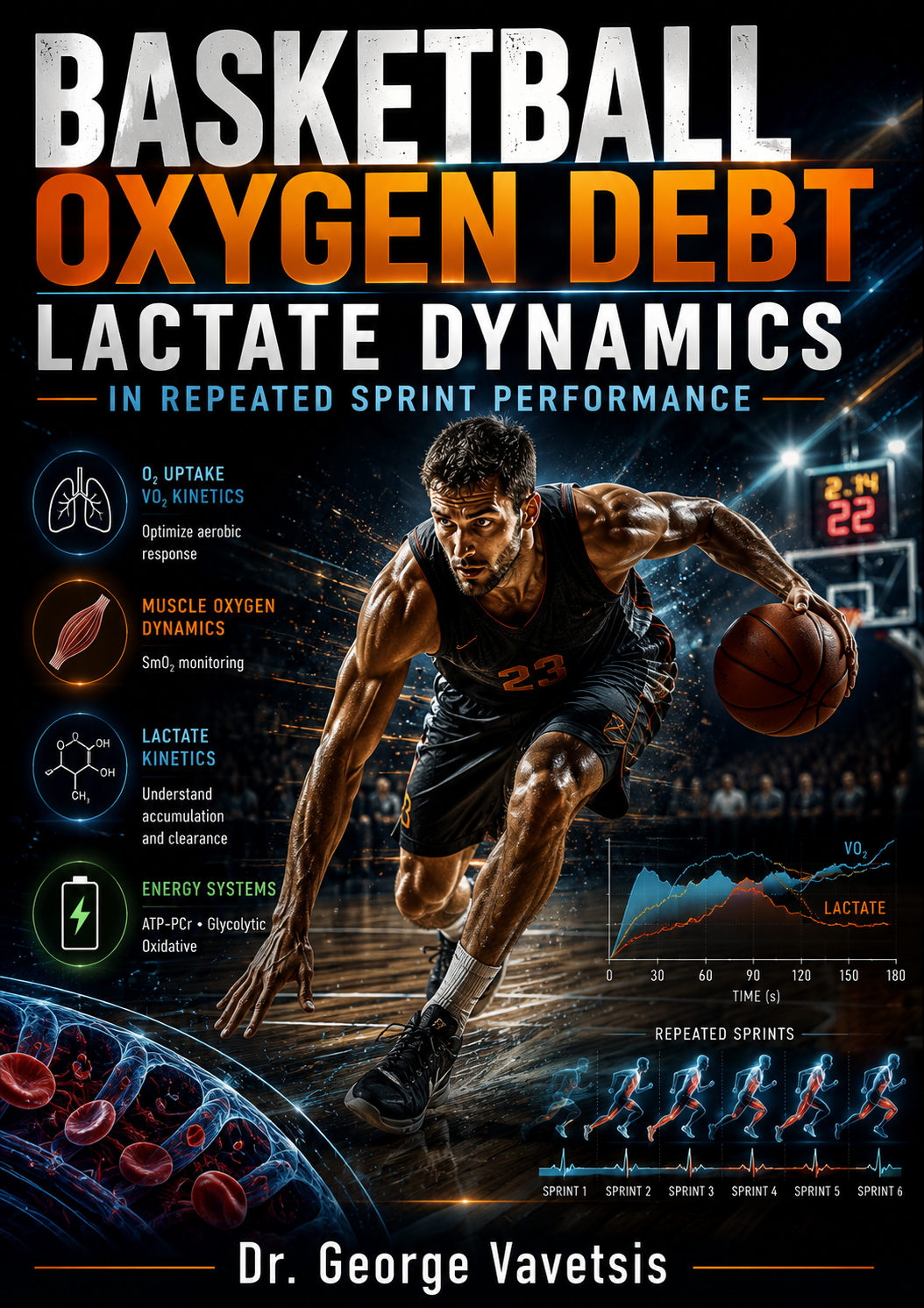
Basketball Oxygen Debt-Lactate Dynamics in Repeated Sprint Performance
Pages: 672
Basketball is no longer interpreted solely through the lenses of skill execution, tactical organization, or anthropometric superiority. Modern elite basketball has evolved into a bioenergetic war of transient acceleration, incomplete recovery, metabolic disruption, and neuromuscular resilience. Every explosive transition, repeated sprint cluster, defensive rotation, and full-court acceleration sequence imposes profound disturbances upon the oxygen transport system and the dynamic interaction between oxidative and glycolytic metabolism. The contemporary game is therefore fundamentally governed by the athlete’s capacity to tolerate, redistribute, buffer, and recover from oxygen deficit accumulation during repeated high-intensity locomotor events.
Basketball Oxygen Debt – Lactate Dynamics in Repeated Sprint Performance was conceived to explore these mechanisms from an integrative scientific perspective. This book examines the physiological architecture underlying repeated sprint ability (RSA), accumulated oxygen deficit (AOD), phosphocreatine depletion, glycolytic compensation, skeletal muscle oxygen extraction, and lactate-buffering dynamics specific to basketball competition. Rather than isolating aerobic and anaerobic systems into simplistic categories, the present work approaches basketball conditioning as a continuously shifting bioenergetic continuum characterized by overlapping energetic contributions, neuromuscular perturbations, and tactical-metabolic interactions.
Elite basketball imposes intermittent physiological chaos. Players repeatedly transition between accelerative bursts, multidirectional decelerations, change-of-direction actions, reactive defensive recoveries, and high-force transition sequences, often with insufficient recovery durations to restore phosphocreatine stores or normalize intramuscular oxygen saturation. These repeated disturbances generate an accumulated oxygen deficit that progressively alters mechanical efficiency, decision-making capacity, motor-unit recruitment, and fatigue resistance.
Traditional conditioning paradigms frequently underestimate the complexity of this metabolic environment. Classical aerobic conditioning models fail to fully represent the violent oscillatory demands of basketball locomotion, while purely anaerobic frameworks overlook the decisive role of oxidative recovery kinetics between repeated sprint exposures. The physiological reality of basketball exists between these systems. The sport demands athletes capable of rapidly restoring oxygen homeostasis while simultaneously tolerating substantial glycolytic stress and maintaining neuromechanical output under conditions of escalating fatigue.
This book therefore focuses on the dynamic interaction between oxygen deficit accumulation and lactate kinetics during basketball-specific repeated sprint activity. Particular attention is given to pulmonary oxygen uptake (VO₂) on-kinetics, intramuscular oxygen desaturation, phosphocreatine recovery kinetics, glycolytic compensation strategies, mitochondrial oxidative adaptation, and neurometabolic fatigue responses. Advanced monitoring approaches—including near-infrared spectroscopy (NIRS), muscle oxygen saturation (SmO₂), heart-rate variability (HRV), breath-by-breath gas analysis, and sprint decrement profiling—are explored as practical tools for elite strength and conditioning coaches, sports scientists, physiologists, and performance directors.
Repeated sprint ability is not merely a measure of speed endurance. It represents the integration of oxygen delivery efficiency, oxygen extraction capacity, phosphagen restoration speed, buffering potential, mitochondrial adaptability, neural fatigue resistance, and tactical locomotor economy. Basketball athletes capable of sustaining repeated accelerative efforts under incomplete recovery conditions possess a decisive physiological advantage during modern transition-based basketball systems. Full-court pressure defenses, rapid offensive transitions, tactical chaos sequences, and possession-density escalation all increase the metabolic burden placed upon the athlete’s oxygen transport and lactate-buffering systems.
Importantly, this text does not present conditioning as isolated running physiology detached from basketball movement realities. Every bioenergetic concept discussed throughout this book is contextualized within basketball-specific movement ecology. Transition drills, shuttle-based accelerations, multidirectional sprint clusters, deceleration–reacceleration exposure, full-court press conditioning, and tactical transition oscillations are all analyzed through the lens of oxygen debt and metabolic redistribution. The aim is to bridge laboratory physiology with the chaotic reality of elite basketball competition.
Another central objective of this work is to redefine the interpretation of lactate within basketball performance. Lactate is not merely a waste product or a simplistic marker of fatigue. Instead, lactate accumulation reflects the dynamic balance between glycolytic energy provision, oxidative insufficiency, buffering efficiency, and recovery capacity. The magnitude, timing, and clearance of blood lactate responses provide valuable insight into an athlete’s ability to tolerate repeated sprint exposure and sustain tactical execution during metabolic disruption.
The modern game increasingly rewards players capable of maintaining high-intensity performance during oxygen-deficit states. As tactical systems become faster, spacing becomes wider, and transition frequencies increase, athletes must demonstrate greater bioenergetic adaptability than ever before. Consequently, basketball conditioning can no longer rely on generalized endurance methods disconnected from the unique oxygen-kinetic demands of the sport. Conditioning must become biologically specific, tactically integrated, and metabolically intelligent.
This book also emphasizes the role of individualized monitoring. Contemporary performance preparation demands precision. Two athletes may produce identical sprint times while exhibiting profoundly different oxygen extraction efficiency, SmO₂ recovery kinetics, lactate accumulation profiles, or phosphocreatine restoration capacities. Therefore, individualized bioenergetic profiling becomes essential for optimizing conditioning prescription, recovery management, tapering strategies, and competition readiness.
Throughout these chapters, readers will encounter advanced discussions regarding VO₂ kinetics, oxidative-glycolytic redistribution, oxygen extraction dynamics, glycolytic tolerance development, mitochondrial oxidative stress adaptation, transition-chaos conditioning, and metabolic periodization strategies for basketball athletes. Each topic is approached from both a scientific and applied performance perspective, ensuring direct transferability to elite-level practice.
Ultimately, basketball performance is constrained not only by technical skill or tactical intelligence, but by the athlete’s capacity to repeatedly survive energetic instability. The player who restores oxygen faster, buffers lactate more efficiently, preserves phosphocreatine availability longer, and maintains neuromechanical precision under metabolic fatigue will dominate the tempo of modern basketball.
This book is dedicated to advancing the scientific understanding of these processes and to supporting the next generation of basketball performance specialists who seek to integrate physiology, biomechanics, conditioning science, and tactical specificity into a unified high-performance framework.