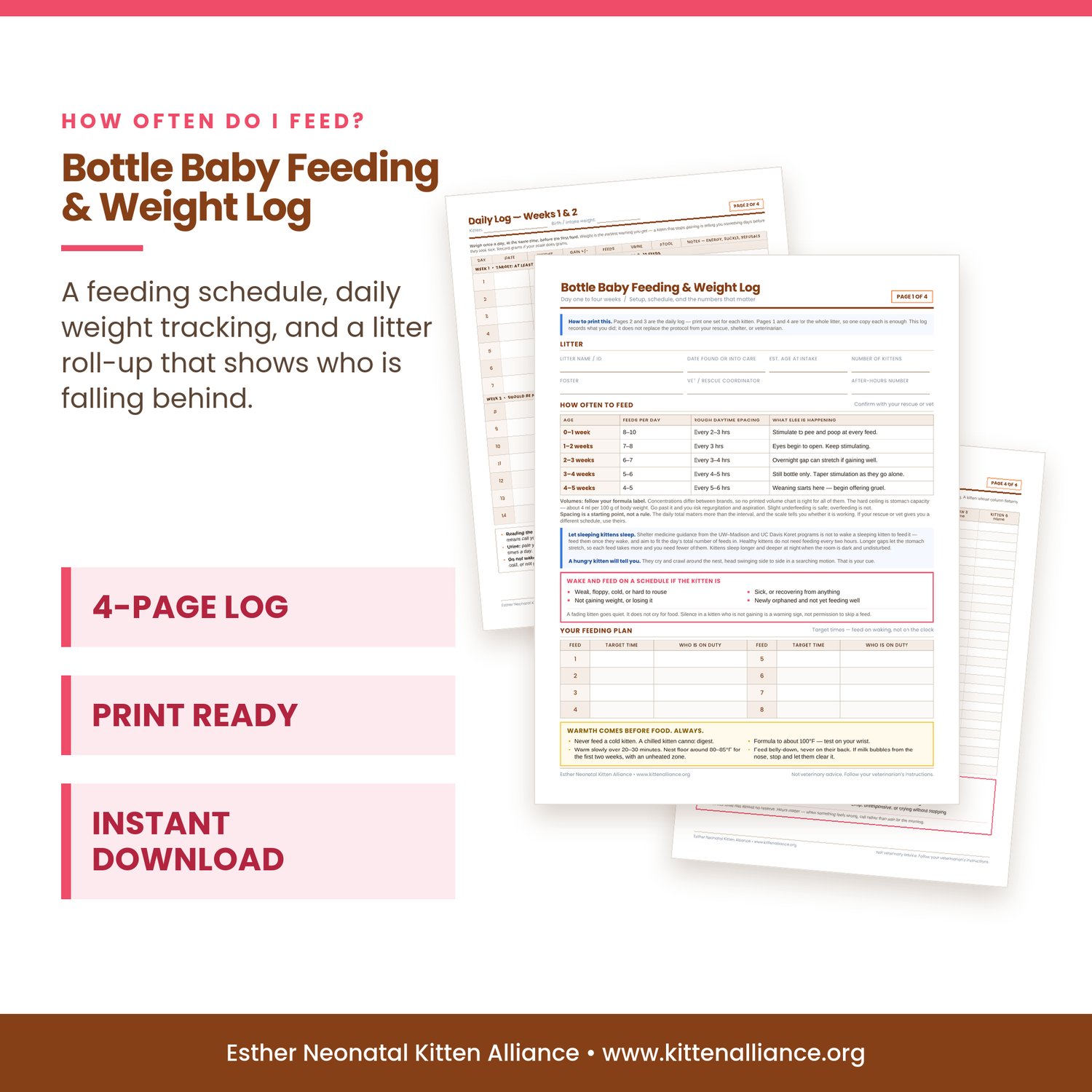
Bottle Baby Feeding & Weight Log — Round-the-Clock Schedule & Daily Weight Tracker
How often do I feed a newborn kitten, and how do I know it's working? A printable feeding schedule and daily weight log for the first four weeks.
Bottle babies don't tell you they're in trouble. They stop gaining first, and by the time a kitten looks sick you've usually lost days you needed. The scale is the only early warning you get, which makes writing the number down every day the single highest-value habit in neonatal fostering.
WHAT'S INSIDE — 4 pages, one PDF
Page 1 — Setup & Feeding Schedule How often to feed at each age from day one to four weeks. A planner for your own target times and who's covering each feed. Warmth rules, formula temperature, and feeding position.
Also the sleep guidance most feeding charts leave out: shelter medicine programs at UW–Madison and UC Davis advise not waking a sleeping kitten, and letting a hungry one tell you — healthy kittens don't need feeding every two hours, and longer gaps stretch the stomach so each feed takes more. Printed right beside it is the exception that makes it safe to follow: weak, cold, sick, or non-gaining kittens still get woken and fed on a schedule, because a fading kitten goes quiet rather than crying.
Page 2 — Daily Log, Weeks 1 & 2 A row per day. Weight, gain, feeds given, urine, stool, and notes, with the week's targets printed across the top of each block.
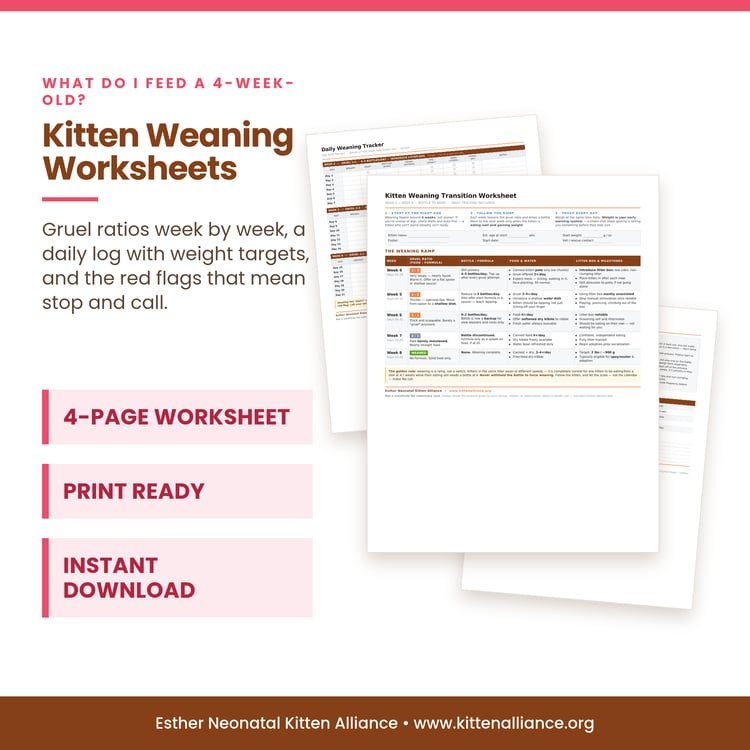
Page 3 — Daily Log, Weeks 3 & 4 The same log through week four. Formula stays the only food all the way through this stage — gruel does not start until four to five weeks, and the page says so plainly, because starting solids early is a common and avoidable mistake.
Page 4 — Litter Weight Roll-Up Every kitten's daily weight side by side for 28 days, up to six kittens. This is the page that earns its keep. A single kitten's log tells you they gained 4 g; the roll-up tells you the other five gained 12 g each, and which one to weigh separately at every feed.
WHY THERE ARE NO FORMULA VOLUMES
Milk replacers differ in concentration between brands, so any printed volume chart is wrong for somebody. This log points you to your formula label and gives you the one number that generalises — the stomach capacity ceiling — so you know when you're pushing too much.
The same goes for feeding frequency. Veterinary sources genuinely disagree about how often to feed after the first week, so the table shows the common shelter range and tells you to follow your own vet or rescue's protocol rather than pretending there's one right answer.
HOW TO PRINT IT
Pages 2 and 3 are per kitten. Pages 1 and 4 are per litter. Prints legibly in black and white with no heavy color fields.
WHAT YOU GET
4-page print-ready PDF, US Letter, instant download. Print as many copies as you need for your own fostering.
Not veterinary advice. This log records what you did; it does not replace the protocol from your rescue, shelter, or veterinarian. Neonatal kittens decline within hours — when something feels wrong, call.