
AI Filmmaker: From Prompt to Premiere
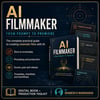
AI Filmmaker: From Prompt to Premiere
The Complete Practical Guide to Creating Cinematic Films with Artificial Intelligence
AI can generate an impressive image, a realistic voice or a few seconds of video—but a collection of beautiful clips is not yet a film.
A complete film needs a story, characters, visual consistency, planned shots, believable performances, dialogue, sound, music, editing, continuity, quality control and a clear release strategy.
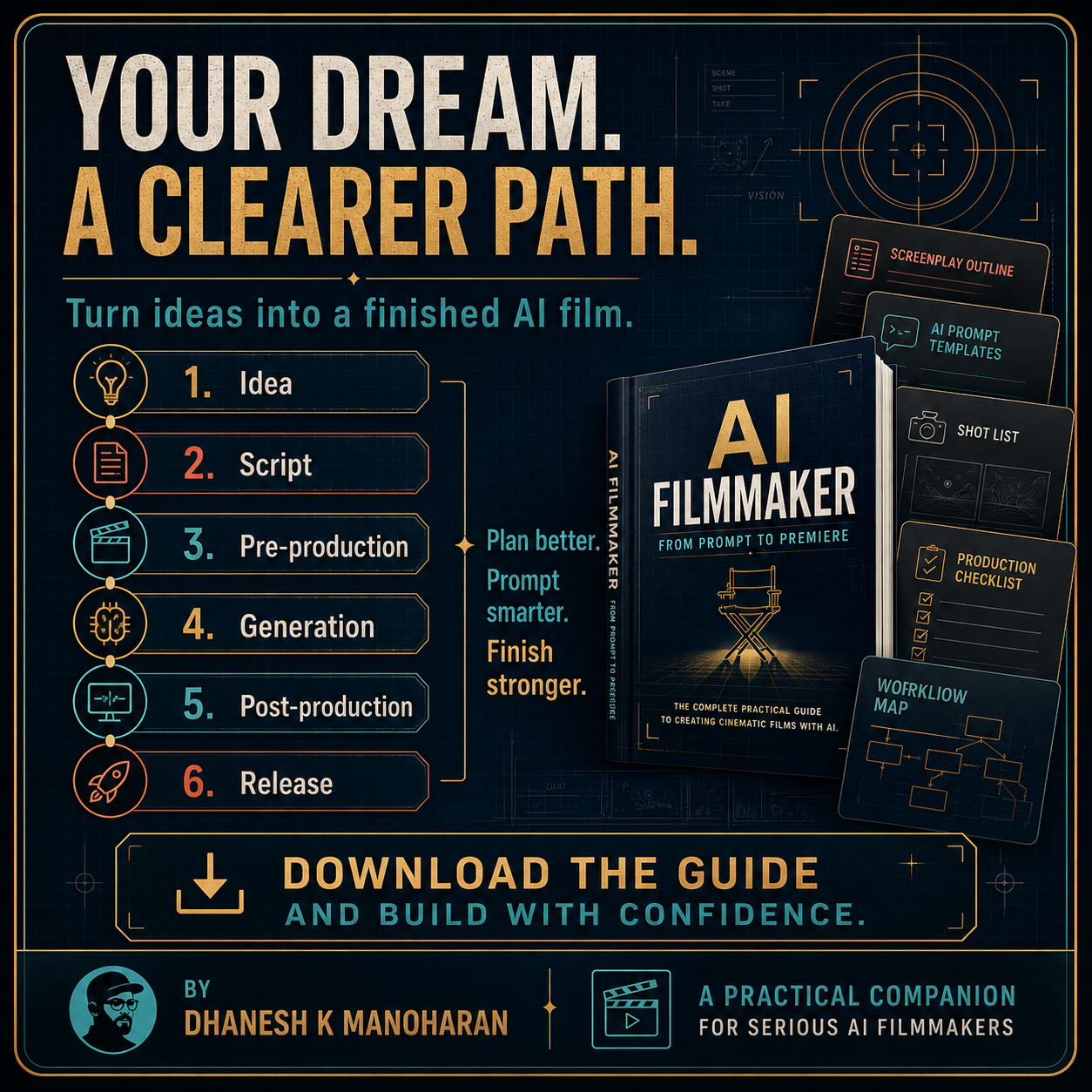
AI Filmmaker: From Prompt to Premiere brings all these elements together in one structured production system.
This book is designed for serious creators who want to move beyond random experimentation and learn how to develop, produce, finish and release a complete AI-assisted film.
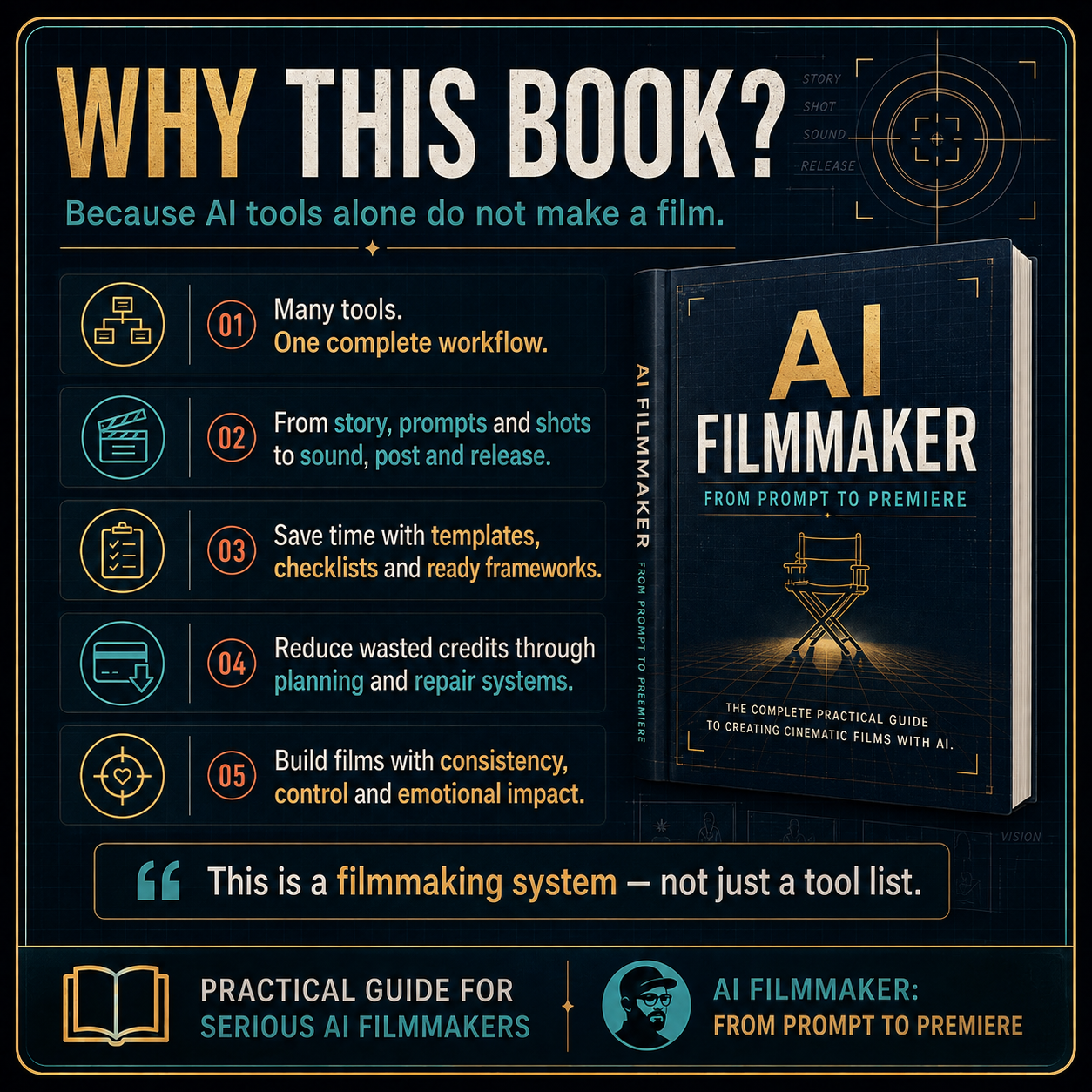
Why This Book Matters
There are now hundreds of AI tools for writing, image generation, video, voice, music, animation, editing and visual effects. The real difficulty is not finding a tool.
The real difficulty is knowing:
- Which tool to use at each stage
- How to connect multiple tools into one workflow
- How to maintain the same character across scenes
- How to stop costumes, props and locations from changing
- How to direct camera movement and performance
- How to create natural dialogue and believable lip-sync
- How to repair failed generations
- How to organise prompts, references, files and versions
- How to finish the film with professional sound, colour and editing
- How to prepare the project for festivals, clients or commercial release
This book gives you the complete path.
It is not built around one temporary platform. It teaches filmmaking principles and production systems that remain useful even when AI tools change.
What You Will Learn
Turn an Idea into a Filmable Story
You will learn how to transform a basic concept into a cinematic story with:
- A clear genre
- A defined audience
- An emotional promise
- A compelling logline
- A meaningful theme
- Strong character goals
- Conflict and pressure
- A beginning, middle and ending
- Scenes that create change
The book guides you from the first idea through the beat sheet, treatment, scene outline and finished screenplay.
Build Characters Audiences Can Remember
AI-generated characters often change from shot to shot. Faces drift, hairstyles change, costumes disappear and body proportions become inconsistent.
This book shows you how to create and control:
- Character bibles
- Character reference sheets
- Expression sheets
- Costume variations
- Hair and makeup references
- Body-language references
- Voice descriptions
- Emotional arcs
- Relationship maps
- Character continuity records
You will learn how to treat each character as a controlled production asset rather than a new generation in every scene.
Design a Believable Cinematic World
A strong film needs more than attractive backgrounds.
You will learn how to create:
- Location bibles
- Prop bibles
- Costume bibles
- World rules
- Colour palettes
- Material and texture references
- Lighting systems
- Weather and time-of-day continuity
- Production-design standards
- Visual motifs
These systems help the film feel like one connected world rather than a collection of unrelated images.
Create a Master Film Bible
The Master Film Bible becomes the single source of truth for the entire project.
It connects:
- Story
- Characters
- Locations
- Costumes
- Props
- Cinematography
- Sound
- Continuity
- Production planning
- File management
- Release information
This is especially valuable for teams because every writer, artist, AI operator, editor and sound designer can work from the same approved information.
Plan Scenes Before Spending AI Credits
Repeated generation can become expensive when a scene has not been properly designed.
The book teaches you how to break every scene into:
- Story purpose
- Character objective
- Emotional beat
- Shot size
- Lens choice
- Camera angle
- Camera movement
- Lighting
- Composition
- Performance
- Props
- Sound
- Visual effects
- Continuity requirements
- Generation method
By planning before generating, you can reduce wasted credits, avoid unnecessary revisions and make more confident creative decisions.
Write Better Image and Video Prompts
This is not simply a book of attractive prompt phrases.
You will learn a complete prompt operating system based on:
- Story intent
- Subject and action
- World and continuity
- Camera and lighting
- Performance and physics
- Output controls
- Negative constraints
The book explains how to write prompts for:
- Character portraits
- Character turnarounds
- Locations
- Props
- Establishing shots
- Dialogue scenes
- Emotional close-ups
- Action scenes
- Suspense scenes
- Horror scenes
- Crowd scenes
- Vehicle scenes
- Fantasy and VFX scenes
- Transitions
- Final hero shots
- Posters and trailers
You will also learn how to create structured JSON prompts for production tracking and consistent reuse.
Understand Text-to-Video and Image-to-Video
The book explains when to use:
- Text-to-video
- Image-to-video
- Start-frame and end-frame generation
- Keyframe-controlled generation
- Video-to-video
- Motion transfer
- Compositing
- Hybrid workflows
You will learn how to select the correct method based on the complexity of the shot, required character consistency, camera movement and performance.
Direct AI Actors
A believable performance is not created by asking a character to “look emotional.”
You will learn how to direct:
- Objectives
- Tactics
- Reactions
- Eye movement
- Breathing
- Posture
- Gesture
- Facial restraint
- Emotional progression
- Timing
- Micro-expressions
- Physical interaction
This helps AI-generated performances feel purposeful and human rather than exaggerated or mechanical.
Create Dialogue and Lip-Sync Scenes
Dialogue scenes require control over more than the spoken words.
The book covers:
- Character voice design
- Dialogue rhythm
- Subtext
- Pauses and interruptions
- Voice generation
- Human recording
- Voice cleanup
- Breath placement
- Lip-sync
- Eyelines
- Reaction shots
- Shot-reverse-shot coverage
- Multilingual dubbing
You will learn how to make dialogue feel like part of a real dramatic scene rather than an isolated voice attached to a moving face.
Produce Action, Crowd and VFX Scenes
Complex scenes often fail because too many actions are placed into one prompt.
The book shows you how to:
- Break action into controlled shots
- Maintain screen direction
- Establish spatial geography
- Use keyframes
- Control vehicle movement
- Layer crowd activity
- Design cause-and-effect motion
- Create environmental interaction
- Separate foreground and background action
- Composite difficult elements
- Add visual effects in stages
This approach makes complex sequences easier to generate, repair and edit.
Repair Failed Generations
A failed generation does not always need to be discarded.
You will learn how to identify whether the real problem is:
- Character identity
- Facial expression
- Hands
- Motion
- Composition
- Camera movement
- Clothing
- Props
- Backgrounds
- Reflections
- Physics
- Lip-sync
- Lighting
- Flicker
- Warping
- Continuity
The book provides a repair decision system that helps you change one variable at a time, label each version and record the result.
This can save time, credits and frustration.
Create Professional Sound
Sound is one of the main differences between an AI clip and a cinematic film.
The book covers:
- Voice casting
- Dialogue recording
- Dialogue editing
- Room tone
- Ambience
- Foley
- Hard sound effects
- Signature sounds
- Sound transitions
- Music spotting
- Instrumental scoring
- Music stems
- Dialogue, music and effects balance
- Mixing
- Loudness
- Mastering
You will learn how sound creates realism, emotion, tension, space and rhythm.
Edit and Finish the Film
The book guides you through:
- Reviewing generated takes
- Selecting the best material
- Building scenes
- Controlling pace
- Using reaction shots
- Creating transitions
- Achieving picture lock
- Adding visual effects
- Compositing
- Colour correction
- Shot matching
- Colour grading
- Upscaling
- Denoising
- Stabilisation
- Frame repair
- Final sound mixing
- Exporting delivery masters
You will understand how separate generated elements are transformed into one finished film.
Prepare for Professional Release
A film is not finished when the final edit is exported.
You will also learn about:
- Technical quality control
- Caption and subtitle checks
- Accessibility
- Credits
- AI-process disclosure
- Copyright
- Commercial-use rights
- Performer consent
- Voice-cloning permission
- Digital-replica consent
- Music rights
- Chain of title
- Festival submissions
- Distribution
- Posters
- Trailers
- Press kits
- Marketing
- Studio operations
These sections help creators approach AI filmmaking responsibly and professionally.
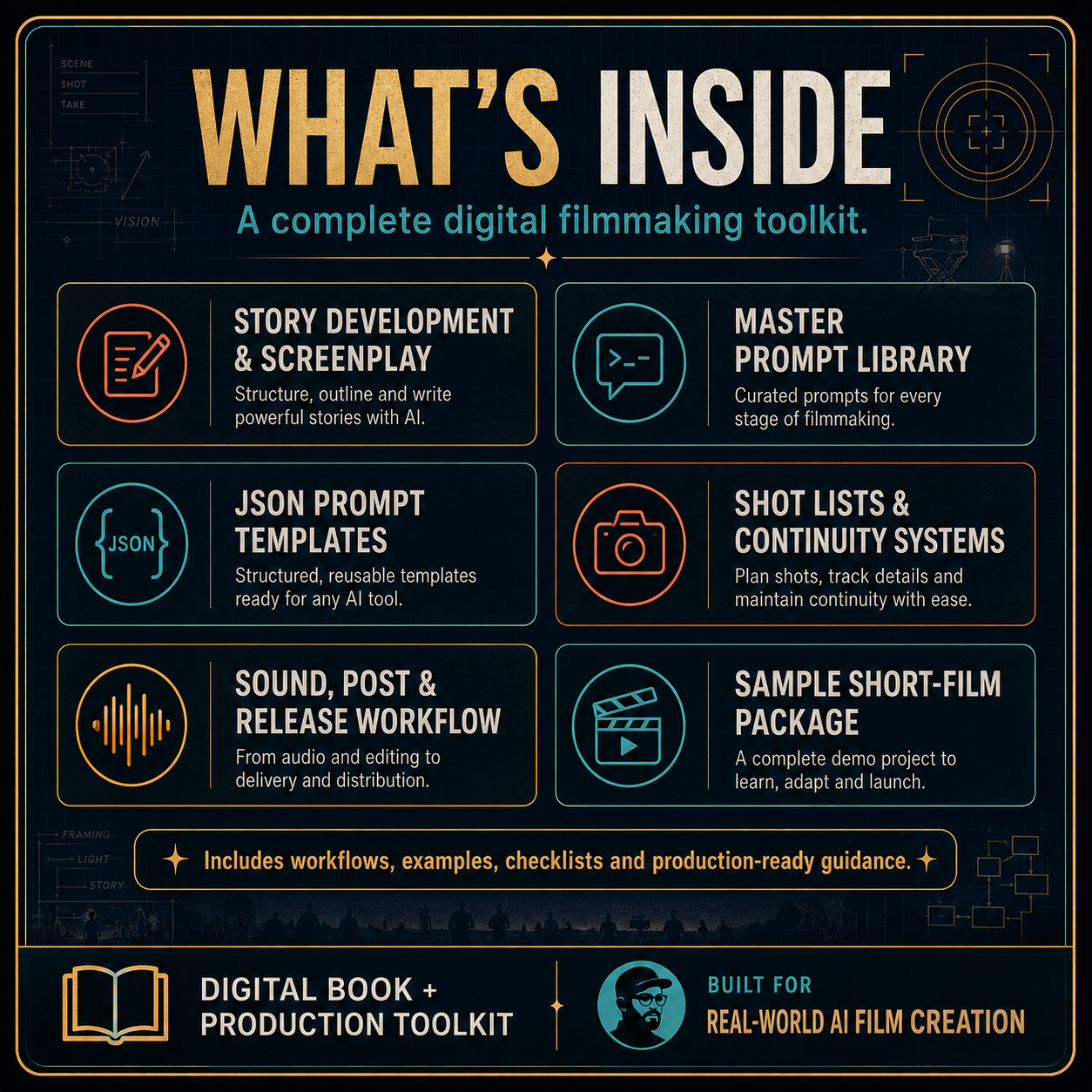
What Is Included
The book combines detailed teaching with practical production resources.
You receive:
- A complete idea-to-release filmmaking workflow
- Story and screenplay development guidance
- Master Film Bible instructions
- Character, costume, prop and location systems
- Cinematography and visual-style frameworks
- Scene breakdown and shot-list methods
- Storyboard and animatic guidance
- Prompt engineering systems
- JSON prompt templates
- Character-consistency methods
- Voice, dialogue and lip-sync workflows
- Sound and music prompt systems
- Editing and post-production guidance
- Repair and troubleshooting systems
- Continuity checklists
- Quality-control checklists
- Delivery checklists
- Tool-comparison guidance
- File-naming and folder-structure systems
- Budget and AI-credit planning methods
- Legal, consent and documentation guidance
- Printable worksheets
- Complete sample short-film package
Complete Project Emberline Case Study
The book includes a continuing sample film project called Project Emberline.
Instead of explaining filmmaking only in theory, the same project is developed through the entire production process:
- Initial concept
- Genre and emotional promise
- Logline
- Theme
- Character development
- Worldbuilding
- Beat sheet
- Treatment
- Screenplay
- Film Bible
- Character references
- Visual style
- Storyboard
- Shot list
- Image and video prompts
- Voice and dialogue
- Sound effects
- Music
- Editing
- Continuity
- Quality control
- Release preparation
This allows you to see how all the parts of an AI film connect.
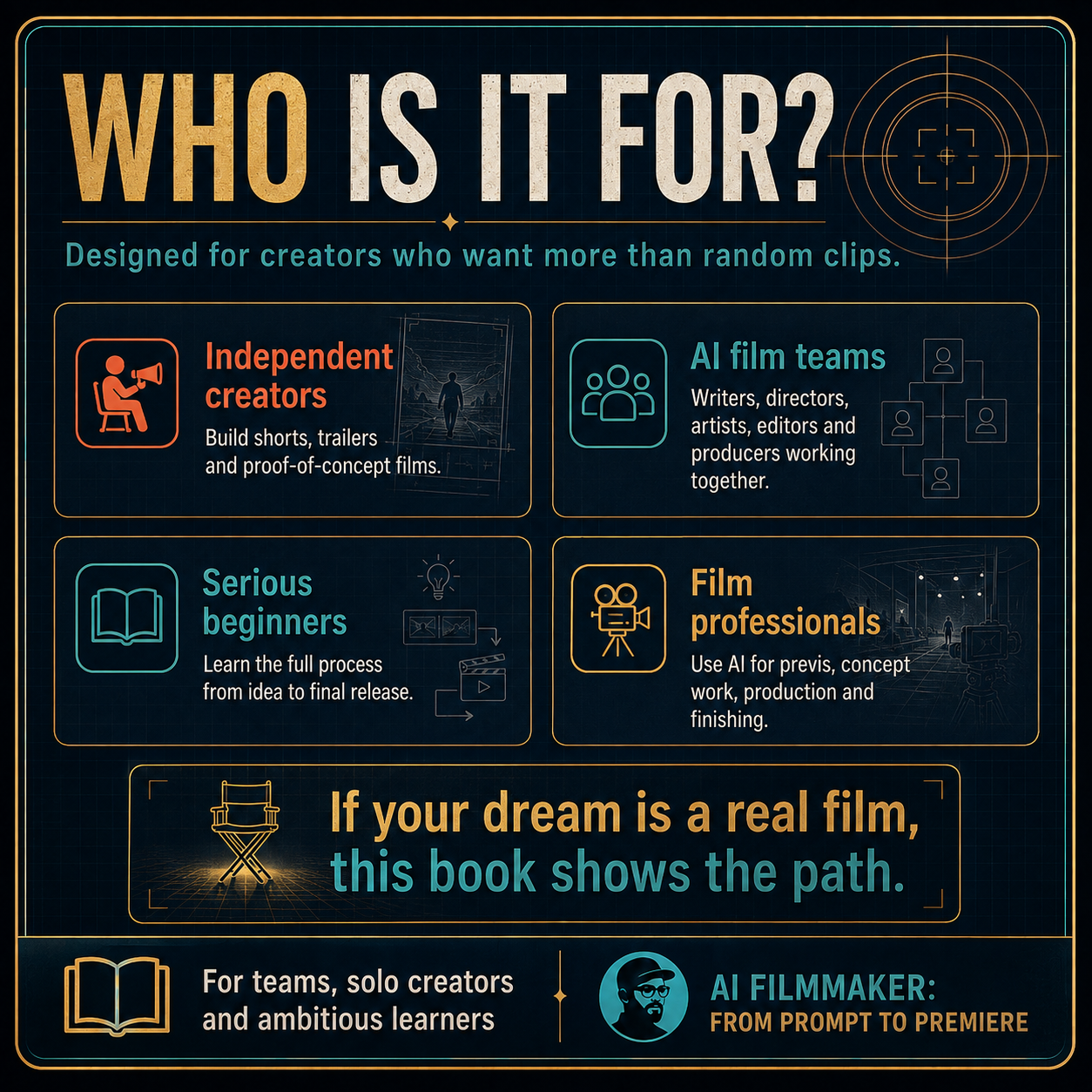
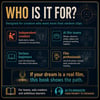
Who Is This Book For?
Independent Creators
Create short films, trailers, proof-of-concept films, music videos, animated stories and cinematic online content.
AI Film Teams
Give writers, directors, visual artists, AI operators, editors, sound designers and producers one shared production system.
Serious Beginners
Learn the full process from idea to release without needing previous filmmaking experience.
Traditional Filmmakers
Use AI for story development, previsualisation, concept art, storyboarding, virtual locations, VFX planning and production support.
Trainers and Students
Use the structured chapters, exercises, worksheets and examples for filmmaking courses, workshops and self-study.
Creative Agencies and Content Studios
Develop more consistent cinematic content for clients while maintaining better control over prompts, assets, approvals and versions.
Why Buy This Book When Free Tutorials Exist?
Free tutorials are useful, but they often focus on one tool, one effect or one platform.
You may watch separate tutorials on:
- Screenwriting
- Image generation
- Video generation
- Lip-sync
- Voice cloning
- Music
- Editing
- Colour grading
But those tutorials may use different terminology, different workflows and different production assumptions.
This book brings the complete process into one organised system.
You do not have to rebuild your workflow from disconnected videos every time you begin a new project.
Why This Book Can Save You Money
AI credits are often wasted because:
- The story is unclear
- The shot is not planned
- Character references are weak
- Too much action is requested
- The wrong generation method is selected
- Versions are not labelled
- Continuity is checked too late
- Failed shots are regenerated without diagnosis
The systems in this book help you plan before generating and repair more intelligently.
It cannot guarantee that every generation will succeed, but it can help you avoid many preventable mistakes.
Why This Book Can Save You Time
Without a production system, creators repeatedly search for old prompts, lose approved references, regenerate completed work and discover continuity errors during editing.
This book teaches you how to:
- Organise project files
- Label versions
- Record approved assets
- Maintain continuity
- Build reusable prompts
- Control references
- Track shot status
- Create repair records
- Prepare release files
That means less time searching and more time creating.
This Is Not a One-Click Promise
This book does not promise that AI will make a successful film automatically.
It does not guarantee:
- Festival selection
- Commercial profit
- Perfect results from every model
- Instant Hollywood-level quality
- A complete film without practice
- Freedom from legal or licensing responsibilities
The book gives you a professional road map. You still bring the imagination, judgement, patience and creative decisions.
Tools Will Change—The Filmmaking System Remains
AI platforms, prices, features and credit systems change frequently.
For that reason, the book focuses on durable principles:
- Story
- Character
- Direction
- Cinematography
- Performance
- Continuity
- Sound
- Editing
- Quality control
- Rights
- Release
You can apply these principles across different tools and update your technical workflow as the technology evolves.
What Can You Create?
After studying and applying the book, you can work toward creating:
- Cinematic test scenes
- One-minute narrative films
- Film trailers
- Three-to-five-minute short films
- Proof-of-concept films
- Music videos
- Animated stories
- Branded cinematic content
- Festival-ready short-film packages
- Production plans for longer AI films
Your final result will depend on your tools, experience, time and creative decisions, but you will have a clear system to follow.
Your AI Tools Are Powerful. Your Vision Needs a System.
The camera does not decide where it should be placed.
The voice model does not decide what the character truly wants.
The video generator does not decide why the scene matters.
The music model does not decide what the audience should feel at the end.
Those decisions belong to the filmmaker.
AI Filmmaker: From Prompt to Premiere helps you organise those decisions into a complete production process.
This is not merely a collection of prompts.
It is a practical filmmaking system for turning an idea into a controlled, consistent and emotionally engaging film.
Plan Better. Prompt Smarter. Finish Stronger.
Download AI Filmmaker: From Prompt to Premiere and begin building your film with clarity, confidence and professional control.