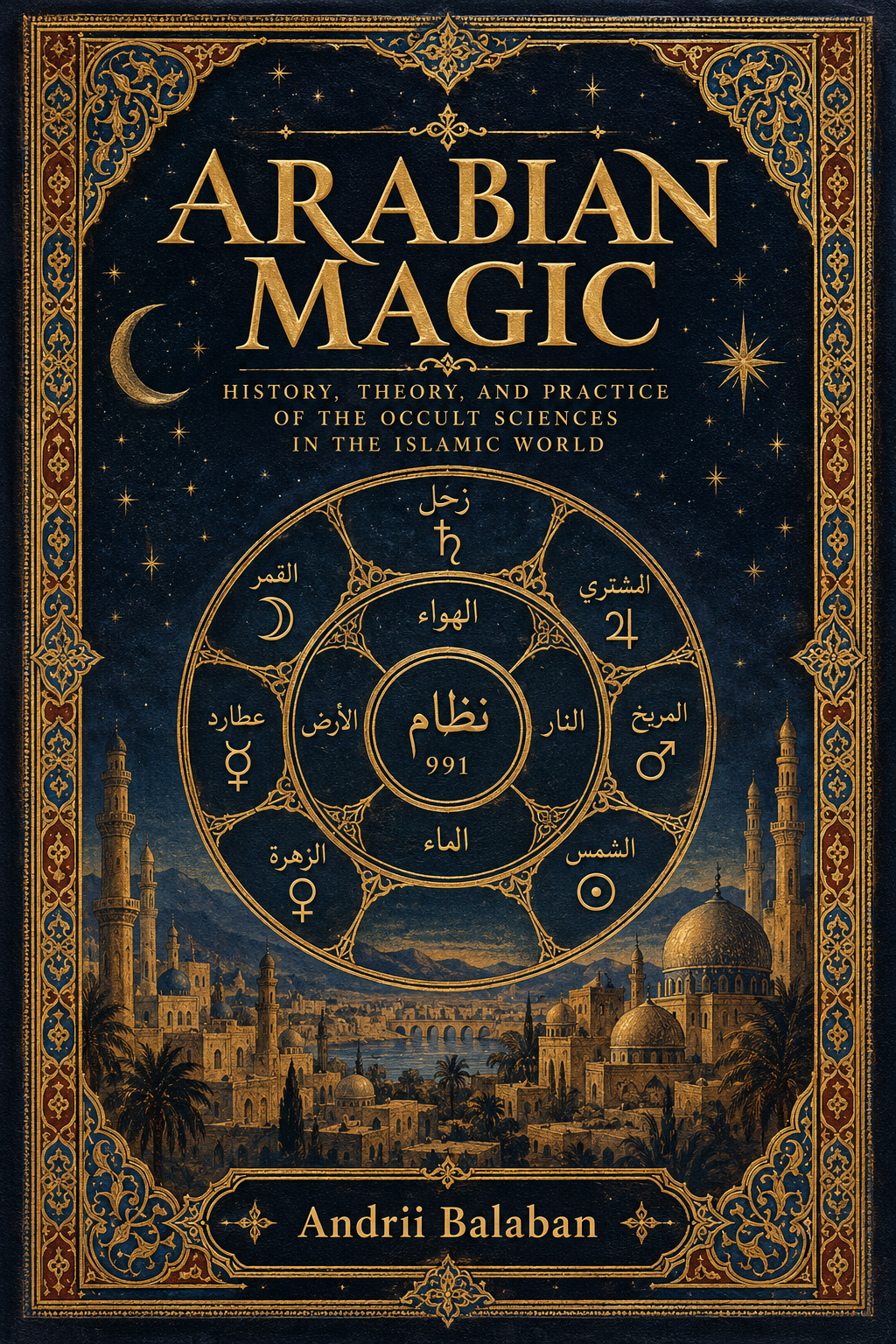
Arabian magic
Contents
Chapter One. The Hidden Structure of the Magical Universe
The cosmological foundations of Arabian magic. The visible and invisible worlds. The hierarchy of existence. The relationship between matter, spirit, celestial influence, and human consciousness. The magician as mediator between different levels of reality. Magical causality and the doctrine of correspondences. Intention, imagination, concentration, and ritual action as instruments through which hidden forces are directed toward manifestation.
Chapter Two. The Celestial Powers and the Seven Planets
The seven classical planets and their occult natures. Saturn, Jupiter, Mars, the Sun, Venus, Mercury, and the Moon as distinct currents of celestial power. Planetary hours and days. Zodiacal relationships. Colors, metals, fragrances, stones, and other correspondences. Choosing the proper celestial moment for an operation. Invocations designed to establish ritual harmony between the magician and a planetary influence.
Chapter Three. The Secret Science of Letters and Numbers
Letters as vessels of occult power. The relationship between written language, number, sound, and creation. Numerical correspondences and traditional calculations associated with Arabic letters. Magical squares and numerical constructions. Sacred and occult names. The formation of written formulas, seals, and invocations. The use of names and numerical relationships within practical magical operations.
Chapter Four. Talismans, Seals, and the Fixation of Magical Power
The talisman as a material body prepared to receive and preserve an occult influence. The principles governing the selection of materials, inscriptions, symbols, names, and celestial timing. Planetary and protective talismans. Seals and magical characters. Consecration through fumigation, recitation, and invocation. The ritual process through which an ordinary object is transformed into a permanent instrument of magical action.
Chapter Five. Incense, Perfumes, Stones, Metals, and Magical Substances
The material foundations of ritual practice. Aromatic substances and fumigation as instruments of attraction and correspondence. Traditional relationships between plants, minerals, metals, colors, and celestial powers. Preparation of the ritual environment. Purification and consecration of magical substances. The combination of material correspondences with spoken formulas and ritual intention.
Chapter Six. Jinn and the Invisible Orders
The place of jinn within Arabian magical cosmology. Different conceptions of invisible beings and their relationship with humanity. Spiritual hierarchies, intermediaries, guardians, and hostile entities. The distinction between invocation, evocation, petition, and command. Preparation of the ritual space. Protective boundaries and formulas. The opening of an operation, the calling of an invisible presence, communication, dismissal, and ritual closure.
Chapter Seven. Divination, Dreams, and the Unveiling of Hidden Things
Divination as the magical disclosure of information concealed from ordinary perception. Dreams, signs, numerical methods, written oracles, and ritual consultation. Preparation of consciousness before divination. The distinction between symbolic perception and literal interpretation. Incantations associated with seeking knowledge. Methods for recording, comparing, and interpreting the results of repeated divinatory operations.
Chapter Eight. Protection, Purification, and the Breaking of Harmful Influence
The theory of magical contamination and spiritual interference. Protective boundaries, amulets, inscriptions, fumigations, recitations, and talismanic defenses. Purification of the practitioner and ritual space. Recognition and removal of unwanted magical influence within the internal worldview of the tradition. Protective invocations. The establishment, reinforcement, and periodic renewal of magical defenses.
Chapter Nine. Invocation, Conjuration, and the Architecture of Ritual
The complete structure of ceremonial operation. Selection of purpose and timing. Preparation of the magician. Construction and purification of the ritual space. Placement of talismans and substances. Opening formulas. Recitation and repetition. Invocation and conjuration. Concentration of intention. The moment of magical command or petition. Signs traditionally interpreted as manifestations of the operation. Dismissal, closure, and the restoration of ordinary ritual space.
Chapter Ten. The Complete Art of Arabian Magic
The integration of cosmology, astrology, letters, numbers, talismans, magical substances, spiritual invocation, divination, and protection into a unified system of practice. The construction of a complete operation from intention to conclusion. Choosing correspondences and determining the appropriate time. Writing the formula and preparing the talismanic components. Performing the invocation and completing the operation. Recording results and refining subsequent practice. The discipline of the magician and the transformation of separate techniques into a coherent personal art.
Arabian magic constitutes one of the most intricate systems of occult knowledge to emerge from the civilizations of the medieval Near East. Within its historical traditions, magic did not exist as an isolated collection of spells. It stood at the intersection of cosmology, astrology, mathematics, medicine, philosophy, the interpretation of dreams, the properties of stones and plants, the science of letters, the construction of talismans, and the invocation of invisible intelligences.
The magician therefore approached the universe as an ordered structure of correspondences. Stars, planets, metals, fragrances, names, letters, numbers, hours, directions, and spiritual beings were understood as parts of a single hierarchy. A magical operation succeeded not merely because words were pronounced or gestures performed, but because the operator brought several levels of this hierarchy into deliberate correspondence.
Central to this worldview is the principle that visible events possess invisible causes. The material world represents only the outermost manifestation of a more complex order. Human beings occupy a unique position within this structure because consciousness, imagination, intention, speech, and ritual action allow them to participate deliberately in relationships that ordinarily remain concealed.
Arabian occultism consequently developed several distinct but interconnected technologies of magical practice. Celestial magic sought to capture planetary influences through carefully timed operations. Talismanic magic fixed those influences within material objects. The science of letters investigated hidden relationships between language, number, and creation. Incantations employed sacred and magical names as instruments of command and mediation. Evocatory practices established ritual contact with spiritual beings, while divinatory arts attempted to uncover events concealed from ordinary perception.
This book approaches these traditions as a coherent magical universe. Its purpose is not merely to catalogue old beliefs, but to reconstruct the internal logic by which the practitioner understands the operation of magic. Historical concepts will therefore be placed beside practical ritual principles so that theory and operation remain inseparable.
The magician must nevertheless distinguish knowledge from theatrical imitation. A ritual is not made powerful by exotic terminology alone. Every operation possesses its own structure: intention, preparation, correspondence, timing, invocation, concentration of the magical act, manifestation, and closure. Understanding this structure is the beginning of practical mastery.
The chapters that follow proceed from the cosmological foundations of Arabian magic toward increasingly specialized forms of practice. Particular attention is given to celestial correspondences, the science of letters and numbers, talismans, incense and materia magica, spirits and jinn, divination, ritual invocation, protection, and the construction of complete magical operations.
The result is intended as both an occult treatise and a practical grimoire: a systematic journey into a universe in which the spoken word, the written sign, the movement of the heavens, and the disciplined will of the magician become different expressions of the same hidden order.
Amanar