

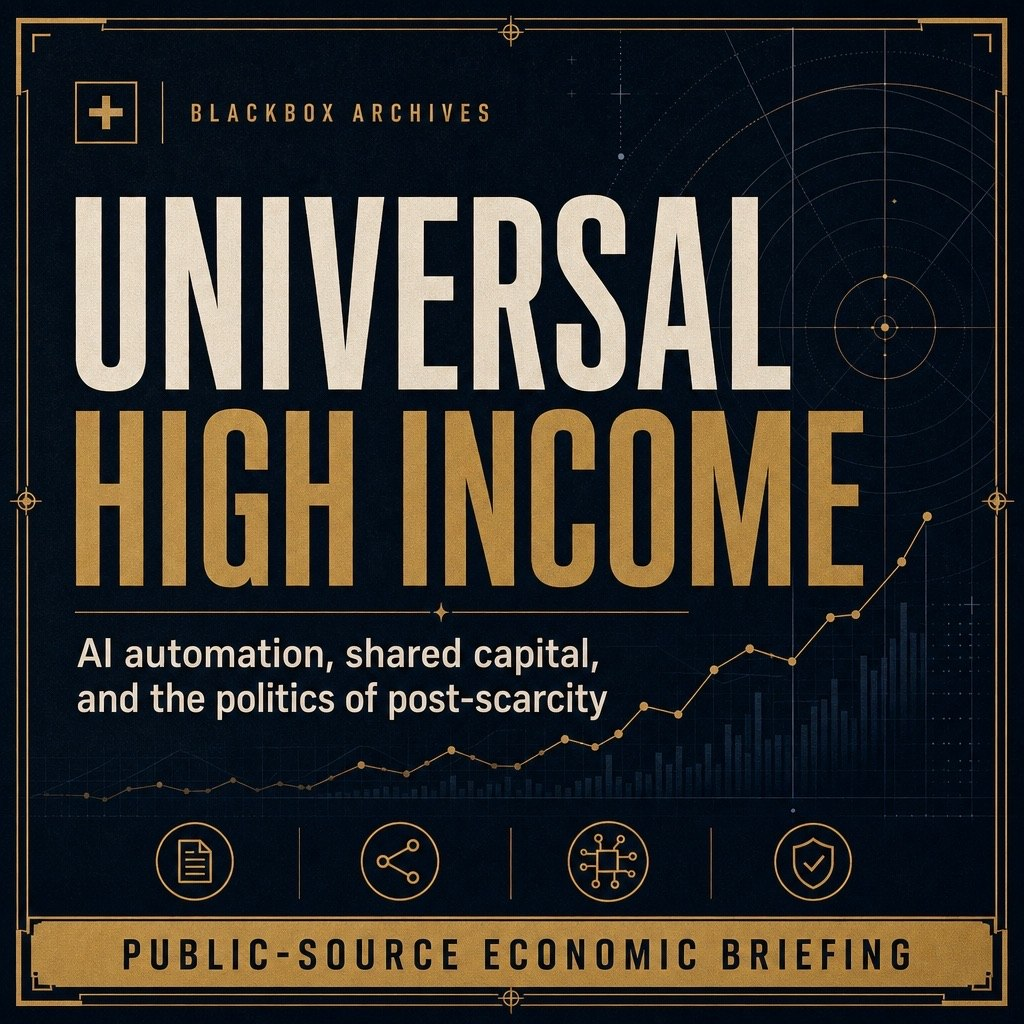
Through The Looking Glass - Universal High Income
Universal High Income is a short, serious paper about what happens if AI makes society much richer, but the money keeps flowing to the people who own the machines.
I wrote this because most discussions about Universal Basic Income and post-scarcity economics are either cowardly or stupid.
On one side, you get the usual techno-utopian fantasy: robots will do everything, everyone gets free money, nobody has to worry, and somehow housing, energy, medicine, land, status, and political power magically stop being scarce.
On the other side, you get the grim little accountant answer: people need jobs, money must be earned, anything else is childish, and the current system should continue forever even if machines eventually do most of the productive work.
Both answers are weak.
This paper argues for a more credible middle position: Universal High Income is not believable as magical cash-printing. It becomes believable only if it is built as a shared claim on AI-era capital, automation rents, and real productive abundance.
If AI creates enormous wealth while ordinary people still depend mainly on wages, then the economy may become richer while most people become more fragile. The point is not that work disappears overnight. The point is that labor may become a weaker and weaker way to distribute the output of civilization.
This paper looks at psychology, economics, automation, universal income evidence, scarcity, bottlenecks, and the political problem of who owns the machine economy.
It covers:
• why unconditional income can reduce scarcity pressure
• why cash alone does not solve housing, healthcare, energy, or status scarcity
• what the evidence says about work, wellbeing, and guaranteed income
• why AI automation may weaken wages as the main distribution system
• why a serious UHI would need social wealth funds, public abundance, and shared capital ownership
• why “post-scarcity” is not the same as “nothing is scarce”
• why humans still need agency, competence, meaning, and contribution after survival pressure is reduced
This is not a utopian manifesto.
It is not an anti-work rant.
It is not AI hype.
It is a blunt economic briefing on what would have to be true for Universal High Income to become credible.
The conclusion is conditional, but clear:
If AI disappoints, Universal High Income will remain fantasy.
If AI succeeds and ownership stays concentrated, the future gets uglier.
If AI succeeds and society builds the right institutions, UHI could become one of the cleanest ways to turn machine abundance into human freedom.
Format: Digital PDF
Length: 8 pages
Brand: Blackbox Archives
This is not financial advice, investment advice, political advice, or economic forecasting. It is a public-source analytical paper based on current debates around universal income, AI automation, labor, scarcity, and post-scarcity economics.