
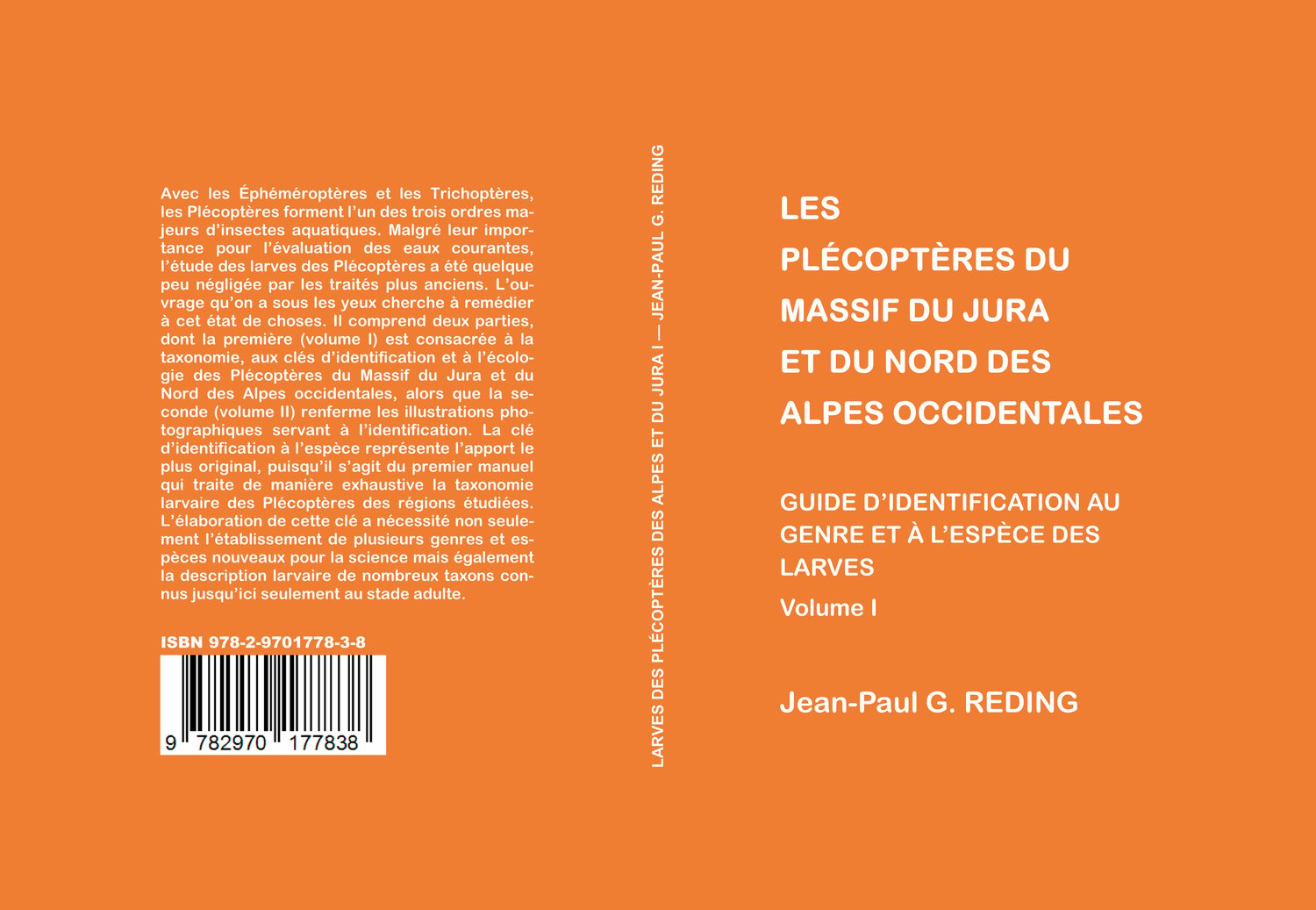
Les Plécoptères du Massif du Jura et du Nord des Alpes occidentales : Guide d’identification au genre et à l’espèce des larves. plecoptera-jurassica, Neuchâtel, 2026. 2 volumes. Vol. 1 : Introduction. Taxonomie. Clés d’identification. Écologie (284 pp.)
Abstract
General features. Despite their importance for the evaluation of running waters, the study of
Plecoptera nymphs has been somewhat neglected by older treatises. The present work is the first
manual to deal exhaustively with the larval taxonomy of Plecoptera down to species level for the
Jura Mountains, the northern slope of the Swiss Alps, the Savoy Alps and parts of the French
Northern Prealps. The small Jorat Massif of the Lausanne region is also included. Volume I is
devoted to the taxonomy, the identification keys and the ecology of the Plecoptera from the Jura
Mountains and the North of the Western Alps, whereas Volume II contains the photographic
illustrations used for identification. The number of species treated amounts to 116. An important
section is devoted to an in-depth discussion of plecopterological taxonomy, justifying the choice of
the nomenclature of the species considered for the regions under investigation. The morphological
features of each of the species considered and keyed out are illustrated by means of numerous
photographs taken under a binocular microscope. The general intent of these illustrations is to
provide plethoric criteria for the identification of each taxon. This method is designed to provide,
on the one hand, a solid framework to beginners, and, on the other hand, to roll out as many
identification criteria as possible to enable also the separation of closely related species. The
photographs have, on purpose, not been reworked by using focus stacking software, since they
mainly seek to faithfully reproduce what is actually seen under a binocular microscope during
practical identification work.
Taxonomic novelties. The name Isoperla grammatica, attributed to Poda von Neuhaus (1761) or to
Scopoli (1763), is shown to be a nomen dubium, since the original descriptions of these two authors
either do not refer to a stonefly, but to a caddisfly, or do not designate a species of the genus Isoperla.
There is presently no consensus over the zoological identity of Isoperla grammatica, which would have
been required for maintaining an older name for taxonomic purposes. The taxa hitherto listed under
the name Isoperla grammatica hence are all renamed. The species described by Despax (1936) under
the name Isoperla grammatica, forma typica is renamed to Isoperla hercynia nom. nov., since it occurs only
in regions of hercynian origins, such as the Eastern Pyrenees, the Massif central, or the Black Forest.
The species Isoperla subarmata (Despax, 1936) is reinstated, and redescribed. For Alpine specimens,
hitherto also identified as Isoperla grammatica, the protonym Isoperla virescens (Pictet, 1833) is reinstated.
Moreover, two new species of Isoperla, endemic to the Jura Mountains are described: Isoperla
bellicensis, and Isoperla pseudooxylepis. The results of the revision of the species groups Dictyogenus
alpinum – fontium (Reding 2024), and Perla bipunctata – grandis (Reding 2023), are also included in the
present work. The Capnia vidua superspecies group is revised, and a new genus, presently under
description, named Viduacapnia, is introduced. All former subspecies of Capnia vidua are raised to
species level, and two new species, Viduacapnia alpina and Viduacapnia pyrenaica are described. The
genus Capnioneura is separated from the Capniidae and placed in the new family of the
Capnioneuridae. The recently reinstated species Nemoura banatica Kis, 1965 is freshly described from
adults as well as nymphs, and separated from the closely related Nemoura marginata. The nymph of
Nemoura erratica is described and keyed out.