
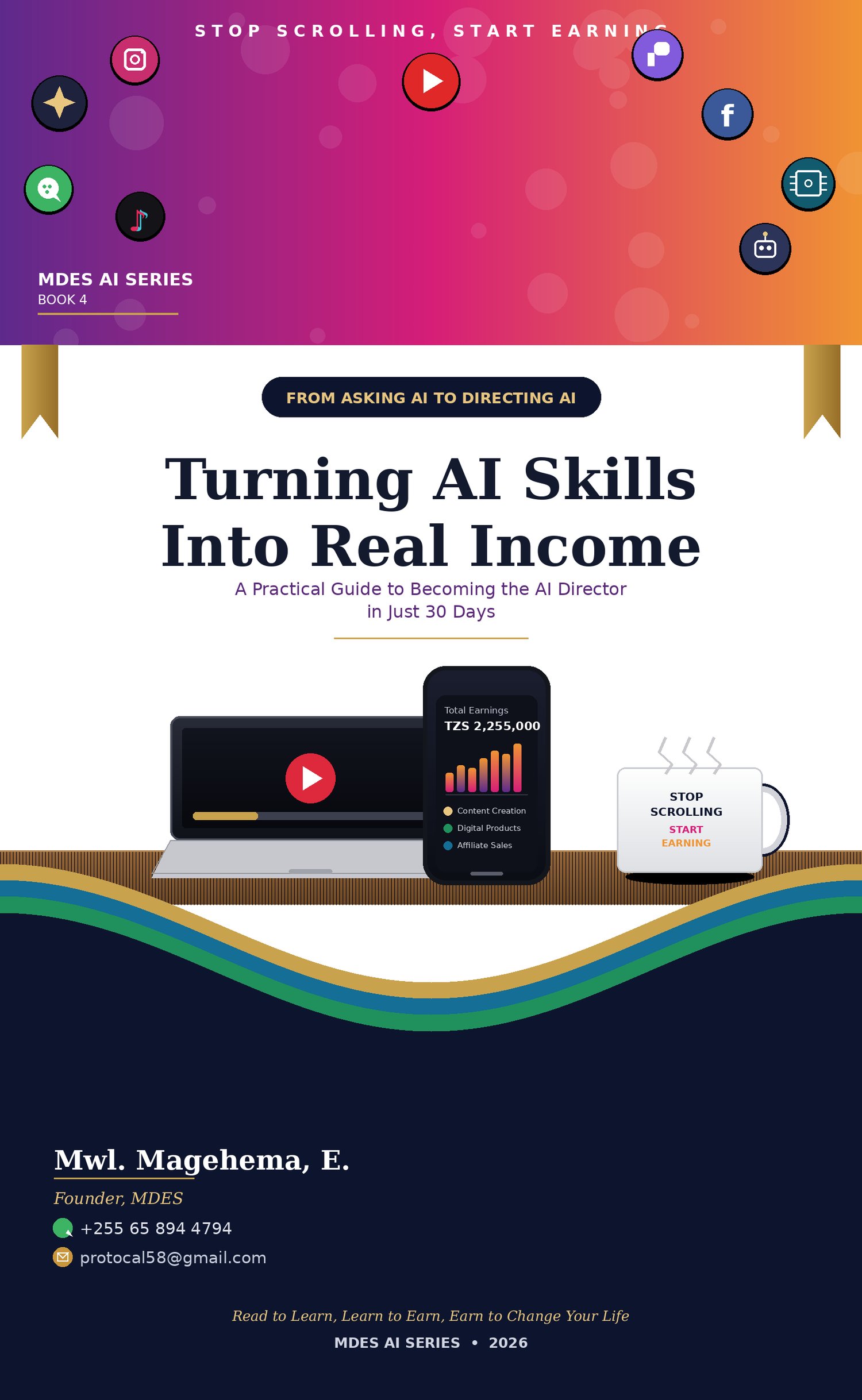
From asking AI to directing AI. turning AI skills into real income.
From Asking AI to Directing AI
Turning AI Skills Into Real Income
Do you use AI regularly but still receive generic, unclear, or disappointing results? Have you ever wondered why someone else can use the same AI tool and produce professional content, practical plans, and useful business materials while your output still requires heavy editing? The difference is often not the tool. It is the way the tool is directed.
From Asking AI to Directing AI: Turning AI Skills Into Real Income is a practical guide for anyone who wants to move beyond using AI simply to ask questions and start using it as a capable assistant for building useful work, services, and digital products. This book shows you how to give AI clear roles, context, objectives, boundaries, and quality standards—and how to turn that skill into results that can help a client, a business, or your own project.
This is Book 4 in the MDES AI Series, published through the Magehema Digital Entrepreneurship System. Rather than focusing only on AI theory, this book takes you step by step from casual AI usage to the mindset of an AI Director: someone who knows how to define the work, create a repeatable process, evaluate the output, and package the resulting skill into a service that people can understand and value.
Who is this book for?
This book is designed for three main groups of readers. First, it is for freelancers and content creators who already use AI casually but want to improve the quality of their work and offer more valuable services. Second, it is for small-business owners who want to use AI more deliberately for content, marketing, planning, and day-to-day operations without beginning with expensive resources. Third, it is for aspiring digital entrepreneurs who want a practical, low-cost entry point into the digital economy through learning, practice, and consistent action.
You do not need to be a programmer, a technology expert, or someone with expensive equipment to begin. You need to learn how to communicate with AI clearly, evaluate the quality of its responses, and build a process that can be repeated. The book explains these foundations in accessible language, using examples connected to work, business, content, and everyday services.
What will you learn?
The first chapter introduces the difference between an Asker and a Director. An Asker enters a short request and accepts the first response. A Director gives AI a role, context, audience, constraints, format, and a clear standard to meet. This shift in mindset is the foundation of using AI for more reliable and useful results.
You will then learn the anatomy of a directive prompt and the essential elements that help AI understand a task correctly. The book explains why role, context, task, constraints, and format matter, and how to combine them to produce outputs that can be used in real work instead of generic answers that require extensive rewriting.
The book also explores multi-step AI workflows. Instead of expecting one prompt to solve an entire project, you will learn how to break a larger task into manageable stages, organize the sequence, and use AI within a repeatable workflow. This helps you move from simply saying, “AI gave me an answer,” to building a process that consistently produces a useful result.
Another important focus is learning how to move from output to product. This may include well-structured content, a service package, a working draft, a business plan, a content calendar, or another deliverable that a client can understand and use. The book encourages you to focus on the value of the final result—not on the length of the prompt or the number of responses generated by AI.
The business-focused chapters show you how to begin turning AI direction skills into income. You will learn to think about the problems that people and businesses need solved, the types of results you may be able to provide, and how to present your service without relying on exaggerated claims or unrealistic promises.
You will also be guided through building your first AI-directed offer. Instead of simply saying, “I do AI work,” you will learn to define your offer more clearly: who you serve, what problem you help solve, what result you provide, and what your process looks like. This is an important step in transforming an invisible skill into a service that potential clients can understand.
The later chapters introduce the value of systemizing your work and building a process that can grow. You will explore templates, workflows, quality standards, and documentation. The goal is not merely to work faster, but to create a reliable way of working that allows you to maintain consistency and improve over time.
The book also addresses common objections and doubts that arise when people begin using AI as a professional skill. You will encounter questions about competition, lack of experience, fear of starting, finding clients, and the belief that AI tools can do everything without human direction. This section helps you approach these concerns realistically and respond to them with practical thinking.
Finally, the book concludes with Your Next Seven Days, a practical starting plan designed to move you from learning to action. You will be encouraged to identify your skill, choose a problem, create a service or deliverable, test it, and begin communicating with real people. The emphasis is on steady progress, practice, and implementation—not passive reading.
Why is this book different?
This book is not built around “get rich quick” hype or the promise that AI will solve every problem without effort. Instead, it focuses on developing a useful capability: directing AI clearly, reviewing its responses, communicating with purpose, creating repeatable systems, and delivering value that can be understood.
AI is a tool. The greatest value comes from the person who knows how to apply that tool to the right problem, with the right instructions and the right quality standards. The book helps you develop that mindset through practical examples, common mistakes, and action steps that connect each chapter to real implementation.
What will you be able to do after reading?
You will have a stronger foundation for writing effective AI instructions, organizing work into a sequence of steps, producing useful deliverables, and evaluating whether an output meets the original requirement. You will also be able to think more clearly about services: what problem you can help solve, what result you can prepare, and how to communicate your value to a client or business.
The book does not present these outcomes as magic or as a replacement for learning, practice, communication, or real-world work. Instead, it gives you a starting framework that you can continue developing over time. By working through the exercises and action steps, you can create a practical foundation for using AI more productively and combining it with your existing business, content, service, or entrepreneurial skills.
Start becoming an AI Director
If you are tired of receiving generic AI responses, want to work with greater structure, or see an opportunity to use AI skills to support people and businesses, this book gives you a practical place to begin.
From Asking AI to Directing AI helps you move from asking to directing, from receiving output to creating useful results, and from casual AI usage to building a focused work system. It is a guide for freelancers, creators, small-business owners, and aspiring digital entrepreneurs who want to approach AI with more clarity and purpose.
Download the book today, read it in sequence, complete the practical action steps, and begin building your ability to direct AI in ways that can be applied to work, business, content, and digital opportunities.
Important note: This book is an educational and practical guide. It does not guarantee income, clients, sales, or any specific result. Outcomes depend on each reader’s effort, skills, market, quality of work, communication, and implementation.