
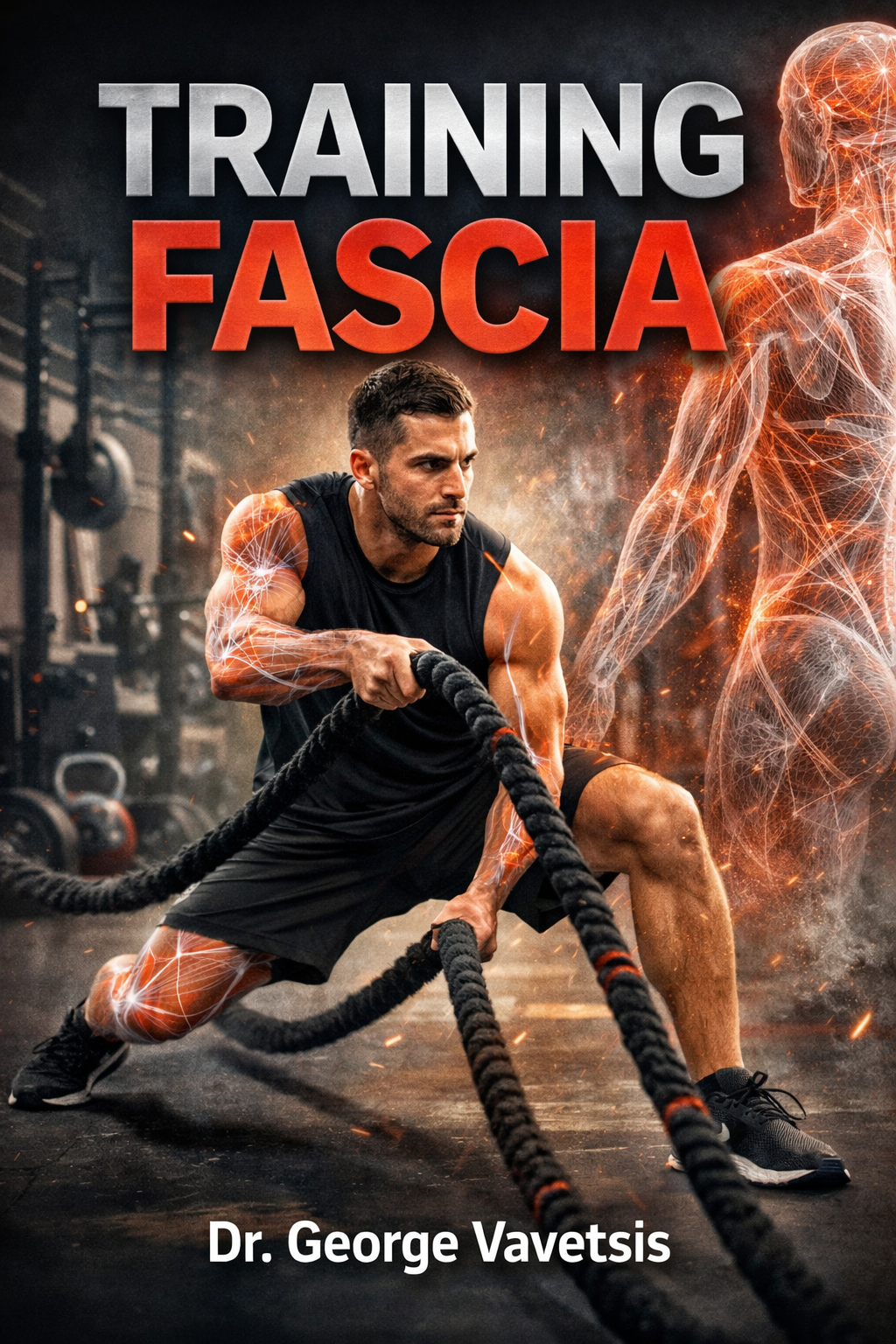
Training Fascia
Pages: 1307
In the evolving landscape of sports performance, rehabilitation, and human movement science, fascia has emerged from the shadows of anatomical anonymity to claim its rightful place as a central regulator of force transmission, movement efficiency, injury resilience, and sensory perception. Once regarded merely as passive packing material, the fascial system is now understood as a dynamic, metabolically active, mechano-responsive network that integrates muscle, tendon, ligament, bone, and the nervous system into a single, continuous tensegrity structure. This book is written from the conviction that no modern strength and conditioning, rehabilitation, or performance model can be considered complete without a precise, scientifically grounded, and practically applicable understanding of fascial behavior under load.
The purpose of this work is not to romanticize fascia, nor to reduce it to fashionable terminology, but to place it firmly within the rigorous framework of biomechanics, mechanobiology, neurophysiology, and applied training methodology. Fascia is neither mystical nor secondary; it is a load-bearing, force-modulating, proprioceptive, and metabolic organ system whose adaptive rules obey the same principles of stress, strain, time, and recovery as muscle and bone—yet with unique viscoelastic, thixotropic, and anisotropic properties that demand a distinct programming logic.
Elite performance is ultimately the art of managing interfaces: muscle to tendon, tendon to bone, layer to layer, stiffness to compliance, stability to mobility, and force to fluidity. These interfaces are governed largely by fascial structures. Whether the athlete is sprinting, changing direction, landing from a jump, throwing, striking, or simply maintaining postural integrity under fatigue, the quality of fascial glide, tensile capacity, elastic recoil, and cross-link density determines howToggle muscle power can be expressed, absorbed, recycled, or lost. In this sense, fascia is the silent conductor of movement orchestration, shaping not only mechanical output but also the sensory feedback that guides motor control.
This book was conceived for practitioners who operate at the intersection of science and applied coaching: strength and conditioning coaches, sports physiotherapists, athletic trainers, performance scientists, and clinicians who seek more than isolated muscle strengthening or generic mobility routines. It addresses those who recognize that stiffness without glide leads to fragility, that elasticity without structural integrity leads to inefficiency, and that resilience is born from the intelligent cycling of strain, shear, compression, and recovery across the connective tissue continuum.
Each chapter explores fascia not as an abstract anatomical layer but as a trainable tissue system with specific loading corridors, adaptation timelines, and failure thresholds. Dense and loose connective tissues, deep and superficial layers, collagen fiber orientation, elastin content, ground substance viscosity, and age-related cross-linking are examined through the lens of exercise prescription. The reader will encounter principles of eccentric and isometric strain for collagen remodeling, oscillatory and multi-planar motion for glide restoration, vector-specific loading for anisotropic strength, and high-rate low-amplitude contacts for elastic recoil optimization. These are not theoretical constructs, but programmable variables—frequency, intensity, duration, direction, and rate—that can be periodized with the same precision as traditional strength or speed qualities.
A central theme throughout the book is the concept of tissue intelligence: the capacity of connective structures to sense load, store mechanical memory, and adapt their internal architecture accordingly. Fascia does not merely transmit force; it learns from it. It thickens along dominant vectors, densifies under chronic strain, loses viscosity under inactivity, and stiffens with age through glycation and cross-link accumulation. Training, therefore, becomes a dialogue with tissue history. The practitioner’s task is to apply the right signal, in the right direction, at the right rate, and with the right recovery, so that adaptation enhances performance rather than compromising it.
Equally emphasized is the inseparable relationship between fascia and the nervous system. Mechanoreceptors embedded within the fascial matrix contribute to proprioception, reflex modulation, and intermuscular coordination. Changes in fascial stiffness or hydration alter afferent feedback, influencing movement timing, joint centration, and protective muscle tone. Thus, fascial training is also neural training, and neural readiness is, in part, a reflection of connective tissue state.
This work is written with respect for both laboratory evidence and the lived reality of the training floor. Scientific terminology is preserved where precision is required, yet every concept is translated into actionable strategies: exercise menus, loading schemes, progressions, regressions, and monitoring indicators. The aim is not to add complexity for its own sake, but to offer clarity—clarity in why certain tissues fail, why others over-stiffen, why elasticity disappears, and how intelligent mechanical exposure can restore balance.
Ultimately, this book advocates a shift in perspective: from muscles as isolated engines to the body as an integrated fascial-neuromuscular continuum; from linear strength models to vector-specific force pathways; from simple flexibility to layered glide and controlled stiffness; from short-term performance to long-term tissue sustainability. In doing so, it seeks to equip the reader with a deeper, more nuanced understanding of how to build athletes who are not only stronger and faster, but also more resilient, more efficient, and more adaptable across the demands of sport and life.
May this work serve as both a scientific reference and a practical compass, guiding the professional toward a more refined, connective-tissue-intelligent approach to human performance.