
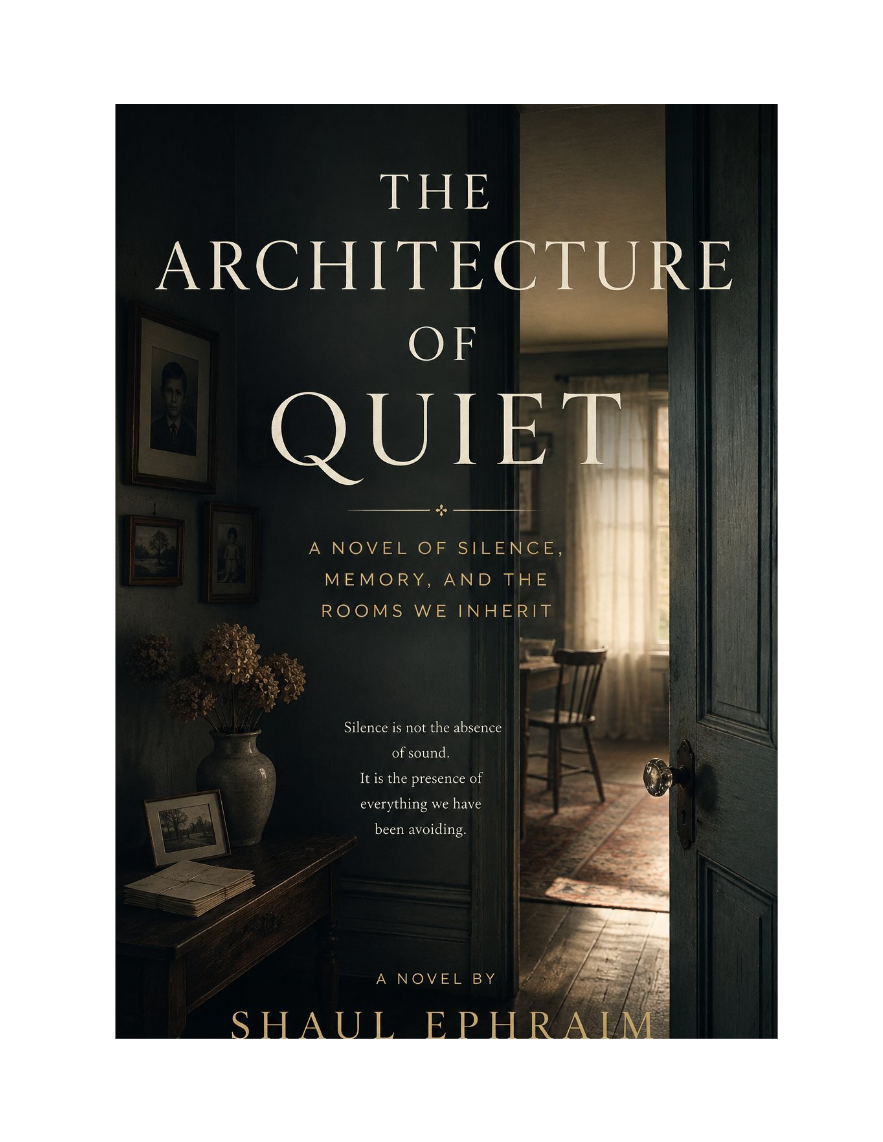
The Architecture of Quiet
The silence was not emptiness. It was architecture.
After his mother's death, Micah Rowan returns to the house on Alder Street expecting grief. What he finds is something harder: a home that has not changed, a family still moving carefully around old absences, and a silence so well preserved it feels like part of the walls.
His sister Naomi manages the household with practiced control. His father Samuel tends the garden with quiet devotion. His aunt Selah speaks in careful fragments, never offering more than the moment can bear. And everywhere Micah looks, the house seems to be holding its own language: a hook by the door that has always held nothing, a blue ceramic bowl on the windowsill, a tilted photograph, a locked drawer, a table where certain names have not been spoken.
At the center of it all is Jonah, the youngest child. The one the family learned, over years and without discussion, never to name directly.
As Micah sorts through his mother's rooms, he begins to understand that the family's silence was not simple avoidance. It was protection. It was guilt. It was love that did not know what else to do. But returning home also forces him to confront a more difficult truth: he did not escape the silence. He carried it with him.
The Architecture of Quiet is a restrained, emotionally precise literary novel about what families preserve, what they conceal, and what happens when a grown child finally learns to read the house that taught him what not to ask.
This is a novel for readers who appreciate quiet psychological fiction, family drama, literary prose, and stories where the deepest revelations arrive not through spectacle, but through rooms, objects, gestures, and the names people have spent years avoiding. The manuscript centers its emotional arc on Micah's return, the preserved family home, the absent figure of Jonah, and the gradual movement from silence toward acknowledgment.