
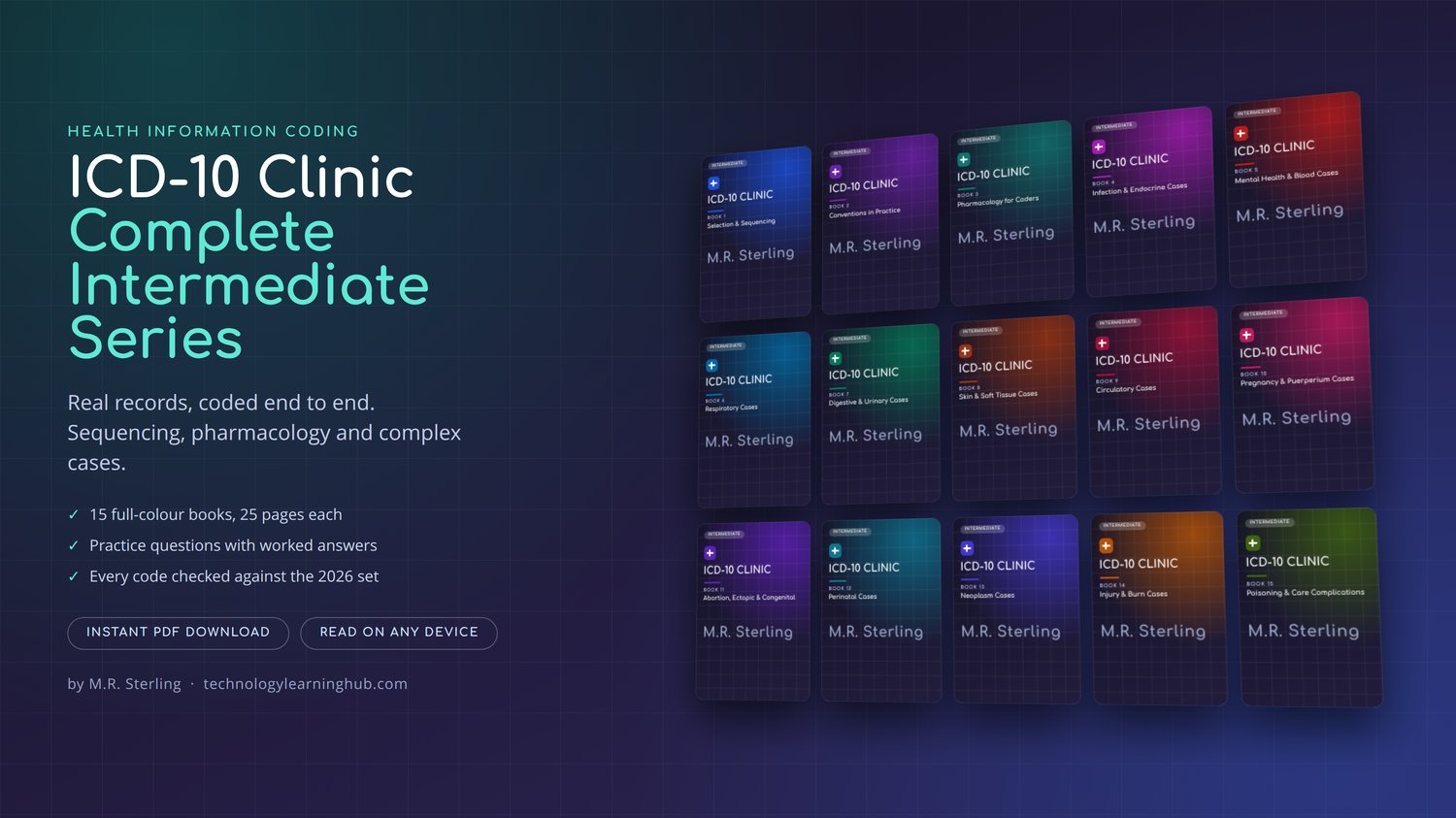
ICD-10 Clinic - Complete Intermediate Series
The Intro series taught you to find a code. This one teaches you what working coders actually
get graded on: which code leads, why, and what the code book obliges you to add.
Two coders can pull the same four codes off the same record and only one of them is correct.
The difference is the order, and the order is not a matter of opinion. It is set by the
principal diagnosis rule, by the instruction notes printed above the code, and by the
sequencing rules that certain chapters impose on every other chapter. This series takes those
rules one at a time and puts each one against records that fight back.
**How each book works.**
One topic, ten chapters, and every chapter closes with the rule
stated in a single line, so you can revise from the rules alone. Then a two-page Coding Lab
where a full record is worked through step by step, a page of the eight pitfalls that cost the
most marks, and fifteen practice questions with a worked answer for every one. Twenty-five
pages, cover to cover, no padding.
**Written to be understood.**
Short sentences. One idea at a time. Every technical word
defined the moment it appears, and a glossary at the end of every book. Built for readers
whose first language is not English, and clearer for everyone else because of it.
**Accurate, and checked rather than claimed.**
Every ICD-10-CM code in these fifteen books was
verified against the current code set before the file was made. Not spot-checked: every code,
in every table, chapter and answer key, including the codes that need a 7th character and a
placeholder. A study book that teaches a retired code teaches a claim rejection.
**What is inside**
1. Selection & Sequencing. Principal and first-listed diagnosis, symptoms that must go,
uncertain wording, Code first and Use additional code, and the principal procedure.
2. Conventions in Practice. Includes, Excludes1 and Excludes2, the word with, code also, NEC
and NOS, default codes, the placeholder X and the 7th character.
3. Pharmacology for Coders. The drug chart as evidence, what a drug class tells you, the long
term use codes, and the three drug events: adverse effect, poisoning and underdosing.
4. Infection & Endocrine Cases. The sepsis severity ladder, organism and resistance codes, HIV
sequencing, the five diabetes categories and their complications.
5. Mental Health & Blood Cases. Use, abuse and dependence, dementia and the disease underneath
it, and the anaemias with the bleeding that caused them.
6. Respiratory Cases. Asthma and COPD, pneumonia by organism and by route, and the respiratory
failure sequencing rule in full.
7. Digestive & Urinary Cases. Ulcers and bleeding, the liver, then chronic kidney disease
staged and chained to the conditions that caused it.
8. Skin & Soft Tissue Cases. Cellulitis, pressure ulcers by site and stage, non-pressure
ulcers by depth, and the diabetic foot.
9. Circulatory Cases. Hypertension and the codes that absorb it, heart failure by type, the
four-week rule for a heart attack, and what a stroke leaves behind.
10. Pregnancy & Puerperium Cases. The three rules that make the obstetric chapter unlike any
other, and the conditions that complicate a pregnancy.
11. Abortion, Ectopic & Congenital. Pregnancies that end early, their complications, and the
congenital codes that may be used at any age.
12. Perinatal Cases. The birth record, birth weight before gestational age, and the rule that
decides when a newborn finding is a diagnosis at all.
13. Neoplasm Cases. The six-column Neoplasm Table, primary against secondary, and the rule
that decides whether the cancer or the treatment leads.
14. Injury & Burn Cases. The 7th characters properly, sequelae, burns by depth and extent, and
the external cause codes.
15. Poisoning & Care Complications. The three drug events at speed, then the four questions
that must all be answered yes before a complication code is correct.
**Who this is for.**
Coding students who have finished an introductory course, new coders in
their first year, anyone preparing for a certification exam, and working coders who want the
sequencing rules straight rather than half-remembered.