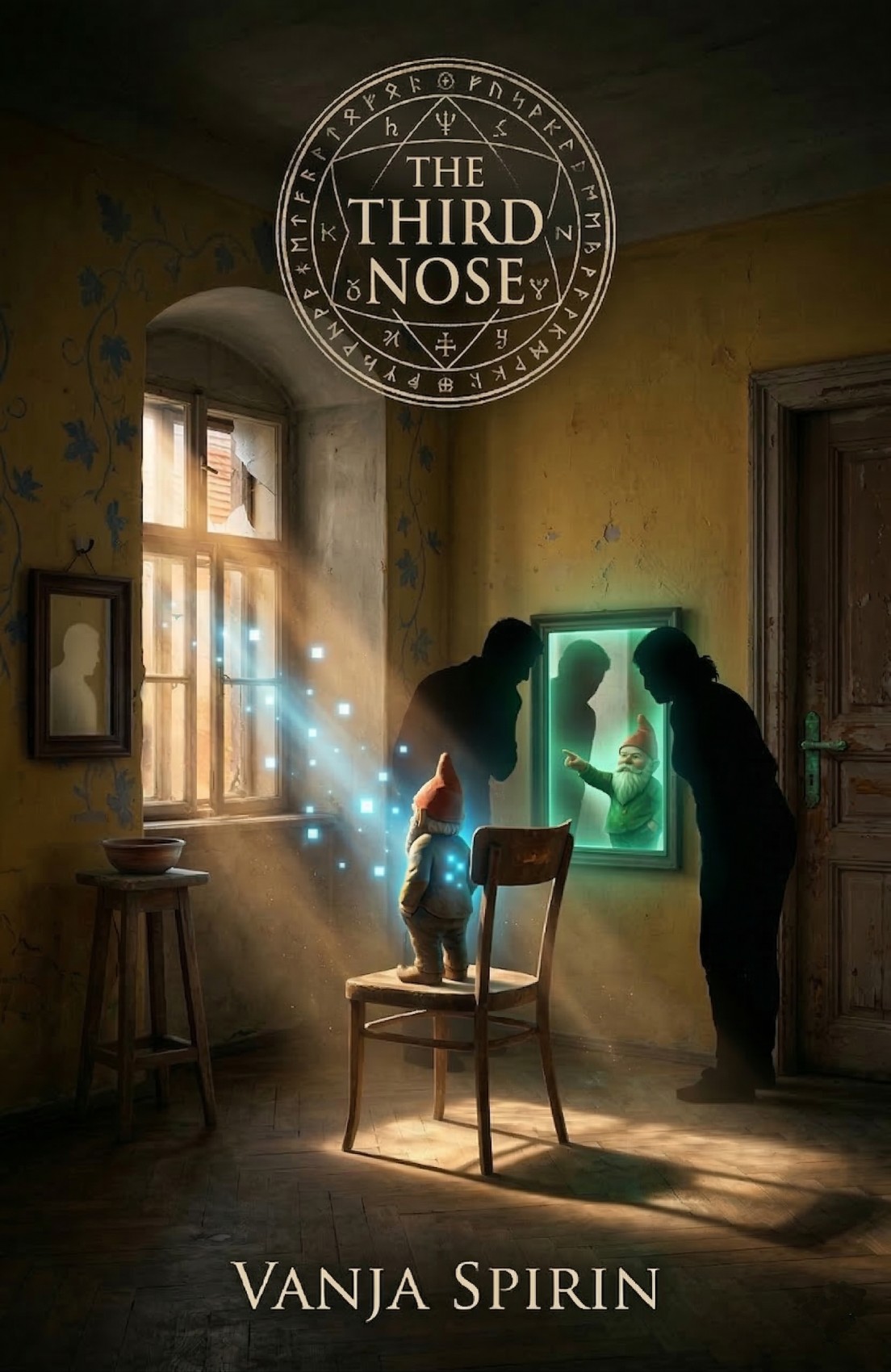
The Third Nose
The Third Nose
Zagreb, early twenty-first century. Three friends, Anjelko, Fabrizzio and Kamilo, stumble upon an ancient Arabic manuscript hidden in an old cobbler's storeroom on Zagreb's Opatovina, a Hebrew document written on paper that cannot be torn, a garden gnome of unexpected historical significance, and, eventually, a doorway into somewhere else entirely.
What follows is part urban comedy, part metaphysical adventure, and part love letter to a very specific kind of Zagreb, one of bowling alleys, Upper Town courtyards, neighbourhood gossip, dubious loan sharks, cats who urinate on ancient Hindu texts, and grandmothers who learned to bark like Alsatians to deter burglars.
The story moves between worlds, literally, drawing on Kabbalah, eleventh-century Arabic alchemy, fairy godmothers with grudges, and an obscure proverb about camel hair, while never losing sight of the stuffed peppers simmering on someone's stove, the Pag lamb that turns out to be from New Zealand, and the inescapable gravitational pull of a good Mussolini cocktail.
The women are sharp, capable, and doing most of the actual work. The men are well-meaning and frequently bewildered. A pair of loan sharks stumble into a parallel dimension while trying to repossess a gnome. At twilight, worlds connect. Things are never what they appear to be at first glance, as the manuscript keeps reminding anyone willing to listen.
The Third Nose is the kind of book that trusts its reader to keep up, and rewards them for doing so.