
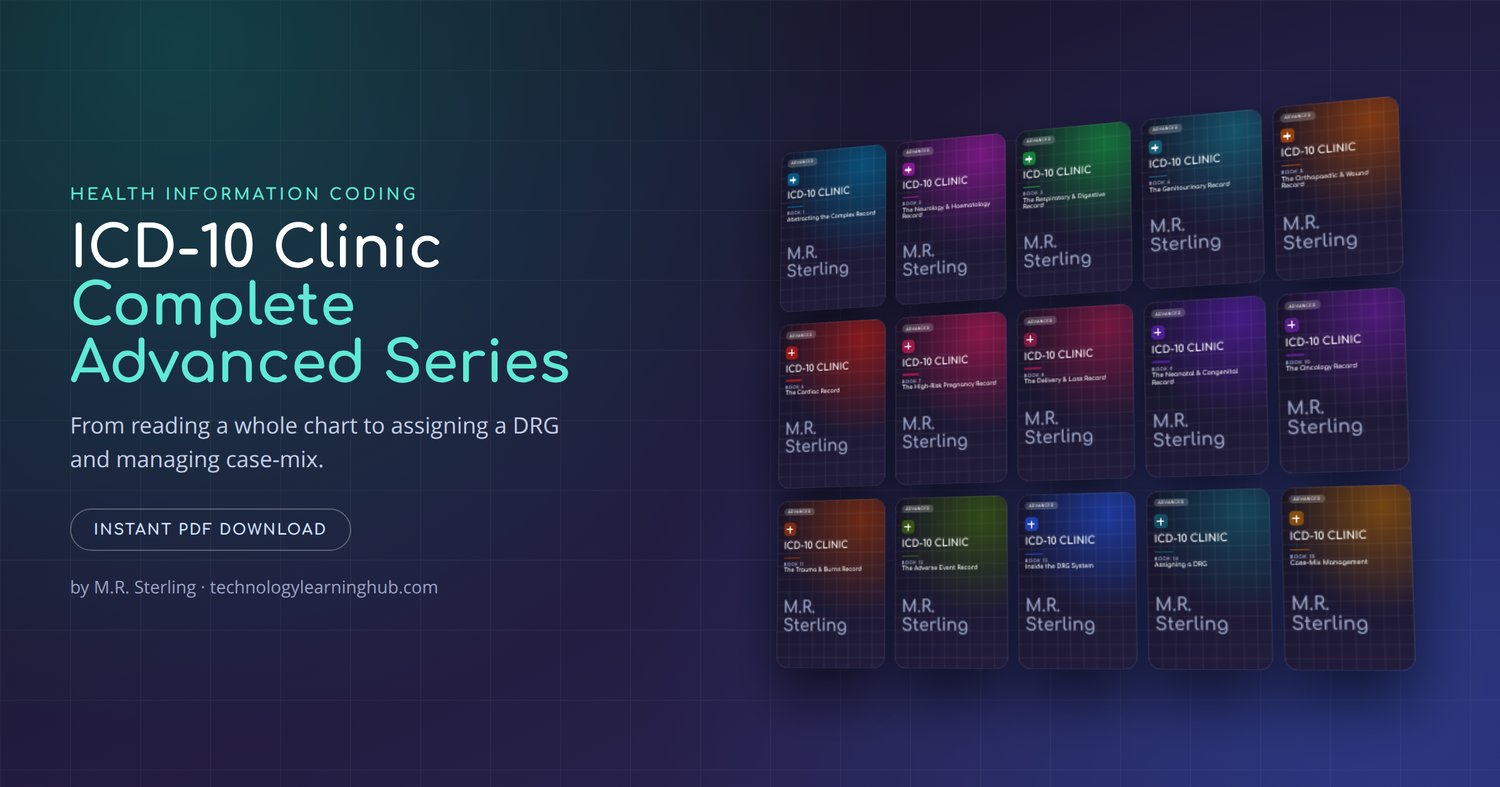
Health Information Coding · ICD-10 Clinic - Complete Advanced Series (15 books)
The Intro series taught you to find a code. The Intermediate series taught you to put codes in
order. This one starts where a real inpatient chart starts: eighty pages written by different
people at different hours, disagreeing with each other, and one coder who has to leave a single
clean answer behind.
That is the work advanced coders are actually paid for, and it is the work an auditor takes apart
first.
**What makes this tier different.**
It is not more body systems. It is the whole method around
them: which document proves what, who is allowed to establish a diagnosis, how to write a query
that is open rather than leading, how the present on admission indicator is decided, and what an
abstraction sheet has to contain before it is released. Every body system book then applies that
method to records that fight back.
**And then the part almost no coding book covers.**
The last three books follow your finished
record out of the coding office: into the grouper, into a diagnosis related group, into a relative
weight, and into a hospital's case-mix index. Not so you can code for money, but so you can see
exactly which of your decisions are load-bearing, and where the line is between coding accurately
and coding for a result.
**How each book works.**
One topic, ten chapters, and every chapter closes with its rule stated in
a single line, so you can revise from the rules alone. Then a two-page Coding Lab where full
records are worked step by step, a page of the eight pitfalls that cost the most marks, and
fifteen practice questions with a worked answer for every one. Twenty-five pages, cover to cover,
no padding.
**Written to be understood.**
Short sentences. One idea at a time. Every technical word defined
the moment it appears, and a glossary at the end of every book. Built for readers whose first
language is not English, and clearer for everyone else because of it.
**Accurate, and checked rather than claimed.**
Every ICD-10-CM code in these fifteen books was
verified against the current code set before the file was made. Not spot-checked: every code, in
every table, chapter and answer key, including the codes that need a 7th character, a placeholder
X, or the numeric character that identifies which baby in a multiple pregnancy.
**What is inside**
1. Abstracting the Complex Record. Which document proves what, what counts as evidence, the
physician query, present on admission, the abstraction sheet, and the eight checks before you
release.
2. The Neurology & Haematology Record. Dementia and the disease underneath it, epilepsy and
status, the stroke and what it leaves behind, and the anaemias with their causes.
3. The Respiratory & Digestive Record. Respiratory failure and the sequencing rule that decides
when it leads, pneumonia by organism and by route, and the bleeding that is already inside the
code.
4. The Genitourinary Record. Kidney disease staged and chained to hypertension and to diabetes,
the transplanted kidney, dialysis, and infections coded by site.
5. The Orthopaedic & Wound Record. The 7th characters properly, sequelae, pathological fractures,
joint replacements, and the two ulcer families with their two different questions.
6. The Cardiac Record. What absorbs hypertension, heart failure by type and phase, the four-week
rule for a heart attack, rhythms, devices and valves.
7. The High-Risk Pregnancy Record. The three rules that make the obstetric chapter unlike any
other, trimesters, weeks of gestation, and every disease that complicates a pregnancy.
8. The Delivery & Loss Record. The outcome of delivery code, complications of labour, the
caesarean and its indication, the puerperium, and pregnancies that end early.
9. The Neonatal & Congenital Record. The birth code, birth weight before gestational age, the six
tests that decide when a newborn finding earns a code, and congenital codes at any age.
10. The Oncology Record. The six-column Neoplasm Table, primary against secondary, and the rule
that decides whether the cancer or the treatment leads.
11. The Trauma & Burns Record. Which injury leads, head injury and consciousness, burns by depth
and extent, the rule of nines, and external causes at scale.
12. The Adverse Event Record. The three drug events, poisoning by intent, underdosing, and the
four questions that gate every complication of care code.
13. Inside the DRG System. What the grouper reads, major diagnostic categories, CC and MCC,
relative weights, the base rate arithmetic, outliers, transfers and POA.
14. Assigning a DRG. The four-step path worked by hand, and the four ordinary errors that put a
case in the wrong group.
15. Case-Mix Management. The case-mix index, benchmarking, documentation improvement, audit, and
the line you do not cross.