
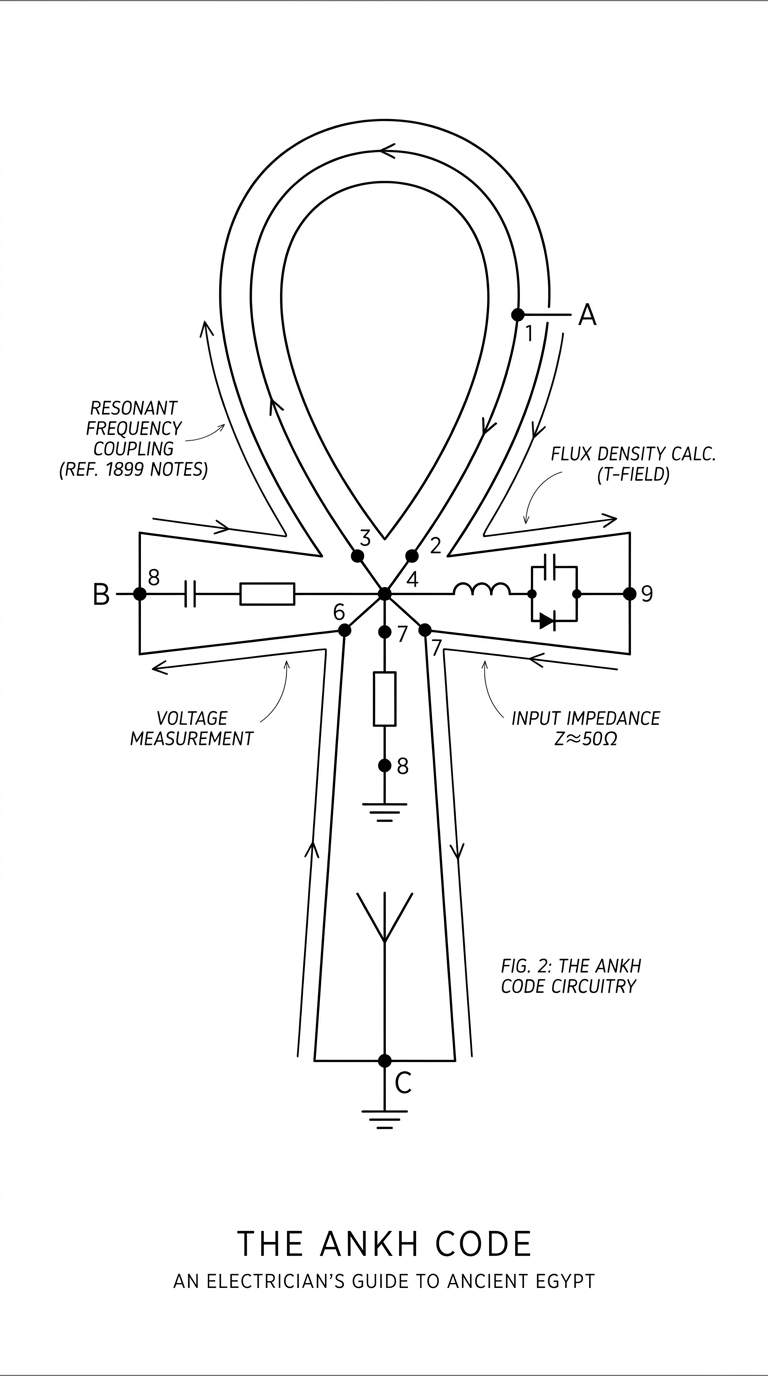
THE ANKH CODE: AN ELECTRICIAN'S GUIDE TO ANCIENT EGYPT
What if the most powerful symbol in human history is not a religious icon - but a circuit diagram?
An electrician from Poland sat down one night with a cup of cold coffee and a copy of Gardiner's Egyptian Grammar. He looked at the Ankh — the symbol that appears on the necks of pharaohs, at every temple entrance, on the walls of tombs for four thousand years and saw something no archaeologist had ever reported seeing.
He saw a schematic.
A closed inductive loop. A regulation bridge. An output line terminated at ground. Nine functional nodes arranged in a pattern that mirrors the Egyptian counting system — the same system that runs the doubling algorithm documented in the Rhind Papyrus, structurally isomorphic with the 4-bit binary iteration at the heart of digital signal processing.
This is not a conspiracy theory. This is an engineer reading a symbol no one thought to give to an engineer.
What You Will Find in This Book
- The King's Chamber of the Great Pyramid resonates at 114–170 Hz — a documented acoustic fact, confirmed by theoretical calculation. No one has yet measured what happens to the piezoelectric granite walls during acoustic excitation. This book asks why.
- Geomagnetically induced currents flow through the limestone plateau of Giza right now, at this very moment. They destroy power transformers during solar storms. The Great Pyramid sits earthed in that same substrate, oriented to true geographic north with a precision of 3 arc-minutes — the precision of a calibration clock, not a compass.
- In 2026, the NASA MMS mission published peer-reviewed evidence of a turbulent dynamo operating in the Earth's magnetosheath — a mechanism that converts the kinetic energy of the solar wind into magnetic field energy. Its topology is isomorphic with the Ankh.
- At dawn above the Nile, millions of scarabs generate broadband acoustic noise in the 80–160 Hz range. The King's Chamber is a selective bandpass resonator in precisely that range. This is not metaphor. It is acoustics.
What This Book Is and What It Is Not
This is a speculative engineering essay, not a history textbook. The author does not claim the ancient Egyptians built electrical infrastructure. He claims something more interesting: that the conceptual apparatus of circuit theory - flow, resistance, feedback, the closure of a loop — permits a fresh reading of the topology of the Ankh and the precision of the monuments at Giza. Every claim is marked: [FACT], [INTERPRETATION], or [HYPOTHESIS]. The mathematics is certain. The analogies are persuasive. The history is an open question.
The book closes with six specific, falsifiable measurements - experiments that could confirm or refute its central hypotheses within a single research season. Not a gospel. A research proposal.
For Readers Who
- Have always felt that Egyptology and engineering should have met long before now
- Are tired of choosing between mainstream archaeology and fringe speculation
- Want a book that is honest about what it knows, what it infers, and what it cannot prove
- Have ever looked at a circuit diagram and thought: this topology looks familiar