
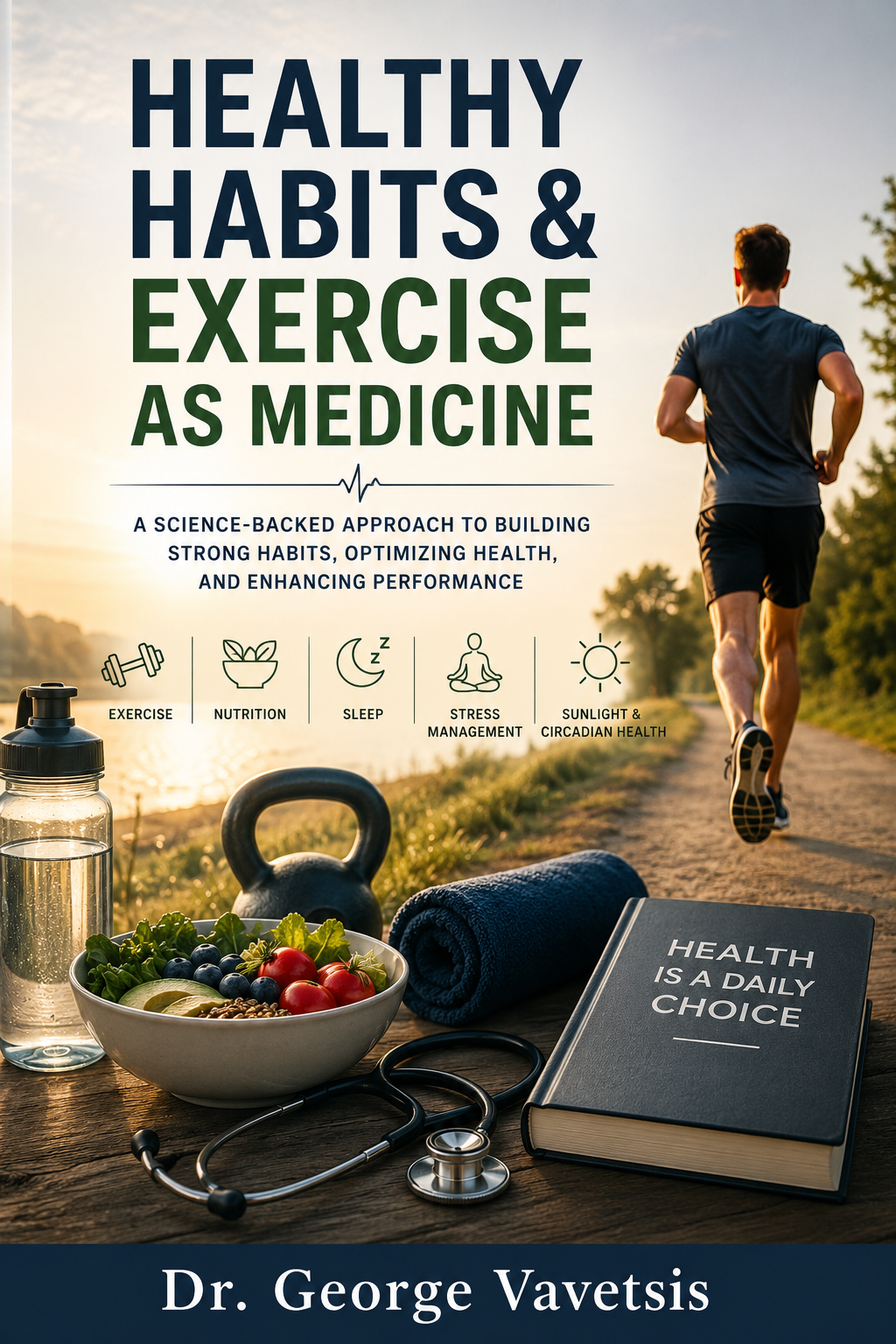
Healthy Habits & Exercise as Medicine
Pages: 2084
In a world increasingly dominated by technological acceleration, chronic psychological overload, physical inactivity, circadian disruption, nutritional inconsistency, and autonomic imbalance, the concept of health can no longer be reduced to the mere absence of disease. Modern physiology demands a far more integrated interpretation of human function—one that recognizes health as a continuously regulated interaction between biological rhythms, movement behavior, environmental exposure, metabolic flexibility, neuroendocrine synchronization, recovery quality, and behavioral consistency. This book, Healthy Habits & Exercise as Medicine, was developed to address precisely this multidimensional reality.
The central philosophy of this work is simple yet scientifically profound: daily habits are biological signals. Every waking time, every meal, every training session, every exposure to light, every breathing pattern, every recovery behavior, and every sleep decision acts as a physiological input capable of modifying hormonal output, autonomic regulation, inflammatory activity, mitochondrial efficiency, glycemic stability, and long-term disease risk. Human biology does not operate randomly; it responds predictably to repeated behavioral patterns. Thus, lifestyle itself becomes either a chronic therapeutic intervention or a chronic pathological stressor.
Exercise, within this framework, is not viewed merely as a tool for aesthetics or athletic performance. Exercise represents one of the most potent non-pharmacological interventions ever identified in modern medicine. Properly prescribed movement influences virtually every physiological system in the human organism. Skeletal muscle acts as an endocrine organ through the secretion of myokines; cardiovascular efficiency improves through vascular remodeling and autonomic adaptation; neuroplasticity increases through brain-derived neurotrophic factor (BDNF) signaling; insulin sensitivity improves via GLUT-4 translocation; mitochondrial density expands through aerobic and resistance adaptations; inflammatory biomarkers become attenuated; sleep architecture stabilizes; and psychological resilience improves through neurochemical modulation involving dopamine, serotonin, endocannabinoids, and catecholamines.
However, the effectiveness of exercise is highly dependent on context. The same training load may function as medicine under one physiological condition and as excessive stress under another. This distinction is one of the major themes explored throughout this book. Recovery status, sleep quality, circadian alignment, hydration status, fueling strategies, autonomic readiness, emotional stress, and environmental conditions fundamentally alter the body’s adaptive response to training. Therefore, the modern practitioner must move beyond simplistic “more exercise is better” models and instead adopt precision-based lifestyle architecture.
This book strongly emphasizes chronobiology and circadian physiology because timing itself has become a neglected determinant of health optimization. Human physiology evolved under predictable cycles of light and darkness, feeding and fasting, activity and rest. Modern society has severely disrupted these biological oscillations. Artificial light exposure at night, social jetlag, inconsistent sleep schedules, prolonged indoor confinement, and irregular meal timing contribute to neuroendocrine dysregulation and chronic sympathetic overactivation. These disturbances influence cortisol secretion patterns, melatonin suppression, glucose variability, autonomic dysfunction, appetite signaling, recovery capacity, and emotional regulation. Restoring circadian integrity therefore becomes foundational to any high-level health intervention.
Within these pages, readers will encounter practical systems for optimizing sleep-wake consistency, strategic light exposure, hydration behavior, glycemic regulation, meal chronobiology, autonomic monitoring, and exercise timing. The goal is not simply theoretical understanding but practical implementation. Scientific knowledge without behavioral translation has limited physiological value. Consequently, this book was intentionally designed with an applied orientation that bridges exercise science, performance physiology, preventive medicine, lifestyle medicine, behavioral neuroscience, and human recovery systems.
A major focus is also placed on autonomic nervous system regulation. Chronic sympathetic dominance has become one of the defining physiological signatures of contemporary society. Elevated stress exposure, information overload, emotional fatigue, inadequate sleep, and sedentary behavior create a biological environment characterized by heightened cortisol activity, reduced vagal tone, impaired heart-rate variability, increased inflammatory signaling, and diminished recovery capacity. The restoration of parasympathetic efficiency through structured recovery habits, breathing interventions, movement variability, sleep hygiene, and lifestyle organization becomes essential not only for performance enhancement but for long-term health preservation.
Another core principle explored throughout this work is metabolic flexibility—the body’s ability to efficiently transition between carbohydrate and fat utilization according to energetic demands. Modern lifestyles characterized by excessive caloric intake, low movement exposure, disrupted meal timing, and poor sleep quality progressively impair this adaptive capability. As metabolic inflexibility develops, individuals experience worsening glycemic variability, reduced mitochondrial efficiency, increased fatigue, elevated inflammatory burden, and greater susceptibility to chronic disease. Strategic exercise prescription, nutritional timing, circadian feeding windows, and movement integration provide powerful tools for restoring metabolic adaptability.
Importantly, this book does not promote perfectionism. Health optimization is not dependent upon flawless execution but rather on consistent biological alignment over time. Small daily behaviors accumulate into large physiological outcomes. Ten additional minutes of morning sunlight exposure, improved hydration upon waking, reduced evening blue-light exposure, a more stable sleep schedule, or consistent movement throughout the week may appear insignificant in isolation, yet collectively these interventions profoundly influence long-term biological resilience.
The intended audience of this book is broad yet scientifically oriented. Strength and conditioning coaches, exercise physiologists, physiotherapists, physicians, health coaches, sport scientists, nutrition professionals, psychologists, rehabilitation specialists, and high-performance practitioners will all find practical value within these chapters. Simultaneously, motivated individuals seeking evidence-based strategies to optimize health, recovery, energy, and longevity can apply these principles immediately within daily life.
Health is not a static condition. It is a continuously regulated adaptive process shaped by behavior, environment, physiology, and recovery. The future of preventive medicine and performance science will increasingly depend upon integrated lifestyle systems rather than isolated interventions. Exercise alone is insufficient without recovery. Nutrition alone is insufficient without circadian regulation. Sleep alone is insufficient without movement. True optimization emerges when these systems operate synergistically.
Ultimately, this book is an invitation to reconsider the human organism not as a collection of isolated systems but as an interconnected adaptive network governed by rhythms, stressors, behaviors, and recovery processes. Through intelligent habit formation and strategic exercise implementation, physiology can be guided toward resilience, performance, healthspan, and biological efficiency.
The body is constantly listening to behavior. Every habit becomes a message to physiology. The quality of those messages determines the quality of adaptation, recovery, and life itself.