

Iron Deficiency in Menstruating & Perimenopausal Women - The Doctor One-Pager
Iron Deficiency in Menstruating & Perimenopausal Women — The Doctor One-Pager
One page. That's the point. The updated 2026 ferritin thresholds, the symptom overlap with AuDHD, why perimenopause is the dangerous decade, and the exact workup to hand your doctor — with references printed on the page so they don't have to take your word for it. Print it, bring it, hand it over.
A clinician-facing A4 sheet that compresses the whole iron story into something a doctor can read in ninety seconds: why standard ferritin cutoffs fail menstruating and perimenopausal women, what the symptom overlap with ADHD/autistic burnout looks like, why perimenopause is the decade where deficiency peaks while periods make confirmation hardest, and the exact workup and treatment evidence — from alternate-day dosing to IV formulations — with every key reference cited at the bottom of the page.
Designed to be printed and carried into the appointment. If your doctor has ever said "your iron is fine" while you could barely function, this page is your counter-argument — written in their language, with their literature.
What's inside:
- 1 A4 page — deliberate: nothing to skip, nothing to lose
- The symptom map across body, brain, and neurodivergent overlap
- The updated thresholds: ferritin ≤30 µg/L indicates deficiency at any saturation; ≤50 µg/L with low saturation (<20%) — with a note that true iron deficiency begins below ~70–100 µg/L
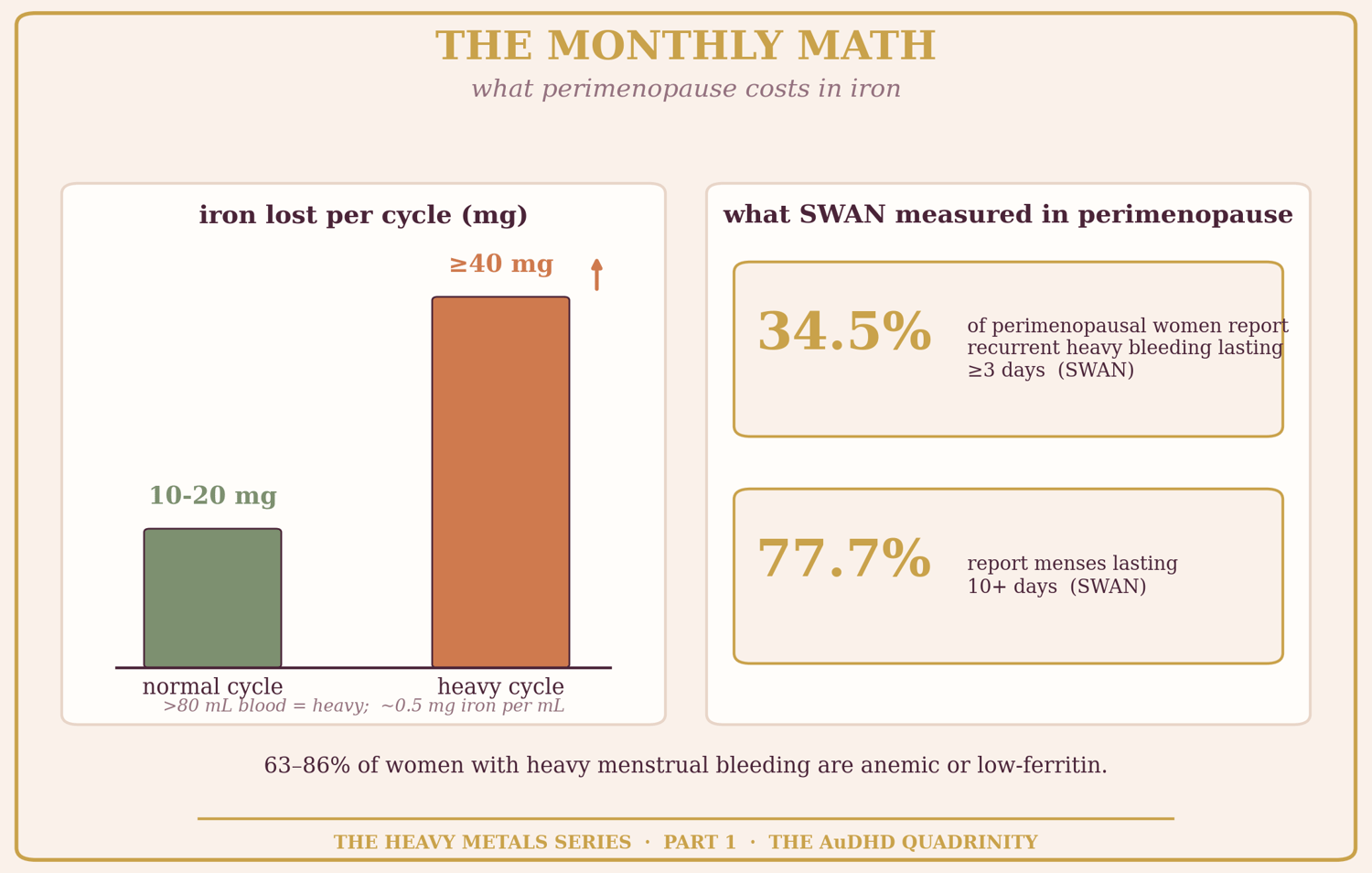
- The perimenopause paragraph: why the transition is the high-risk window (25–30% meet criteria, 3 in 4 say care failed them)
- Workup & treatment: the panel to order, ferritin + TSAT targets (100–200 µg/L / 20–40%), alternate-day dosing, when to escalate to IV
- Key references printed on the page: ASH 2026, Schrier/Auerbach, Stoffel, Krayenbuehl, Wolf, ACOG
Who it's for: anyone who needs their doctor to take iron seriously in one visit — and clinicians who'd rather be handed the evidence than look it up.
Format: PDF, 1 A4 page, print-optimized. Educational resource — not medical advice. Discuss with your clinician.