

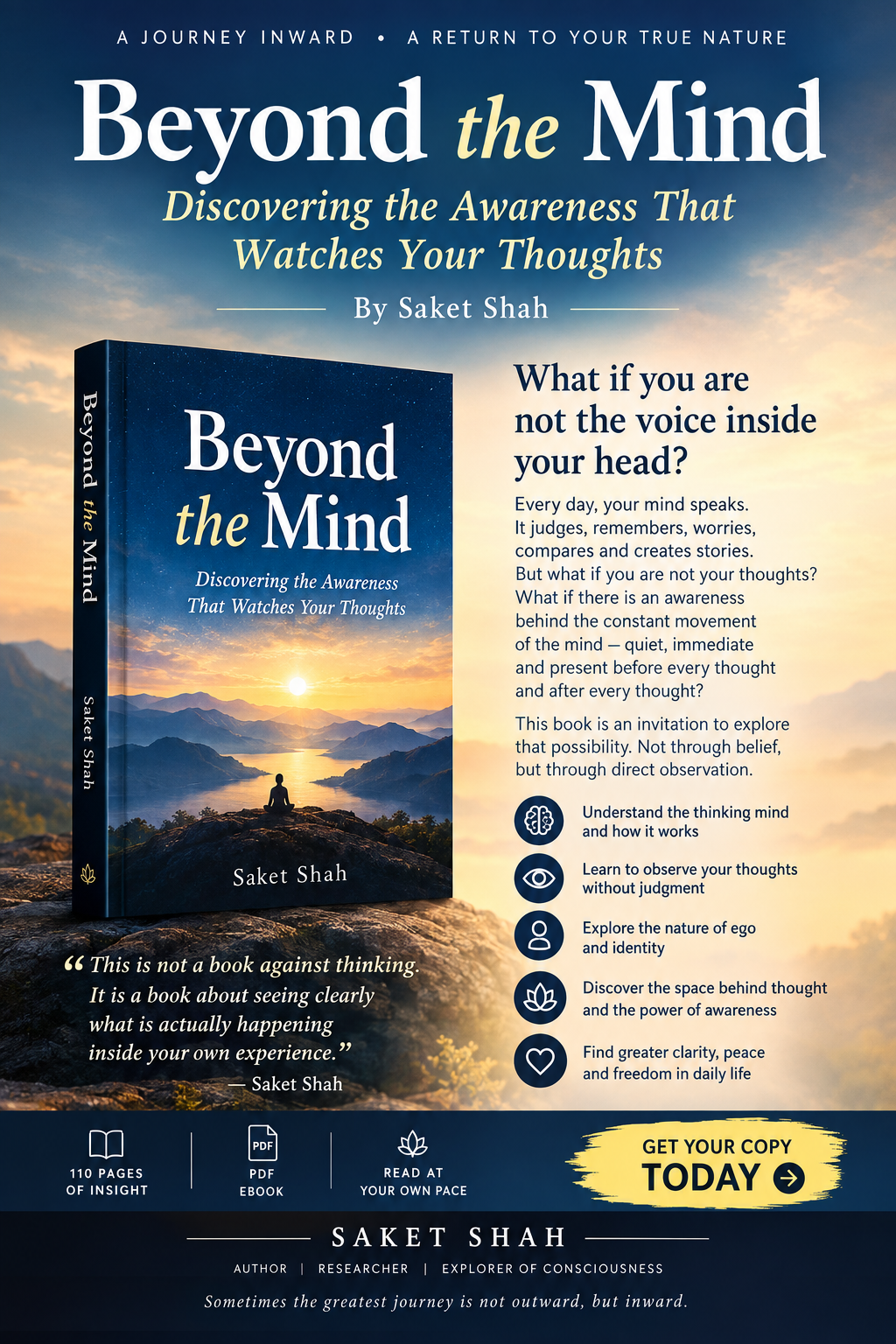
Beyond the Mind Discovering the Awareness That Watches Your Thoughts
BEYOND THE MIND
Discovering the Awareness That Watches Your Thoughts
By Saket Shah
What if you are not the voice inside your head?
Every day, your mind speaks.
It comments.
It judges.
It remembers.
It predicts.
It worries.
It compares.
It rehearses conversations that have already happened and prepares for conversations that may never happen.
And somehow, without ever consciously agreeing to it, you may have come to believe:
“This is me.”
But what if it isn't?
What if thoughts are something you experience rather than something you are?
What if there is an awareness behind the constant movement of the mind—quiet, immediate, and present before every thought and after every thought?
Beyond the Mind is an invitation to investigate that possibility directly.
Not through blind belief.
Not through complicated philosophy.
Not through escaping ordinary life.
But through observation.
Through questioning.
Through learning to notice what is actually happening inside your own experience.
THE MIND IS POWERFUL — BUT IS IT WHO YOU ARE?
The book begins with a deceptively simple observation:
Thoughts appear.
You do not consciously choose every thought that enters your mind.
A memory appears.
A worry appears.
A judgment appears.
A plan appears.
An image appears.
A feeling appears.
And yet, we frequently treat these appearances as commands, facts, identities, and absolute truths.
The opening chapters challenge this automatic identification and invite you to watch the mind rather than simply live inside its stream.
This creates a completely different question:
Who—or what—is aware of the thought?
That question becomes the doorway into the entire book.
A BOOK ABOUT THE SPACE BEHIND THOUGHT
Beyond the Mind explores the possibility that thought is not the deepest level of human experience.
The mind produces content.
But something is aware of that content.
The book calls attention to this distinction repeatedly:
thought is the content; awareness is what knows the content.
Rather than asking you to accept this as doctrine, the book repeatedly turns the reader back toward direct observation.
Pause.
Notice the next thought.
Watch it arise.
Watch it change.
Watch it disappear.
Then ask:
What was aware of it?
The exploration of this “space behind thought” becomes one of the central movements of the book.
WHAT YOU WILL EXPLORE
01 — The Machine That Never Sleeps
Discover how the continuous stream of thought operates and why simply observing it can reveal a surprising distance between the thinker and the thought.
The book argues that freedom does not necessarily require stopping thought. Instead, it begins with changing your relationship to thought.
02 — Thought Is Not Truth
A thought can feel completely convincing without being an objective fact.
You will explore the difference between:
a thought arising
and
believing the thought.
The book presents questioning as a way to create space around emotionally powerful mental interpretations.
03 — The Architecture of Ego
What exactly is the “self” you defend?
The book examines identity as a continuously constructed narrative built from memory, preference, comparison, roles, and expectations.
The goal is not to destroy identity, but to recognize it as a construction rather than the entirety of who you are.
04 — The Space Behind Thought
This is where the inquiry becomes especially direct.
Instead of thinking about awareness, you are invited to investigate awareness itself.
What is aware of this thought?
The book explores awareness as the space in which thoughts, feelings, and sensations appear.
05 — When Thinking Becomes Compulsive
Not all thinking is useful thinking.
The book distinguishes deliberate problem-solving from repetitive mental activity that simply creates more anxiety, agitation, and mental noise.
You will encounter practical ways of recognizing when thinking has stopped serving a genuine present purpose.
06 — The Story of Me
Human beings naturally construct narratives about themselves.
But when the narrative becomes confused with reality, circumstances can become filtered through an increasingly rigid story.
The book examines how separating bare facts from the story constructed around those facts can create greater clarity.
07 — Silence Between Thoughts
Thought may feel continuous.
But careful observation reveals something else:
there are spaces between thoughts.
The book explores these brief intervals of silence as a direct opportunity to notice awareness without becoming absorbed in mental commentary.
08 — The Observer Effect
What happens when you observe anxiety instead of becoming anxiety?
What happens when you notice an emotion instead of immediately reacting to it?
The book explores how conscious observation can create psychological space between awareness and the experience being observed.
09 — Beyond Judgment
The mind evaluates almost everything.
Good.
Bad.
Right.
Wrong.
Success.
Failure.
The book explores what happens when automatic evaluation is temporarily set aside and experience is encountered more directly.
10 — The Illusion of Control
How much control do you actually have?
The book investigates the difference between genuine effort and the expectation that effort must guarantee a particular outcome.
This distinction becomes a foundation for a more peaceful relationship with uncertainty.
THIS IS NOT A BOOK ABOUT DESTROYING THE MIND
That distinction matters.
The book does not argue that thinking is the enemy.
Thought is extraordinarily valuable.
It builds.
It solves.
It communicates.
It creates.
It plans.
It remembers.
The problem begins when the mind's activity is mistaken for the entirety of one's identity.
The opening of the book explicitly frames the exploration this way: the mind is not the enemy; rather, an unconscious relationship with its constant chatter can become a source of unnecessary suffering.
READ THIS BOOK AS AN EXPERIMENT
Do not rush through it.
The author specifically invites the reader to treat the chapters as experiments in direct noticing, rather than simply accepting or rejecting ideas intellectually.
You may therefore find yourself repeatedly stopping while reading.
Watching.
Listening.
Noticing.
Questioning.
And returning to immediate experience.
This is not merely a book to finish.
It is a book to investigate.
WHO IS THIS BOOK FOR?
Beyond the Mind may especially appeal to readers interested in:
- awareness and consciousness
- meditation and contemplative inquiry
- observing thoughts
- self-inquiry
- mindfulness
- the nature of ego
- emotional awareness
- compulsive thinking
- psychological patterns
- presence and direct experience
- philosophical questions about identity
- the relationship between thought and awareness
- living with greater mental clarity
It is written for the reader who has ever stopped and wondered:
“Why does my mind keep doing this?”
“Do I have to believe every thought I think?”
“Who am I when I am not lost in thought?”
“What is aware of my experience?”
THE CENTRAL INVITATION
You do not have to stop thinking.
You do not have to become someone else.
You do not have to escape ordinary life.
The invitation is simpler:
Notice.
Notice the thought.
Notice the reaction.
Notice the story.
Notice the judgment.
Notice the emotion.
Notice the awareness in which all of these appear.
And gradually investigate the possibility that the observer is not the same thing as the experience being observed.
A DIFFERENT KIND OF FREEDOM
The book's approach is not based upon forcing the mind into silence.
Instead, it explores a freedom that can exist even while thoughts continue.
The machine may continue running.
Thoughts may continue appearing.
Emotions may continue moving through experience.
But identification can change.
And when identification changes, the relationship with the mind can change with it.
WHAT MAKES THIS BOOK DIFFERENT?
It asks you to investigate rather than merely believe.
The ideas repeatedly return to direct observation.
It does not declare war on thought.
Thinking remains a valuable human capacity.
It separates thought from truth.
A thought can be powerful without being factual.
It examines the constructed self.
Identity is explored as an ongoing mental architecture.
It points toward awareness itself.
Rather than endlessly analyzing mental content, the reader is invited to notice what is aware of that content.
It is practical without reducing the inquiry to formulas.
The book repeatedly gives simple experiments that can be performed in ordinary life.
YOUR FIRST EXPERIMENT
Before you purchase the complete book, try the experiment introduced near the beginning.
For approximately thirty seconds:
Do nothing to your thoughts.
Do not stop them.
Do not judge them.
Do not improve them.
Simply watch.
Notice what appears.
Notice how quickly thoughts change.
Notice how many are uninvited.
Then ask yourself:
If I can observe my thoughts, am I identical to every thought that appears?
That question is where the journey begins.
THE BOOK'S JOURNEY
THOUGHT → OBSERVATION → DISTANCE → INQUIRY → AWARENESS
From the restless activity of the thinking mind, the book gradually moves toward a quieter question:
What remains when you stop confusing the contents of consciousness with consciousness itself?
GET THE COMPLETE BOOK
If you are ready to investigate your relationship with thought rather than simply continue living inside its constant commentary, Beyond the Mind offers a sustained journey into that inquiry.
Beyond the Mind
Discovering the Awareness That Watches Your Thoughts
By Saket Shah
Read it slowly.
Pause often.
Observe directly.
And discover what may have been present beneath the noise of thought all along.
SEO KEYWORDS FOR PAYHIP
- Beyond the Mind
- awareness and consciousness
- observing thoughts
- self awareness book
- mindfulness ebook
- consciousness book
- meditation and awareness
- ego and awareness
- self inquiry
- spiritual awakening book
- discovering awareness behind thoughts
- how to observe your thoughts
- understanding the thinking mind
- thought is not truth
- awareness beyond the mind
- overcoming compulsive thinking
- understanding ego and identity
- silence between thoughts
- observer awareness
- philosophy of consciousness
- direct awareness practice
- mindfulness and self inquiry
Awareness · Consciousness · Mindfulness · Meditation · Self Inquiry · Spirituality · Ego · Thoughts · Personal Growth · Philosophy