
Syllabus for TVET: Artificial Intelligence in CNC Machining
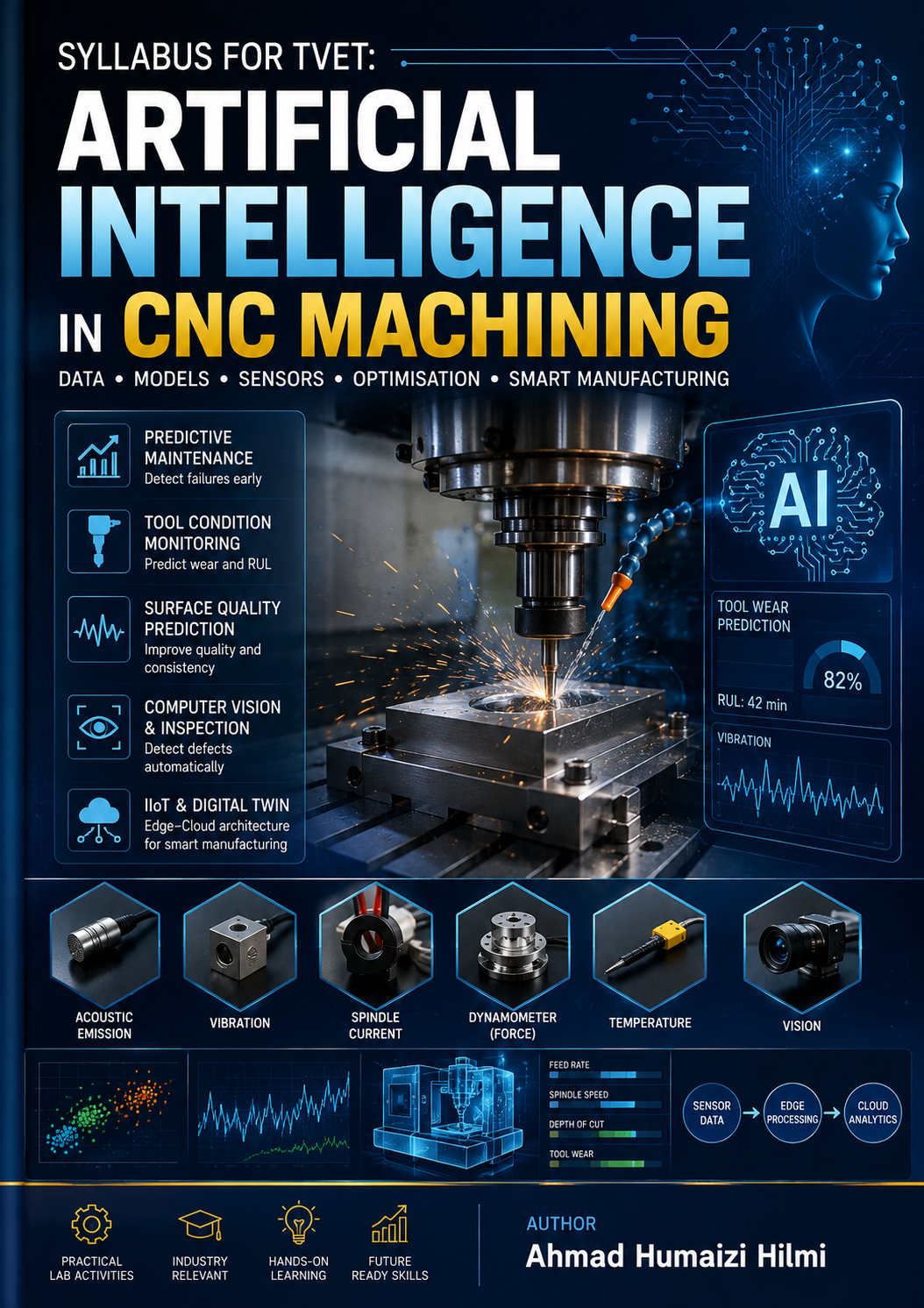
This review synthesises recent work applying artificial intelligence to CNC machining, describing methods, data practices and system architectures that support predictive maintenance, tool-condition monitoring, surface-quality prediction and process optimisation. It surveys supervised, unsupervised and reinforcement approaches and contrasts classical ensembles and kernel methods with deep CNNs, sequence learners and Transformer-based models. The review emphasises the variety of sensor modalities used—acoustic emission, vibration, spindle current, dynamometer, temperature and vision—and shows that multi-sensor fusion and signal-to-image encodings often improve detection and regression accuracy. It summarises IIoT and digital-twin architectures that distribute preprocessing and inference across edge and cloud tiers, and highlights hybrid physics-informed twins and state-estimation cores as practical strategies to reduce data demands and improve interpretability. Recurring practical constraints are identified: limited labelled data, class imbalance, synchronization and sampling-rate mismatches, latency and model explainability, and a measurable accuracy gap between offline experiments and real-time deployments. The review concludes that standardised benchmark datasets, reproducible cross-condition evaluation, uncertainty-aware models and lightweight edge deployment remain priority areas to move AI solutions from lab demonstrations toward industrial acceptance.