
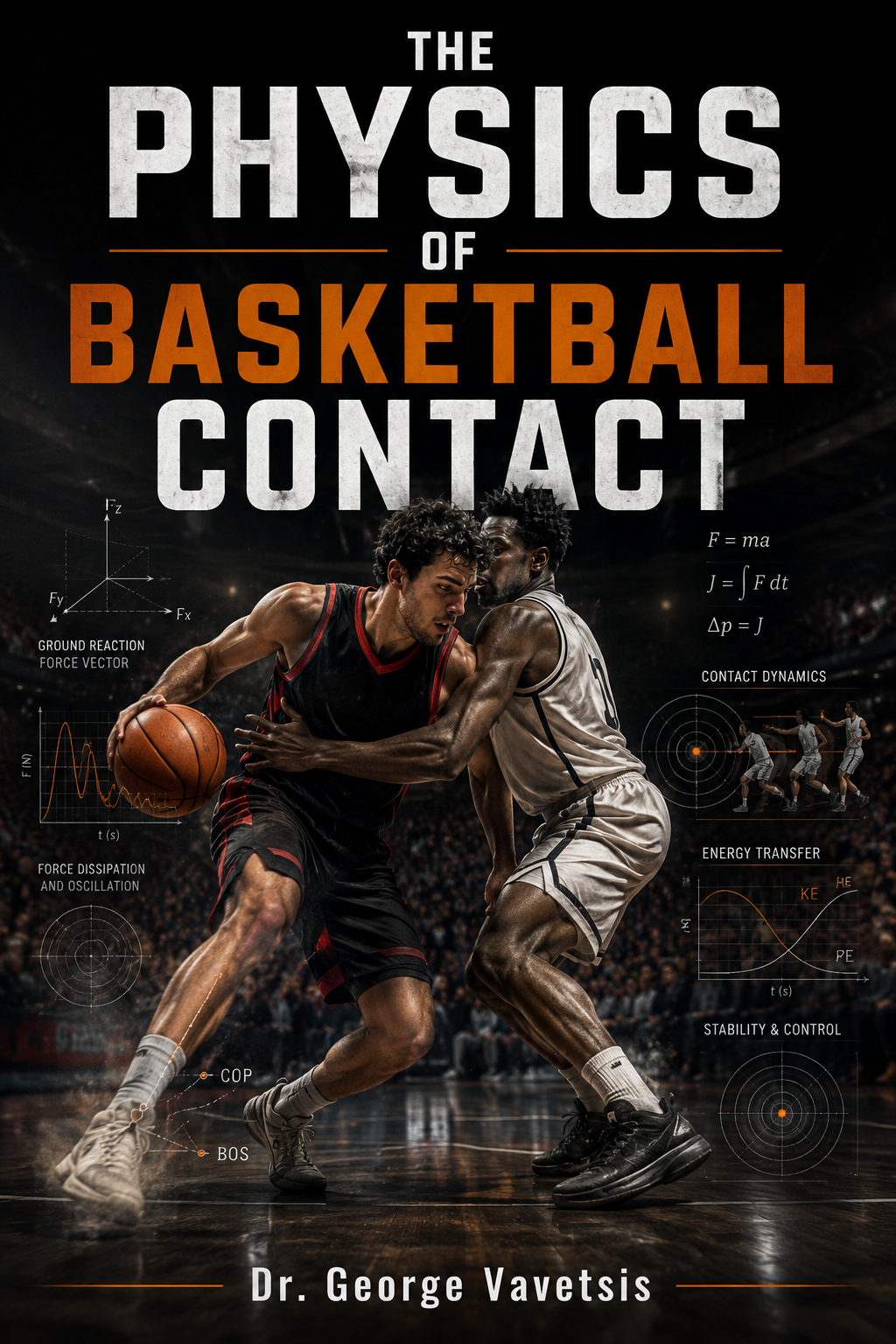
The Physics of Basketball Contact
Pages: 2829
Basketball has traditionally been interpreted through the lenses of skill execution, tactical intelligence, physiological conditioning, and biomechanical efficiency. Yet beneath every screen, cut, drive, rebound, closeout, collision, deceleration, and contested landing lies a far more intricate reality: a constantly evolving network of nonlinear mechanical interactions governed by force transmission, oscillatory stability, impact dissipation, neuromuscular synchronization, and multidirectional collision dynamics. This book, The Physics of Basketball Contact, was written to explore that reality in its deepest scientific form.
Basketball is not simply a game of movement; it is a game of controlled and uncontrolled interactions between bodies operating under extreme temporal and spatial constraints. Every physical engagement on the court represents a highly complex biomechanical event involving force-vector coupling, momentum transfer, elastic and viscoelastic tissue behavior, center-of-mass destabilization, joint torque redistribution, and reactive neuromuscular adaptation. While traditional performance models often isolate movements into linear categories such as sprinting, jumping, or change of direction, real basketball environments rarely function in isolated linearity. Instead, athletes operate within chaotic collision ecosystems where braking, acceleration, perturbation, stabilization, and contact coexist simultaneously.
The purpose of this work is to bridge the gap between applied basketball performance and advanced contact-system physics. This book attempts to integrate biomechanics, motor control, nonlinear dynamics, collision mechanics, force-plate analysis, neuromechanics, oscillatory loading theory, and elite sport performance into a unified framework specifically designed for basketball environments. The goal is not merely to understand contact, but to decode its structure, quantify its variables, and ultimately improve the athlete’s ability to survive, control, manipulate, and exploit physical interaction during competition.
At elite levels of basketball, milliseconds determine separation, stability determines availability, and force-management capacity determines longevity. Players capable of rapidly reorganizing their base of support under perturbation possess a competitive advantage. Athletes who can absorb eccentric loading while preserving directional intent become more resilient under contact. Teams that systematically develop collision tolerance and braking efficiency reduce injury risk while simultaneously enhancing tactical execution under pressure. Consequently, understanding the physics of basketball contact is no longer optional for modern practitioners—it is foundational.
This text was developed with the perspective that collision events in basketball should not be viewed merely as accidental outcomes of play. They are measurable, trainable, and strategically exploitable phenomena. Contact interactions alter movement trajectories, disrupt neuromuscular timing, modify kinetic-chain sequencing, and reshape force-production strategies. Every hip check, shoulder bump, split-stance deceleration, trunk rotation, and lateral perturbation creates a cascade of biomechanical consequences extending throughout the entire kinetic system. These consequences influence not only immediate performance outcomes but also chronic tissue loading patterns and long-term adaptation profiles.
A central theme throughout this book is the concept of nonlinear behavior. Human movement under contact conditions does not follow perfectly predictable mechanical laws. Small alterations in foot placement, trunk orientation, collision timing, or stiffness modulation can generate disproportionately large changes in movement outcome. Basketball athletes constantly transition between stable and unstable states while interacting with dynamic external forces. Therefore, classical linear models alone are insufficient for explaining real-game contact phenomena. Instead, the athlete must be interpreted as an adaptive nonlinear system interacting with another adaptive nonlinear system under continuously changing environmental constraints.
The chapters that follow investigate these interactions from multiple scientific perspectives. Topics include oscillatory ground reaction force signatures, mediolateral braking mechanics, perturbation-response dynamics, eccentric rate-of-force development during contact deceleration, spatiotemporal force coupling, contact-duration manipulation, inter-limb synchronization, collision stabilization strategies, and force-plate quantification of impact behavior. Each concept is examined through both theoretical and applied lenses to ensure practical relevance for performance coaches, sport scientists, biomechanists, rehabilitation specialists, and elite basketball practitioners.
Importantly, this work also emphasizes the integration between laboratory science and on-court application. The value of biomechanical analysis is realized only when it improves athlete preparation, injury resilience, and competitive performance. Therefore, every scientific construct presented in this book is intended to support applied decision-making within strength and conditioning, return-to-play frameworks, movement diagnostics, microcycle design, and contact-exposure planning. The practical drills, collision-based exercise models, perturbation systems, and stabilization methods discussed throughout the text are designed to transform theoretical mechanics into trainable physical capacities.
Another major objective of this book is to encourage a shift in coaching philosophy. Historically, many basketball systems have prioritized skill and tactical development while underestimating the significance of contact preparation. Yet modern basketball increasingly rewards athletes who can maintain mechanical efficiency under high-speed physical disruption. The capacity to decelerate under perturbation, preserve trunk stability during collision, rapidly reestablish postural equilibrium, and transfer force efficiently across unstable kinetic conditions has become a defining characteristic of elite performance. Contact competency must therefore be viewed as an independent athletic quality deserving systematic assessment and targeted development.
This book is also an invitation for interdisciplinary collaboration. The future of basketball performance science depends on the integration of biomechanics, neuroscience, physiology, data analytics, motor learning, and computational modeling. The complexity of basketball contact cannot be fully understood through isolated disciplinary approaches. By combining multiple scientific perspectives, we move closer toward building comprehensive models capable of explaining the emergent behaviors observed during elite competition.
Finally, this text was written with profound respect for the athlete. Behind every collision, every landing, every rapid deceleration, and every unstable recovery lies a remarkable demonstration of human adaptability. Basketball athletes continuously solve mechanical problems at extraordinary speeds while exposed to immense physical and cognitive stress. Their ability to coordinate stability, force, anticipation, and decision-making within chaotic environments represents one of the most advanced expressions of athletic intelligence in sport.
It is my hope that this book contributes meaningfully to the evolution of basketball science and inspires coaches, scientists, therapists, and athletes to examine the game through a deeper biomechanical and physical lens. The future of performance enhancement will belong not only to those who understand movement, but to those who understand interaction, instability, and collision itself.