


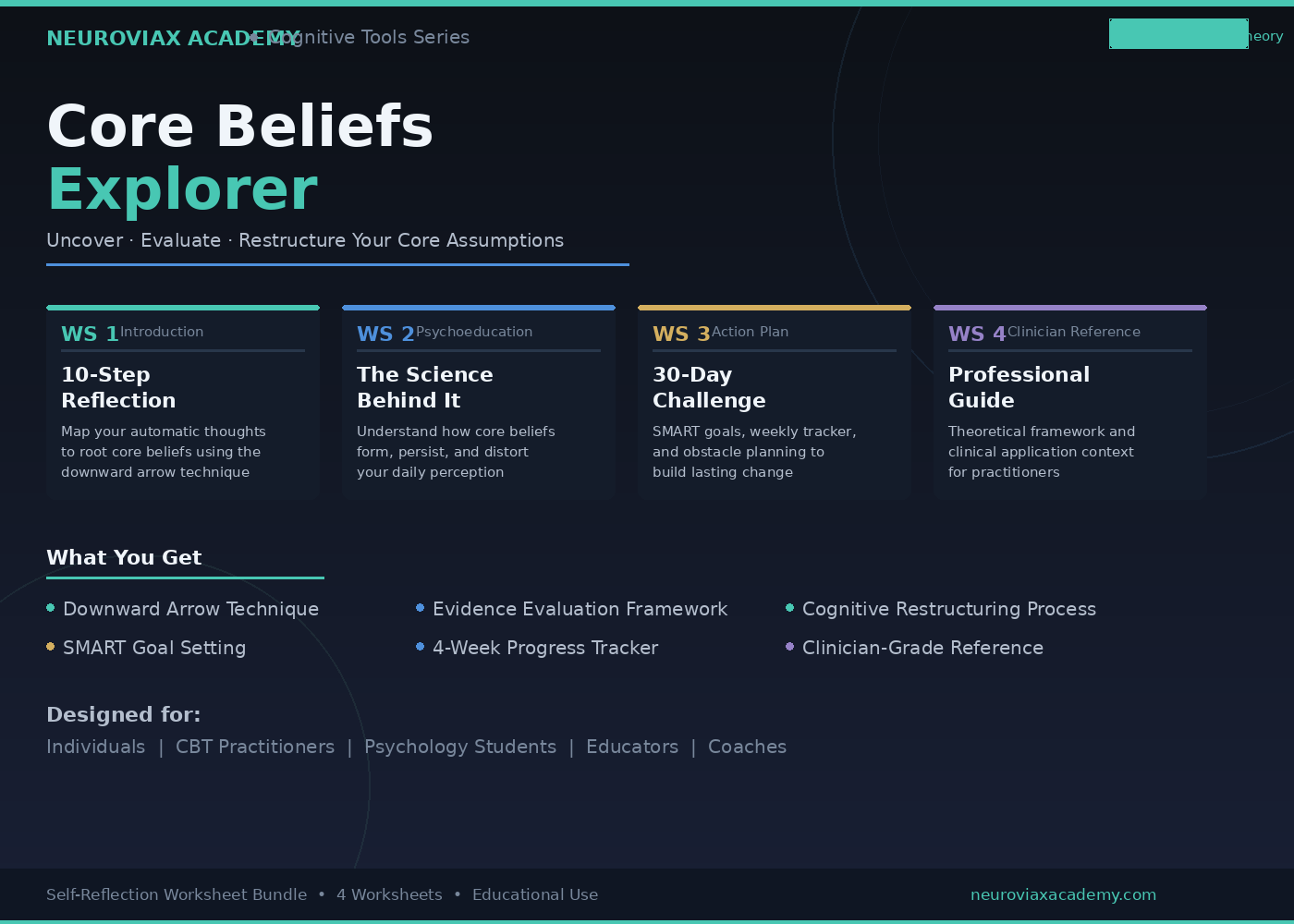
Core Beliefs Explorer — 4-Worksheet CBT Bundle (Self-Reflection, Psychoeducation, Action Plan, Clinician Guide)
Uncover the Beliefs That Are Quietly Running Your Life
Most of the emotional patterns, self-doubts, and behavioral loops you experience every day are not random. They are driven by deeply held core beliefs — rigid, often unconscious assumptions about yourself, others, and the world that formed long before you had the language to question them. This 4-worksheet bundle gives you a structured, psychology-backed system to find those beliefs, understand them, challenge them with evidence, and begin replacing them with something more accurate and more freeing.
The Core Beliefs Explorer is grounded in Cognitive Behavioral Therapy (CBT) and Cognitive Schema Theory. It applies the clinical "downward arrow" technique — the same method therapists use — to help you trace your automatic thoughts all the way back to their root assumptions. This is not a journaling prompt collection. It is a step-by-step cognitive mapping process that moves from awareness to analysis to action.
What Is Inside the Bundle
Worksheet 1 — Introduction and Core Reflection (10-Step Process): This is the heart of the bundle. You work through ten sequential prompts that guide you from recognizing recurring thought patterns and emotional triggers, through identifying your intermediate conditional rules and early developmental context, to naming your suspected core belief, evaluating supporting and contradicting evidence, and finally formulating a balanced alternative perspective. Each step builds on the last, producing a complete cognitive profile by the end.
Worksheet 2 — Psychoeducation: Before you can change a belief, you need to understand how it works. This worksheet explains the psychology of core beliefs, how they form in childhood, how they distort perception through cognitive bias, and why they persist even when they are inaccurate. It includes a practical breakdown of how core beliefs show up in everyday situations — receiving feedback, starting projects, handling setbacks — and what helps in each case. A myth-versus-fact section addresses the most common misconceptions about cognitive change.
Worksheet 3 — Action Plan and 30-Day Tracker: Insight without structure fades. This worksheet helps you translate everything you discovered in the first two sheets into a real-world practice plan. You define your starting point, set three SMART goals to challenge and reframe your core belief, follow a day-by-day weekly implementation guide, identify potential obstacles and their solutions, and track your progress across a full four-week period. A 30-day review section closes the cycle.
Worksheet 4 — Clinician Reference Guide: This document provides the theoretical and clinical foundation of the tool, including its grounding in Beck's cognitive model, the role of schemas and automatic thoughts, guidance on interpreting completed worksheets, and differential considerations for practitioners. It is designed for therapists, counselors, educators, and psychology students who want professional context alongside the self-reflection materials.
Who This Bundle Is For
This bundle is designed for individuals who are engaged in serious self-reflection and want a structured, evidence-based process rather than surface-level positivity exercises. It is also well suited for psychology students and educators using CBT concepts in academic settings, and for therapists and counselors looking for a structured handout that clients can complete between sessions or as a starting point for schema-focused work. It is appropriate for anyone who has noticed persistent patterns in how they think about themselves and wants to understand where those patterns come from.
This is an educational self-reflection tool. It is not a clinical assessment, does not produce diagnostic scores, and is not a substitute for professional mental health support.
What You Will Walk Away With
After completing this bundle, you will have identified your most active core belief, mapped the evidence your mind uses to maintain it, constructed a realistic alternative perspective, and built a 30-day practice plan to begin integrating that perspective into daily life. Most people have never done this work systematically. This bundle makes the process possible without a therapist in the room.
If you have been trying to understand why certain situations trigger you, why self-criticism follows you even when things go well, or why the same fears keep surfacing in different areas of your life — this is the structured tool you have been looking for. Download the bundle and begin the process today.