

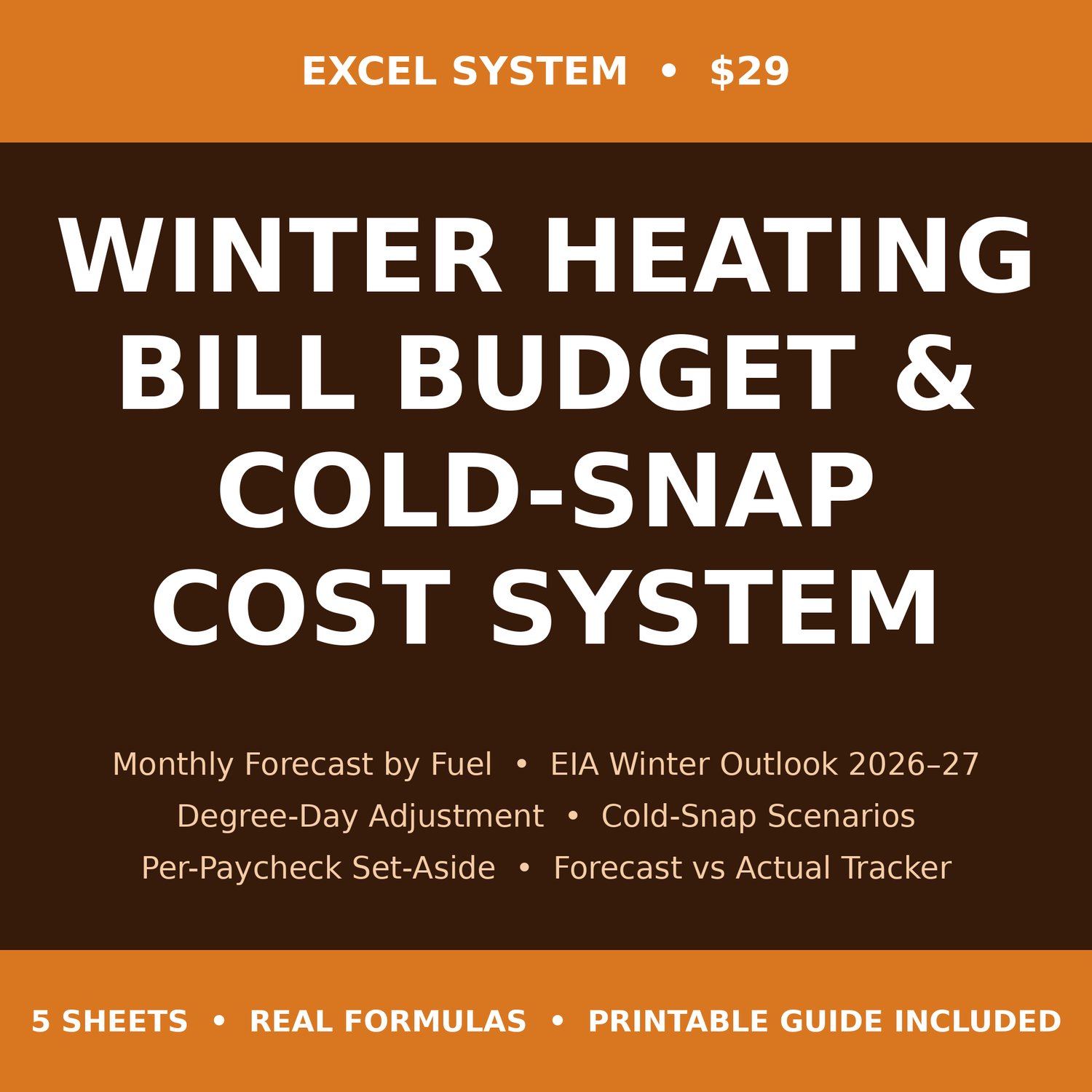
Winter Heating Bill Budget & Cold-Snap Cost System 2026-27 — Monthly Forecast by Fuel, Degree-Day Adjustment & Set-Aside Planner Excel + Guide
The U.S. Energy Information Administration (EIA) published its Winter Fuels Outlook 2026-27 on October 6, 2026, and this winter splits by fuel: natural gas homes average $640 from November to March (down 9%), electricity homes $1,196 (up 4%), propane homes $1,246 (down 3%), and heating oil homes $2,115 (up 21%, with the oil price up 34%). A national average does not pay your bill. This system turns the EIA forecast into YOUR forecast: your fuel, your price, your month-by-month budget, and the per-paycheck amount that funds it.
WHAT YOU GET
- winter-heating-cost-system.xlsx — a working Excel workbook with real formulas. No macros. Works in Microsoft Excel and Google Sheets.
- winter-heating-cost-system-guide.pdf — a printable guide: the EIA split by fuel, heating degree days in plain language, sheet-by-sheet help, delivery-fuel notes for propane and oil homes, and what to do if the forecast is more than you can fund.
THE FIVE SHEETS
1. Start Here — pick your fuel and set a cold-snap extra. The sheet returns your season forecast, peak month, average month, and the set-aside per month, per biweekly paycheck, and per week. A check line re-prices your own last-winter bill by the EIA change for your fuel, so you can see whether your home runs above or below the national pattern.
2. EIA Prices 2026-27 — the full October 6, 2026 EIA table: season price, price change, season use, and published spend for natural gas, electricity, propane, and heating oil, plus cost per million Btu on one scale and regional season spend (Northeast, Midwest, South, West).
3. Monthly Forecast — the engine. For every fuel, monthly use x monthly price x a degree-day factor, November through March. Set the factor to 1.10 and the season reprices as EIA's 10%-colder side case; overwrite any yellow price with your supplier's price and the forecast becomes yours.
4. Cold-Snap Budget — five priced cases for all four fuels: base winter, 10% warmer, 10% colder, a January-only cold snap at +25% degree days, and the combined cold case. Below it, a set-aside planner funds your fuel's cold-snap total: target minus saved, per paycheck.
5. Bill Tracker — your fuel's forecast by month, pulled automatically, next to the actual bill you enter. Variance in dollars and percent, with a clear rule for when to raise the degree-day factor and re-fund.
SAMPLE PRE-LOADED: the EIA U.S. average natural gas home. Season forecast $645.63 (EIA publishes $640; the workbook runs about $6 high because EIA rounds gas use to whole Mcf), peak month January at $139.81, set-aside $58.69 per biweekly paycheck, cold-snap total at +10% of $710.19. All four fuels at the base factor: electricity $1,196.09, propane $1,245.07, heating oil $2,116.28 — each within a dollar or two of the EIA published spend. Cold-Snap Budget range for an oil home: $1,904.65 in the warm case to $2,468.22 in the combined cold case. Bill Tracker sample: November actual $118.40 against a $115.52 forecast. Change any yellow cell and every number updates.
FORECAST, NOT AUDIT: this system predicts bills from the federal outlook. It does not inspect your home, log appliances, or rank insulation and thermostat fixes by payback. If you want to cut the bill itself, that is an audit's job. If you want to know what the bill will be and fund it calmly, that is this workbook's job.
HONEST LIMITS: EIA calls its figures a broad guide for comparing winters, and updates the outlook monthly — the November 2026 update already moved heating oil to about $2,179. Your home's size, insulation, equipment, and local weather decide your actual bill. Refresh the yellow cells when EIA posts an update or when your supplier changes price. General information only; not financial advice.
Instant download (.xlsx + .pdf). Digital product — no physical item ships. Personal use.