
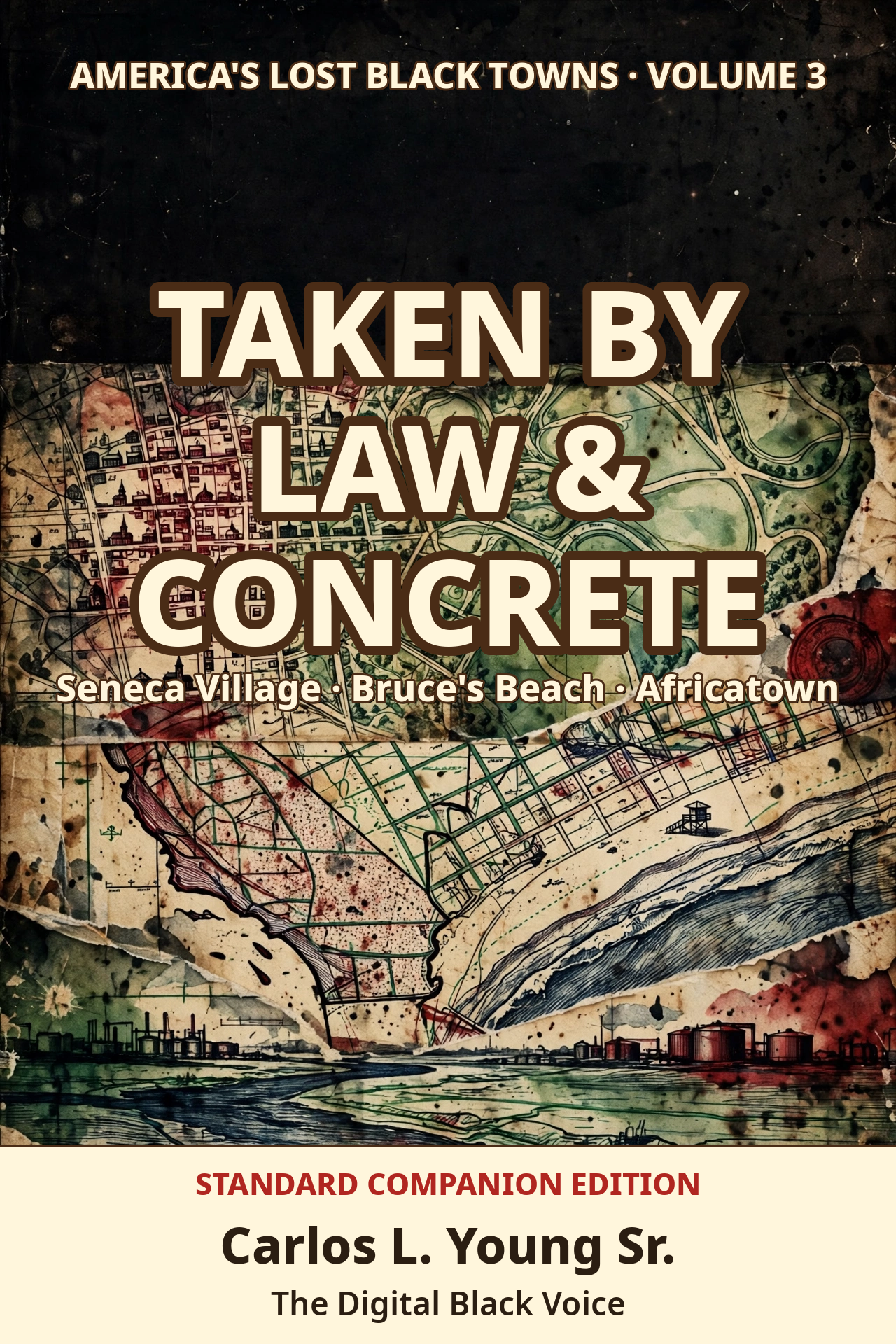
America's Lost Black Towns Vol. 3 — Taken by Law & Concrete (Standard Companion Edition — Interactive Edition)
Not every lost town was burned. Some were taken by paperwork. Seneca Village was a stable, property-owning Black community in Manhattan — about half its Black residents owned their land — until New York seized it by eminent domain in 1857 to build Central Park, smeared its deed-holders as squatters, and wrote it out of the park's story for 150 years. In California, Willa and Charles Bruce built a beach resort for Black families in 1912; the city condemned it in 1924 on a park pretext, awarded them $14,500 of the $120,000 they sought, and left their lots under a lifeguard headquarters — until Los Angeles County gave the land back to their great-grandsons in 2022, in the rarest ending this series has: a return. And Africatown, Alabama, was founded by the survivors of the Clotilda, the last known slave ship, who bought land and built their Africa in America — a town that still lives, cut by highways and ringed by industry, whose founders' testimony, recorded by Zora Neale Hurston, was proven right when the ship itself was found in 2019.
Inside the Interactive Edition: the complete book — all 3 chapters, full text · Recorded narration by Marcus (the Digital Black Voice narration voice) — 31.6 minutes, every chapter read aloud · Four layers per town: Then/Now, the Document, Map/Deeds, and Oral History with its carriers named · A chronological timeline that jumps to the chapter behind each date · A 10-question educator quiz drawn strictly from the text · Every chapter closes with its Receipts — the documents, counts, and oral traditions the story stands on · For educators: a TEKS correlation sheet for this volume is available with the Lost Black Towns educator materials — audited against the finished text and the adopted Texas standards, claiming only what the sheet claims. These materials make classrooms eligible, not district-adopted.