
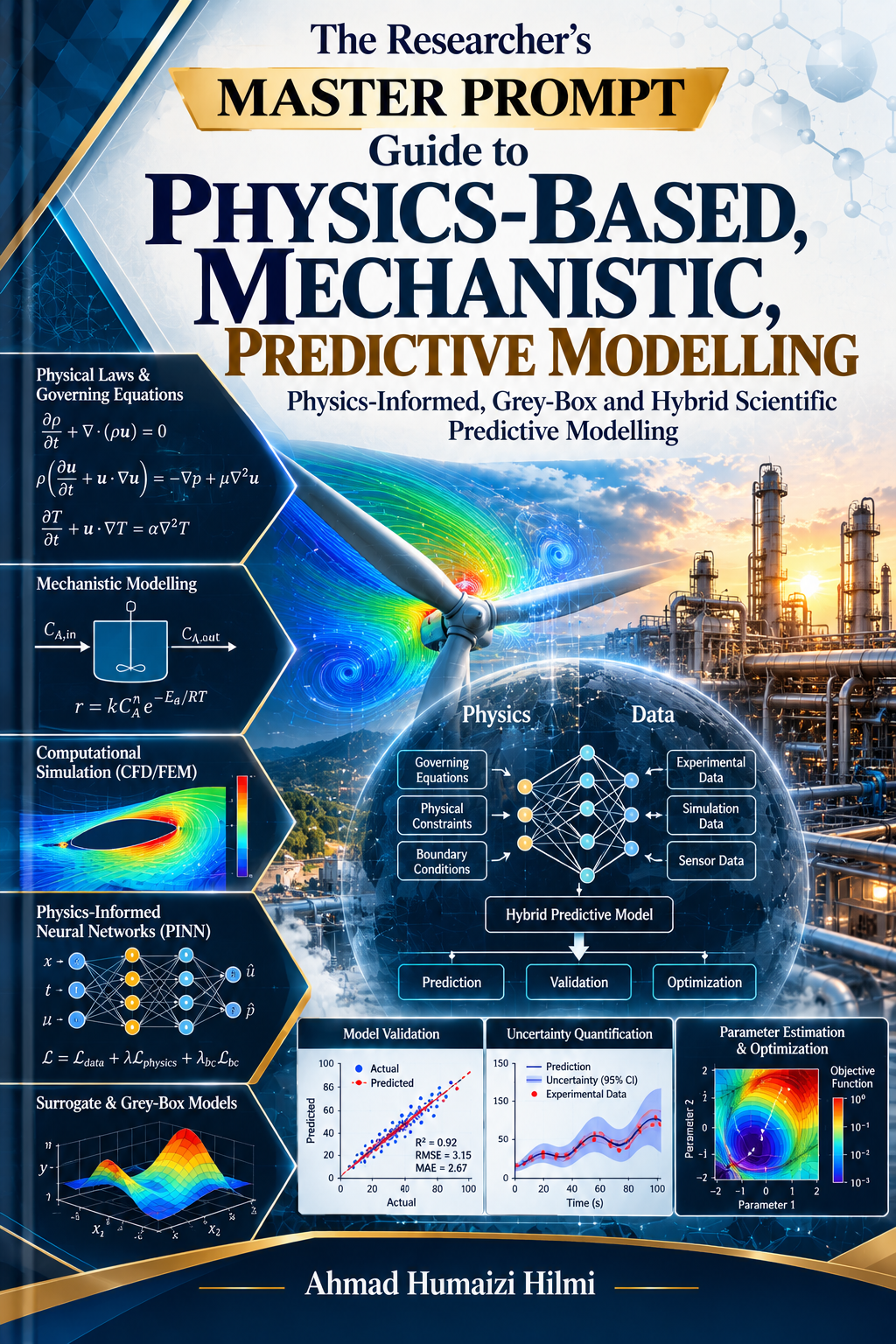
6. PM-PHY-006 — Physics-Based, Mechanistic, Physics-Informed, Grey-Box and Hybrid Scientific Predictive Modelling
Description
This Master Prompt provides an integrated framework for developing predictive models that incorporate physical laws, scientific principles, governing equations, empirical relationships and computational simulations alongside statistical and artificial intelligence techniques. It guides researchers through mechanistic modelling, first-principles formulations, conservation laws, constitutive equations, kinetic models, thermodynamic relationships, transport phenomena, finite element modelling, computational fluid dynamics, reduced-order modelling, grey-box modelling and physics-informed machine learning. The theme addresses physics-informed neural networks, physics-assisted regression, physics-guided deep learning, surrogate modelling, Gaussian processes informed by physical constraints and hybrid physics–data architectures. Particular attention is given to incorporating governing equations, initial and boundary conditions, conservation constraints, dimensional consistency, parameter estimation, model calibration and physical interpretability into predictive systems. Researchers are guided in connecting experimental measurements with numerical simulations and machine learning models to predict material behaviour, thermal transport, combustion, chemical reactions, structural response, crack propagation, hydrogen storage conditions, fluid behaviour and other complex physical phenomena. The theme emphasizes verification, validation, sensitivity analysis, uncertainty quantification, extrapolation limitations, physical plausibility and computational efficiency. It supports research requiring predictive models that combine the adaptability of data-driven methods with the scientific consistency and interpretability of established physical and mechanistic principles.