
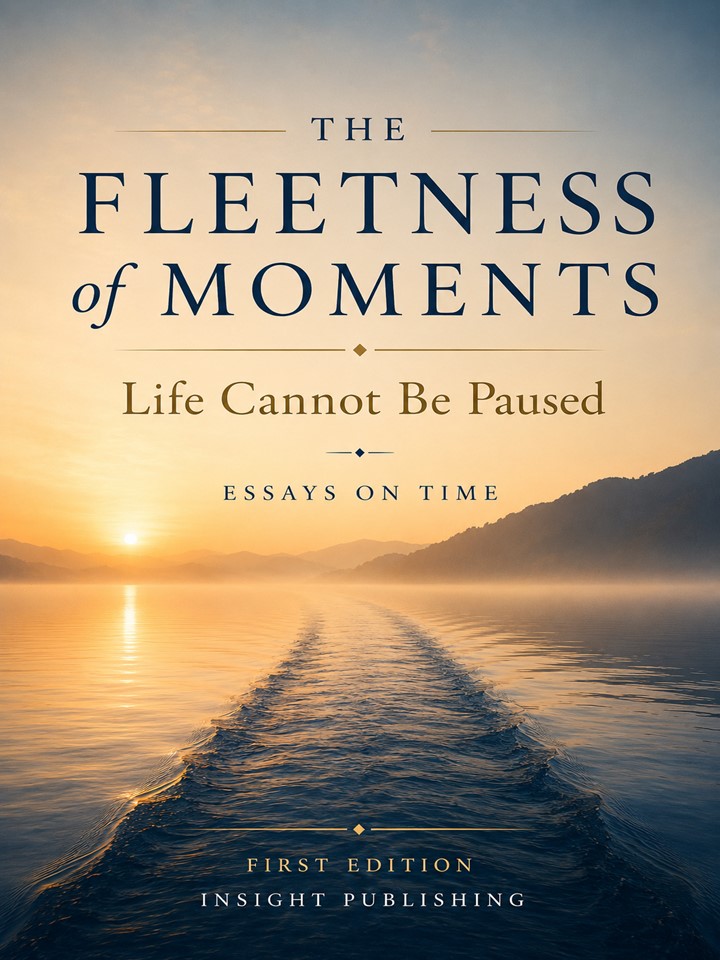
The Fleetness of Moments: Life Cannot Be Paused. First Edition (111 pages)
There are books about time management.
This is not one of them.
The Fleetness of Moments explores a different question: what does the irreversible passage of time reveal about the way we experience life?
Beginning with the unexpected realization that two meaningful weeks had disappeared almost as soon as they had begun, this essay examines memory, ordinary moments, attention, gratitude, permanence, identity, and the quiet transformation through which the present becomes the past.
Rather than offering advice or techniques, the book invites readers to reconsider one of the most familiar aspects of human existence. Time is not presented as a problem to solve, but as a reality to understand.
Throughout twenty interconnected essays, the book explores why ordinary moments often become life's most meaningful memories, why permanence exists more in continuity than in immobility, and why the value of an experience is never measured simply by how long it lasted.
The Fleetness of Moments is part of the Essays Series, a collection of philosophical reflections examining responsibility, interpretation, indifference, value, and the fundamental realities that shape the human experience.
The present was never ours to keep.
Only ours to inhabit.
TABLE OF CONTENTS
Preface - Why Time Is Experienced Before It Is Understood
This book is not about measuring time, but about examining the way human beings inhabit, interpret, and remember its irreversible passage.
PART I – THE EXPERIENCE OF TIME
1. Two Weeks
How an ordinary period of time became an unexpected encounter with one of existence's most enduring questions.
2. The Present That Never Stays
Why the present disappears at the very moment we become conscious of it.
3. Waiting, Living, Remembering
How anticipation, experience, and memory obey entirely different perceptions of time.
4. The Unequal Rhythm of Time
Why identical durations can produce profoundly different experiences.
5. When Experience Becomes Memory
How every lived moment quietly crosses the invisible boundary between presence and remembrance.
PART II – THE IRREVERSIBILITY OF TIME
6. The Economy That Never Stops Spending
Time is the only resource that is consumed continuously, whether we choose to notice it or not.
7. Every Choice Closes a Future
Every decision permanently removes possibilities that can never be recovered.
8. The Cost of Ordinary Moments
The ordinary days we rarely notice eventually become the life we remember.
9. Nothing Repeats Itself
Familiar experiences never return in the same form.
10. The Illusion of Having More Time
Abundance becomes one of the greatest illusions human beings construct.
PART III – WHAT TIME LEAVES BEHIND
11. Memory Does Not Preserve Time
Memory keeps meaning rather than chronology.
12. The Last Time We Never Recognize
Life's most important endings rarely announce themselves as they happen.
13. The Stories That Resist Time
How language, photographs, traditions, and memory become humanity's quiet resistance against disappearance.
14. Permanence as a Human Fiction
Why stability exists largely because we choose to believe in it.
15. Identity Written by Passing Moments
How accumulated moments become the narrative we eventually call a life.
PART IV – LIVING WITH THE PASSING OF TIME
16. Presence Without Possession
Experiencing a moment completely is different from attempting to preserve it.
17. The Discipline of Attention
Awareness gives depth to moments without extending their duration.
18. Gratitude Without Attachment
Appreciation begins where ownership ends.
19. Life Cannot Be Paused
What accepting the irreversibility of time reveals about living well.
20. The Fleetness of Moments
Why life's greatest privilege is not to preserve moments, but to inhabit them fully before they become memory.
Final Reflection - The Present Was Never Ours to Keep
A closing meditation on time, memory, and the quiet realization that the value of a moment is never determined by its duration, but by the depth with which it was lived.