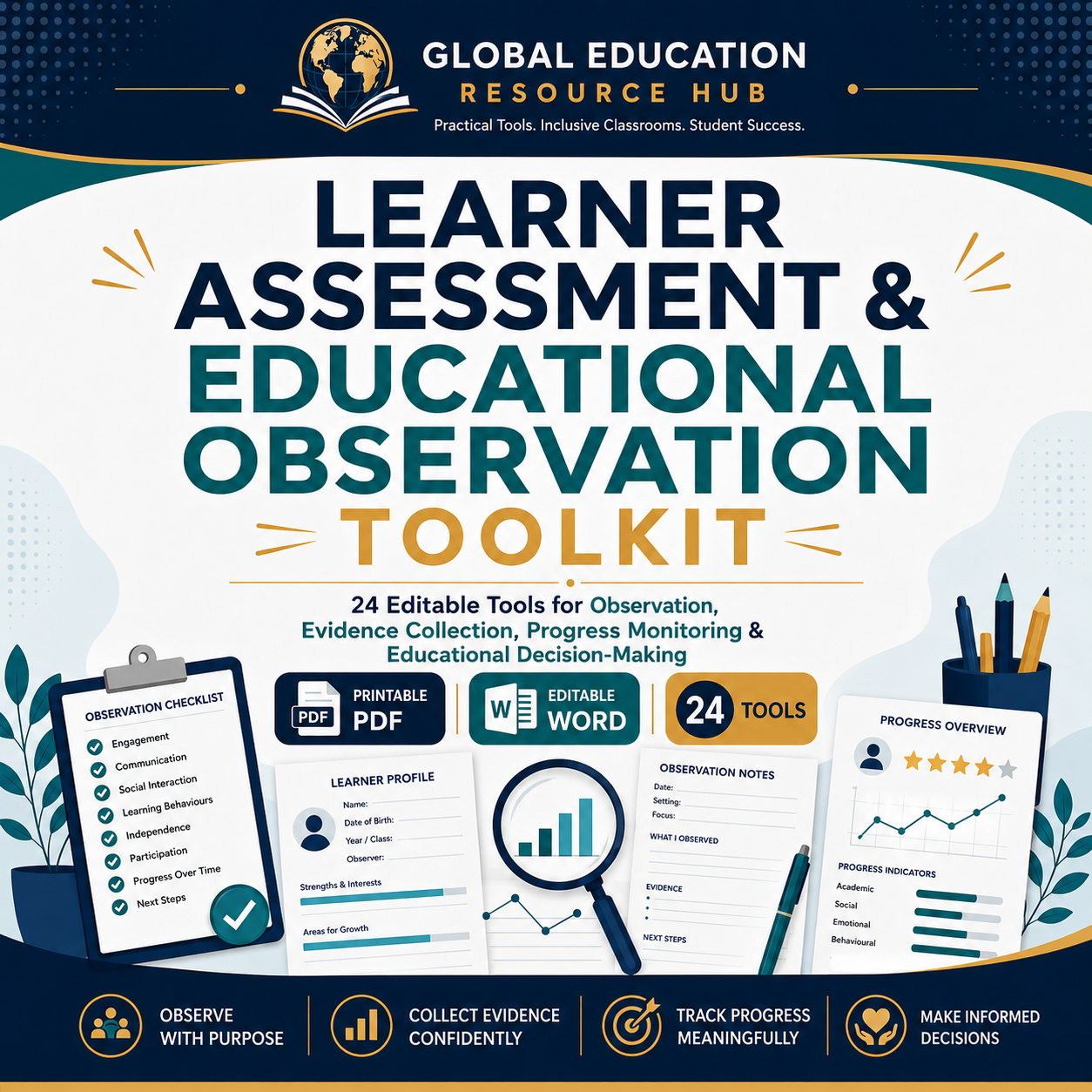
Learner Assessment & Educational Observation Toolkit — 24 Editable Tools for Observation, Evidence Collection, Progress Monitoring & Educational Decision-Making
The Learner Assessment & Educational Observation Toolkit is a practical professional resource designed to help teachers, special educators, inclusion coordinators, school leaders, and support teams collect meaningful educational evidence and use it to guide teaching, support, and learner progress.
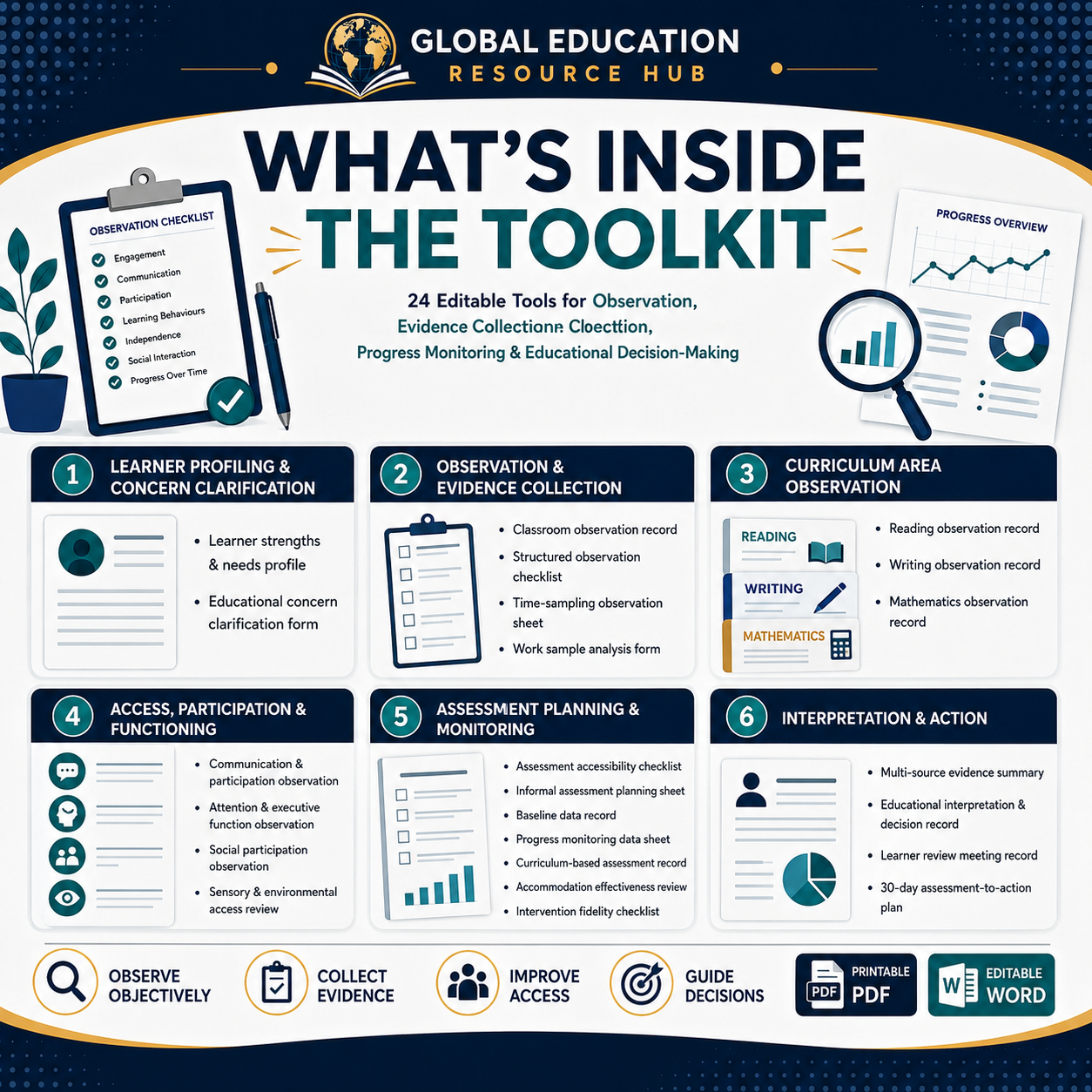
The toolkit contains 24 editable tools covering learner profiling, classroom observation, evidence collection, accessible assessment, progress monitoring, curriculum-based review, and educational decision-making.
It is designed to help educators move from vague concerns to clearer, evidence-informed decisions by observing learners systematically, analysing work and participation, identifying patterns, monitoring change, and linking assessment findings directly to teaching and support.
What’s included:
- Learner Strengths & Needs Profile
- Educational Concern Clarification Form
- Classroom Observation Record
- Structured Observation Checklist
- Time-Sampling Observation Sheet
- Work Sample Analysis Form
- Reading Observation Record
- Writing Observation Record
- Mathematics Observation Record
- Communication & Participation Observation
- Attention & Executive Function Observation
- Social Participation Observation
- Sensory & Environmental Access Review
- Assessment Accessibility Checklist
- Informal Assessment Planning Sheet
- Baseline Data Record
- Progress Monitoring Data Sheet
- Curriculum-Based Assessment Record
- Accommodation Effectiveness Review
- Intervention Fidelity Checklist
- Multi-Source Evidence Summary
- Educational Interpretation & Decision Record
- Learner Review Meeting Record
- 30-Day Assessment-to-Action Plan
Ideal for:
Classroom teachers, special educators, SEN/SEND professionals, inclusion coordinators, learning-support teams, teacher educators, school leaders, educational consultants, and multidisciplinary education teams.
Why this toolkit is useful:
The tools help educators:
- clarify the educational question before assessment begins;
- collect objective classroom observation evidence;
- analyse learner work and participation;
- review reading, writing, mathematics, communication, and executive-function performance;
- identify environmental and accessibility barriers;
- plan informal and curriculum-based assessment;
- establish useful baseline data;
- monitor learner progress over time;
- evaluate whether accommodations and interventions are working;
- combine evidence from multiple sources;
- interpret findings cautiously and educationally; and
- translate assessment evidence into practical teaching and support decisions.
Editable and printable:
The purchase includes both a printable PDF and an editable Word version, allowing buyers to adapt the tools to their own classroom, school, learner group, curriculum, or professional context.
Single-user licence:
One named purchaser may use, print, and adapt the materials for their own professional practice and the learners they directly support. The files may not be resold, redistributed, uploaded, shared, sublicensed, republished, or placed in shared organizational resource libraries. A separate school or multi-user licence is required for use by multiple staff members.
Important professional-use note:
This toolkit supports educational observation, informal assessment, progress monitoring, and instructional decision-making. It does not replace formal psychoeducational, diagnostic, medical, speech-language, occupational therapy, psychological, or other specialist assessment; statutory procedures; safeguarding requirements; or qualified professional judgment.
Educational assessment should improve teaching, access, participation, and learner progress — not simply produce scores.