


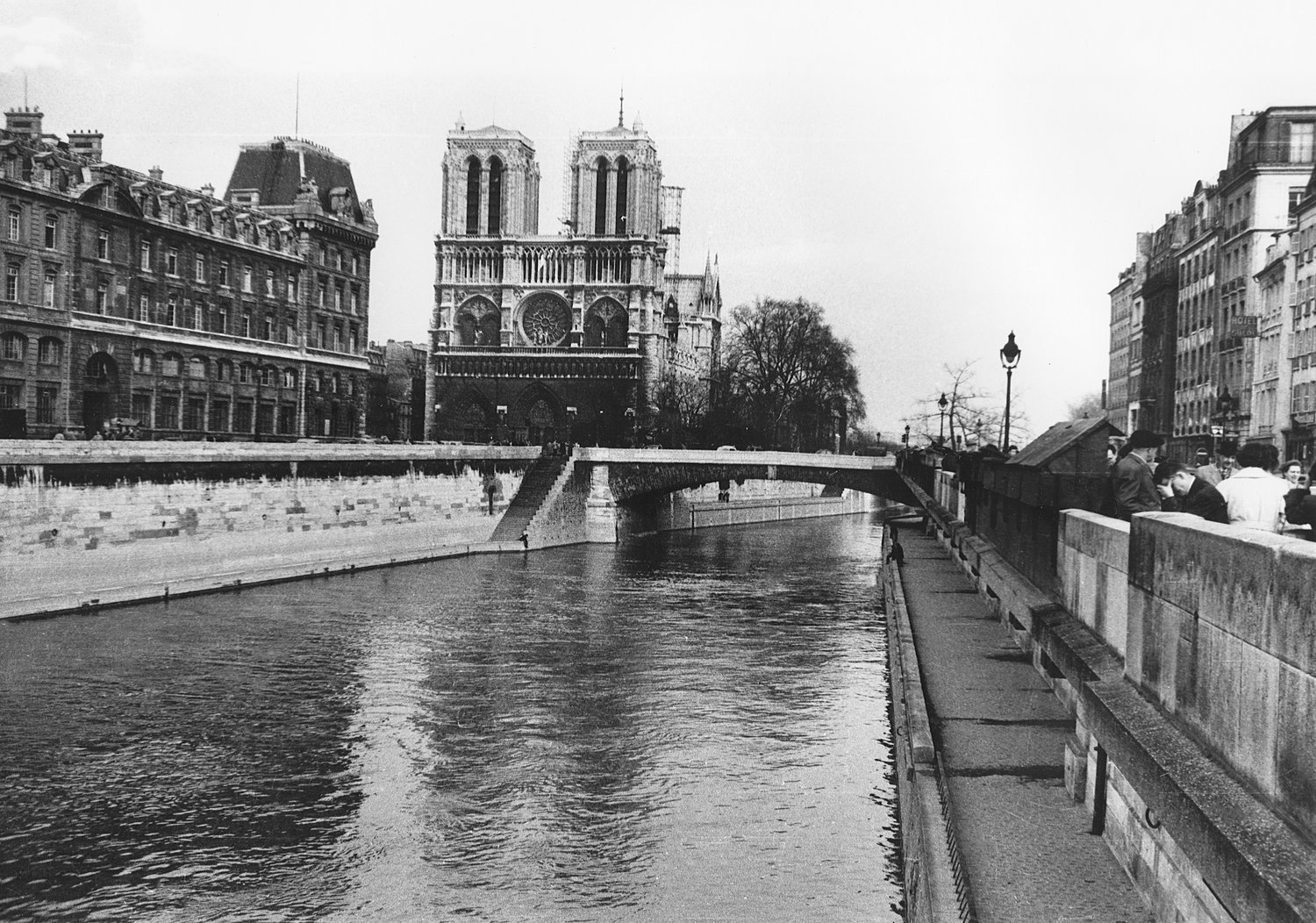
Notre Dame Cathedral & River Seine Paris France 1940's
Notre Dame Cathedral and River Seine Paris France 1940
The Notre-Dame Cathedral in Paris, France stands as an architectural masterpiece and a symbol of French Gothic architecture. Its remarkable construction and intricate design have captivated visitors for centuries. Located on the Île de la Cité, the cathedral has witnessed significant historical events and played a central role in the religious life of France. Its magnificence, intricate detailing, and cultural significance make Notre-Dame Cathedral a true gem of architectural heritage.
Construction on Notre-Dame Cathedral began in 1163 and spanned over 200 years. The cathedral was built in the style of French Gothic architecture, characterized by its pointed arches, ribbed vaults, and soaring towers. The iconic West Façade of the cathedral features three ornate portals adorned with intricate sculptures, depicting religious scenes and figures. The famous rose windows, located on the western and southern facades, are a testament to the craftsmanship and artistic brilliance of the medieval craftsmen. The flying buttresses, which provide structural support to the building, are another distinguishing feature of the cathedral's design. These architectural elements combine to create a harmonious and awe-inspiring structure that continues to leave visitors in awe.
Beyond its architectural magnificence, Notre-Dame Cathedral holds tremendous cultural and historical significance. It has witnessed numerous historical events, including the coronation of Napoleon Bonaparte, the beatification of Joan of Arc, and the crowning of kings. The cathedral survived the French Revolution and both World Wars, becoming a symbol of resilience and national identity for the French people. Furthermore, it holds deep religious meaning as the seat of the Archbishop of Paris. The Notre-Dame Cathedral is not only a tourist attraction but a living testament to the country's history, blending spiritual and cultural heritage.
Tragically, the cathedral suffered a devastating fire in April 2019, leading to the collapse of its iconic spire and extensive damage to the roof. However, the disaster resulted in an outpouring of support from around the world, and efforts are now underway to restore this architectural jewel to its former glory. The rebuilding process is a testament to the cultural significance and universal appeal of Notre-Dame Cathedral.
In conclusion, Notre-Dame Cathedral in Paris, France, represents a pinnacle of architectural achievement and a symbol of French history and culture. Its impressive design, intricate detailing, and historical significance continue to captivate visitors from around the globe. While recent events have dealt a blow to its physical structure, the outpouring of support and the ongoing restoration efforts serve as a reminder of the cathedral's enduring significance and the resilience of human heritage.
German occupation of Paris France
The German occupation of Paris during World War II was a significant event that had far-reaching consequences for France and the world at large. This essay will delve into the complex dynamics of the occupation, analyzing the intelligence and comprehension of a Graduate School student to provide a comprehensive understanding of this historical period.
To begin, it is essential to comprehend the intelligence apparatus that the Germans employed to subjugate Paris. The German occupation relied heavily on intelligence gathering and surveillance to maintain control. The Gestapo, the Nazi secret police, was a particularly formidable force that terrorized the Parisian population. They employed informants, spies, and other intelligence-gathering methods to monitor and suppress any resistance activities, effectively stifling opposition against their rule.
Understanding the intelligence infrastructure alone, however, does not provide a complete picture of the occupation's impact. Comprehending the socio-political climate that facilitated German control is equally crucial. The French collaborationist Vichy regime, led by Marshal Philippe Pétain, played a critical role in enabling the Germans to occupy Paris. The Vichy government's collaborationist policies not only allowed for the German occupation, but also actively participated in anti-Semitic actions, such as the deportation of Jews.
Furthermore, comprehending the varying reactions of the Parisian population towards the occupation is essential to understanding its intelligence implications. While some Parisians collaborated with the Germans, others actively resisted, forming underground networks and resistance movements. Organizations such as the French Resistance engaged in intelligence gathering, sabotage, and espionage, providing vital information to the Allies. This demonstrates the intelligence and adaptability of the Parisian population even under occupation.
In addition to the actions of the local population, it is essential to understand the broader geopolitical context. The occupation of Paris was not an isolated event but part of Nazi Germany's larger ambitions. Hitler aimed to establish hegemony over Europe, and the occupation of Paris was a symbolic demonstration of his power. Understanding this context allows for a more comprehensive analysis of the intelligence strategies employed by the Germans and the motivations behind these actions.
Another crucial aspect to consider is the impact of the occupation on cultural and artistic life in Paris. Many artists and intellectuals fled the city, while others opted to stay and adapt their work to suit the German regime's propaganda needs. Understanding the nuances of the artistic and intellectual response to the occupation requires a deep comprehension of the broader historical and cultural context.
Moreover, analyzing the military intelligence aspects of the occupation provides valuable insights into the German strategy. Occupying Paris allowed the German forces to secure a strategic position and establish control over a key European city. The intelligence gathered from Paris served as a critical asset for Hitler's larger military campaign, aiding in planning and tactical decision-making.
Lastly, comprehending the aftermath of the occupation is vital for a holistic understanding. This includes analyzing the impact of the occupation on post-war France, the process of liberation, and the subsequent trials and tribunals for collaborationists. The intelligence gathered during the occupation played a crucial role in investigating and prosecuting those responsible for collaboration.
In conclusion, the German occupation of Paris during World War II was a multidimensional event that requires an in-depth analysis to fully comprehend its intelligence and comprehension implications. By examining the intelligence apparatus employed by the Germans, the socio-political climate, the reactions of the Parisian population, the geopolitical context, the impact on cultural life, military intelligence aspects, and the aftermath of the occupation, one can develop a comprehensive understanding of this historical period. Through such analysis, Graduate School students can develop a deep and nuanced comprehension of the German occupation of Paris in World War II.