
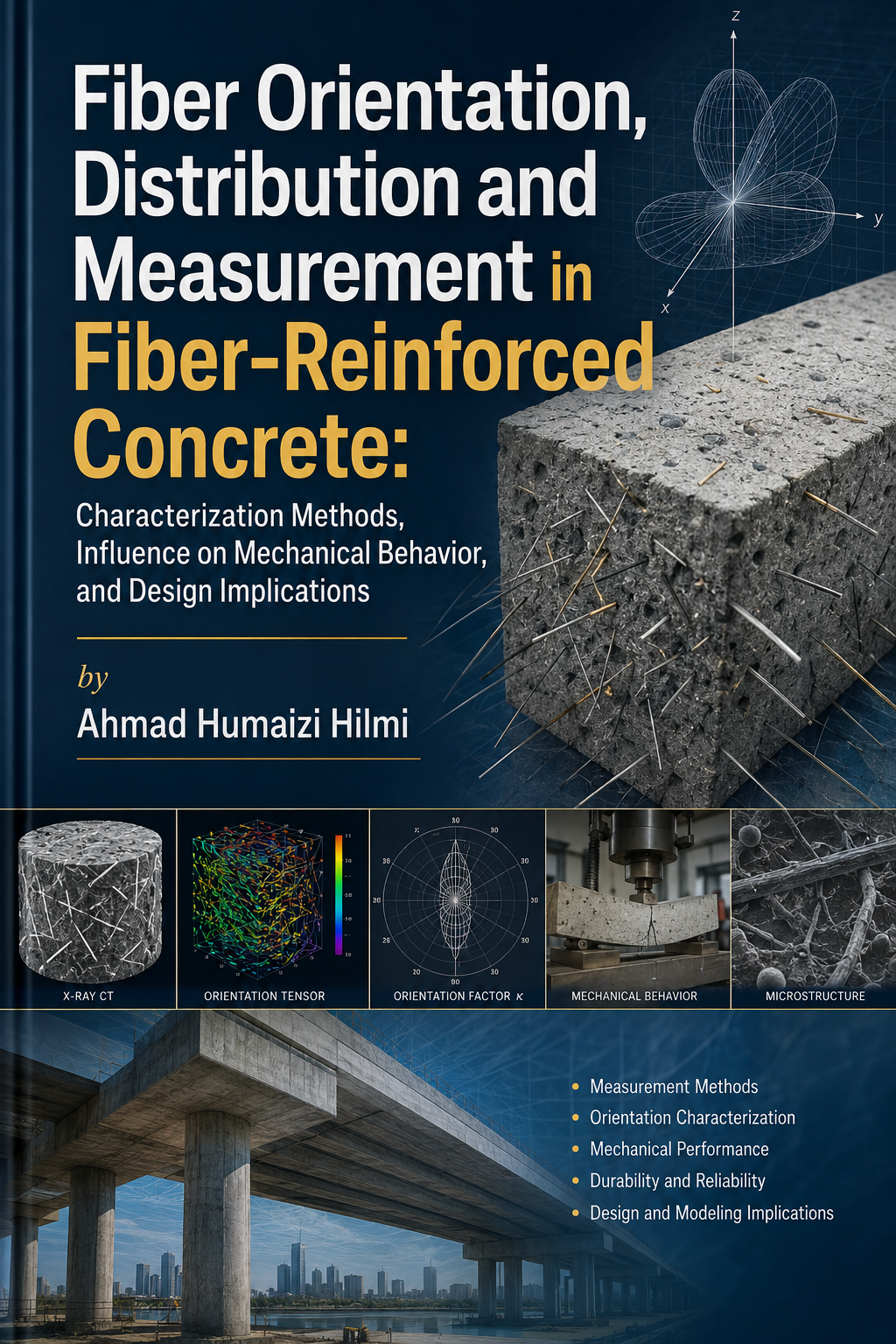
Fiber Orientation, Distribution and Measurement in Fiber-Reinforced Concrete Characterization Methods, Influence on Mechanical Behavior, and Design Implications
This review synthesises measurement, characterisation, modelling and design implications of fiber orientation and spatial distribution in fiber-reinforced concrete (FRC). It summarises practical measurement workflows, from micro- and macro X-ray computed tomography to inductive electrical methods, neutron thermalization, polished-section image analysis and full-field monitoring, and recommends reporting of orientation tensors, the orientation number, local fiber volume fraction and the design-oriented orientation factor κ with associated spatial statistics. The review collates evidence linking orientation and distribution to mechanical and durability outcomes, showing that the number and angle of fibers crossing expected crack planes control residual tensile strength, toughness, punching resistance and transport-related durability. It explains why graded and hybrid fiber systems often outperform mono-length mixes and why optimal fiber volume fractions exist due to dispersion and clustering effects. Advances in orientation-aware constitutive laws, stochastic debonding models and data-driven reliability frameworks are evaluated alongside practical guidance for mix design, casting, sampling and archiving of raw orientation datasets. Remaining challenges include inconsistent measurement protocols, insufficient slab-scale sampling, long-term ageing effects on pull-out versus rupture, and limited probabilistic pipelines for code calibration; the review prioritises standardised, multi-method measurement and probabilistic conversion of orientation statistics into defensible design inputs.