

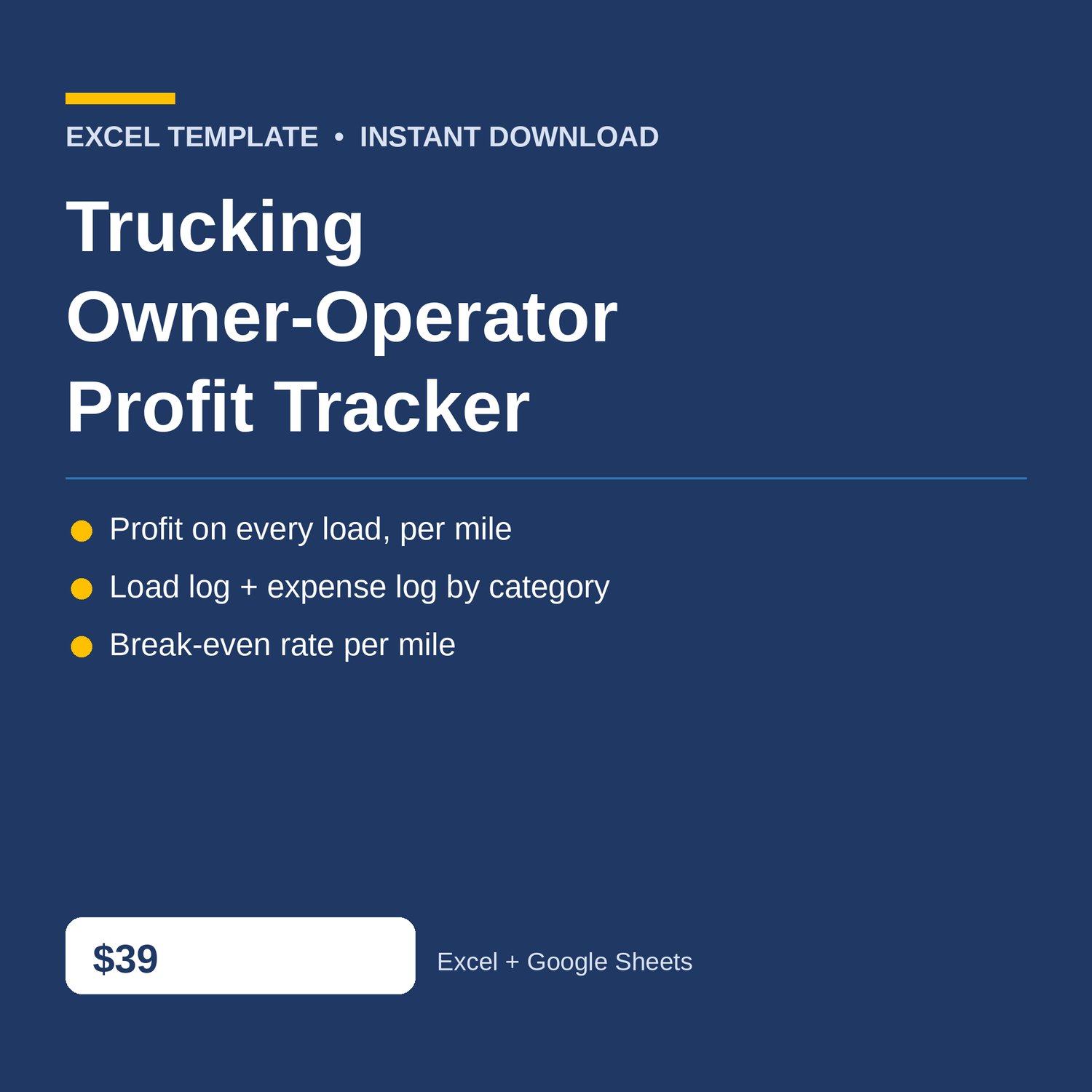

Trucking Owner-Operator Profit Tracker
Trucking Owner Operator Profit Tracker Excel with load log, expense log by category, monthly P and L, and a per-mile dashboard. Know what every load actually made — after fuel, tolls, maintenance, insurance, and permits.
Built for owner-operators and independent truck drivers who need to know, load by load, whether the rate covers the road — without accounting software. If a load is losing money, this workbook shows you while there is still time to turn down the next one like it.
WHAT'S INCLUDED (6 sheets):
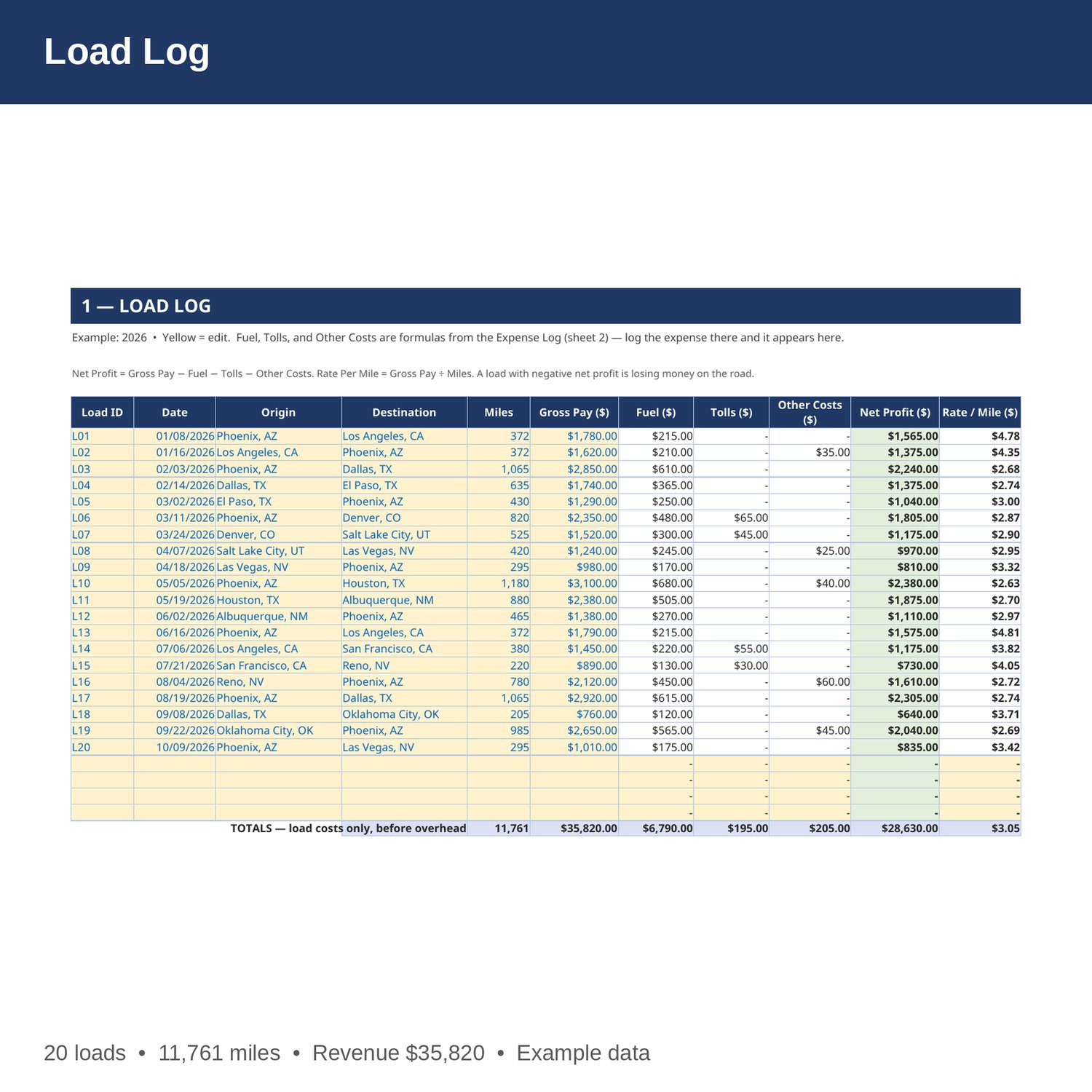
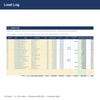
- Load Log — every load: date, origin and destination, miles, and gross pay. Fuel, tolls, and other costs are pulled from the Expense Log by formula, and net profit and rate per mile calculate automatically. A load with negative net profit is flagged.
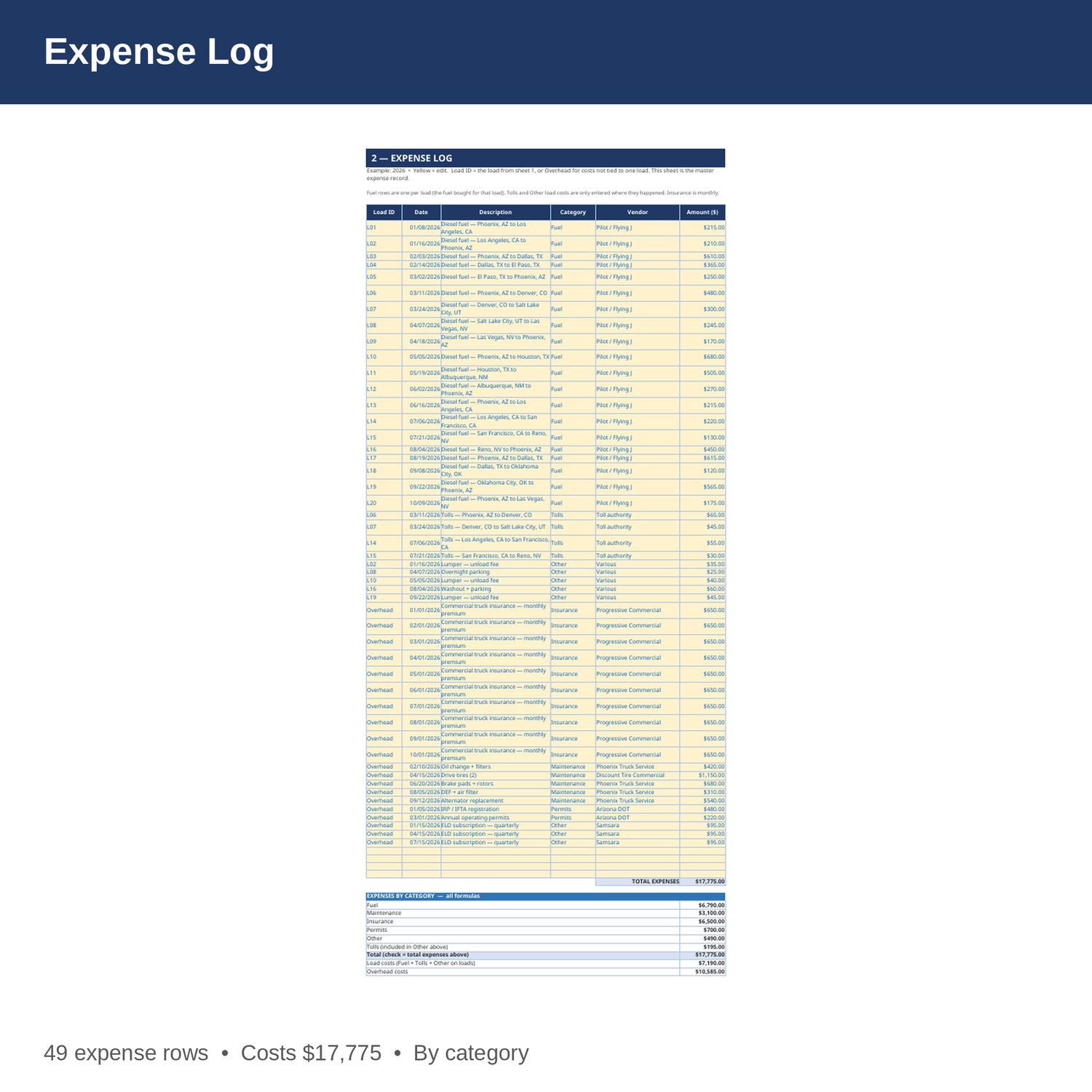
- Expense Log — every expense, tied to a load or marked Overhead: fuel, maintenance, insurance, permits, tolls, and other. This is the master expense record — the Load Log, P and L, and Dashboard all read from it, so nothing is counted twice.
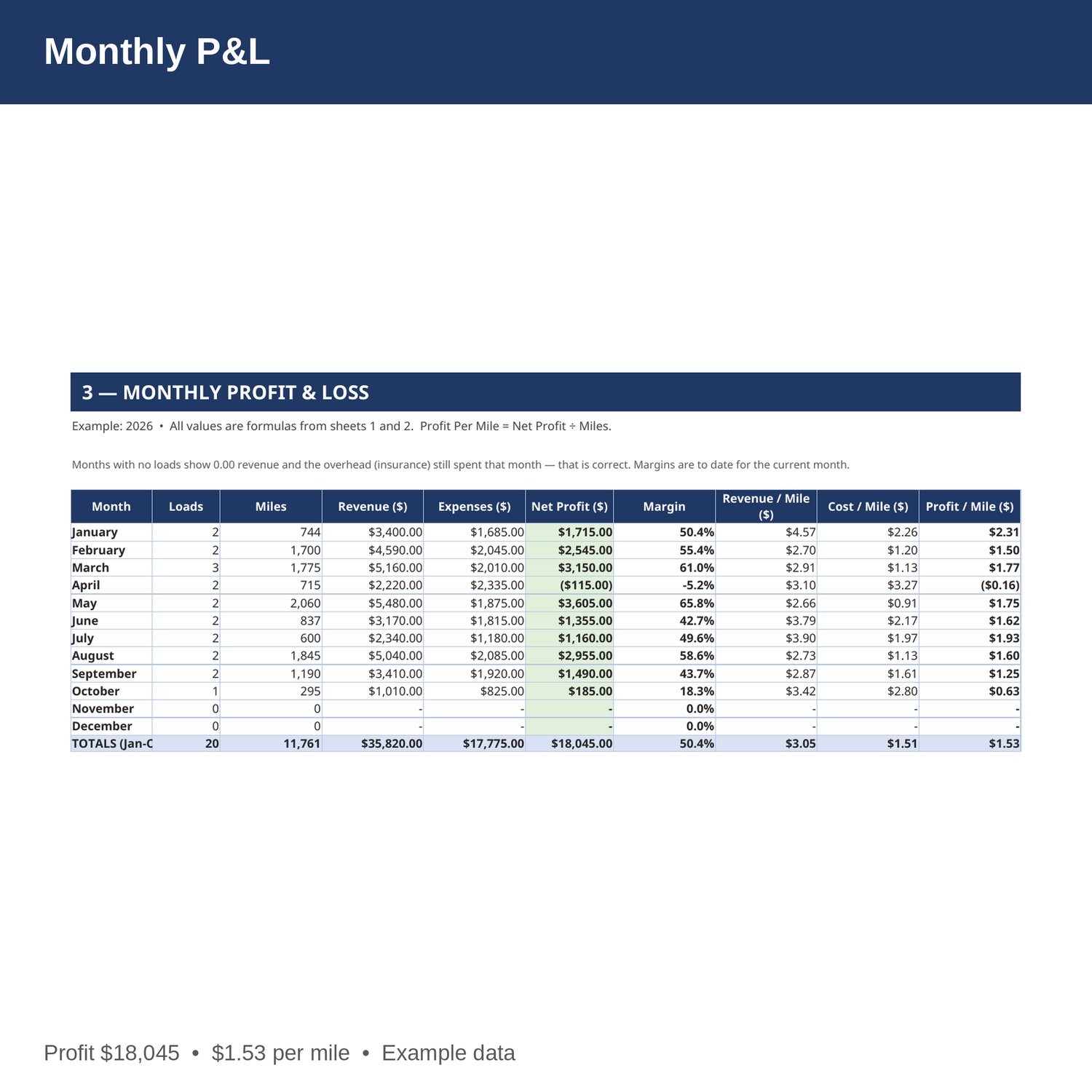
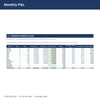
- Monthly P and L — per month: loads, miles, revenue, expenses, net profit, margin, and revenue, cost, and profit per mile. All formulas from sheets 1 and 2.
- Truck and Equipment — your truck: odometer, diesel price, and fuel economy, a maintenance schedule with next-due mileage and miles remaining, and a cost-per-mile breakdown with your break-even rate per mile.
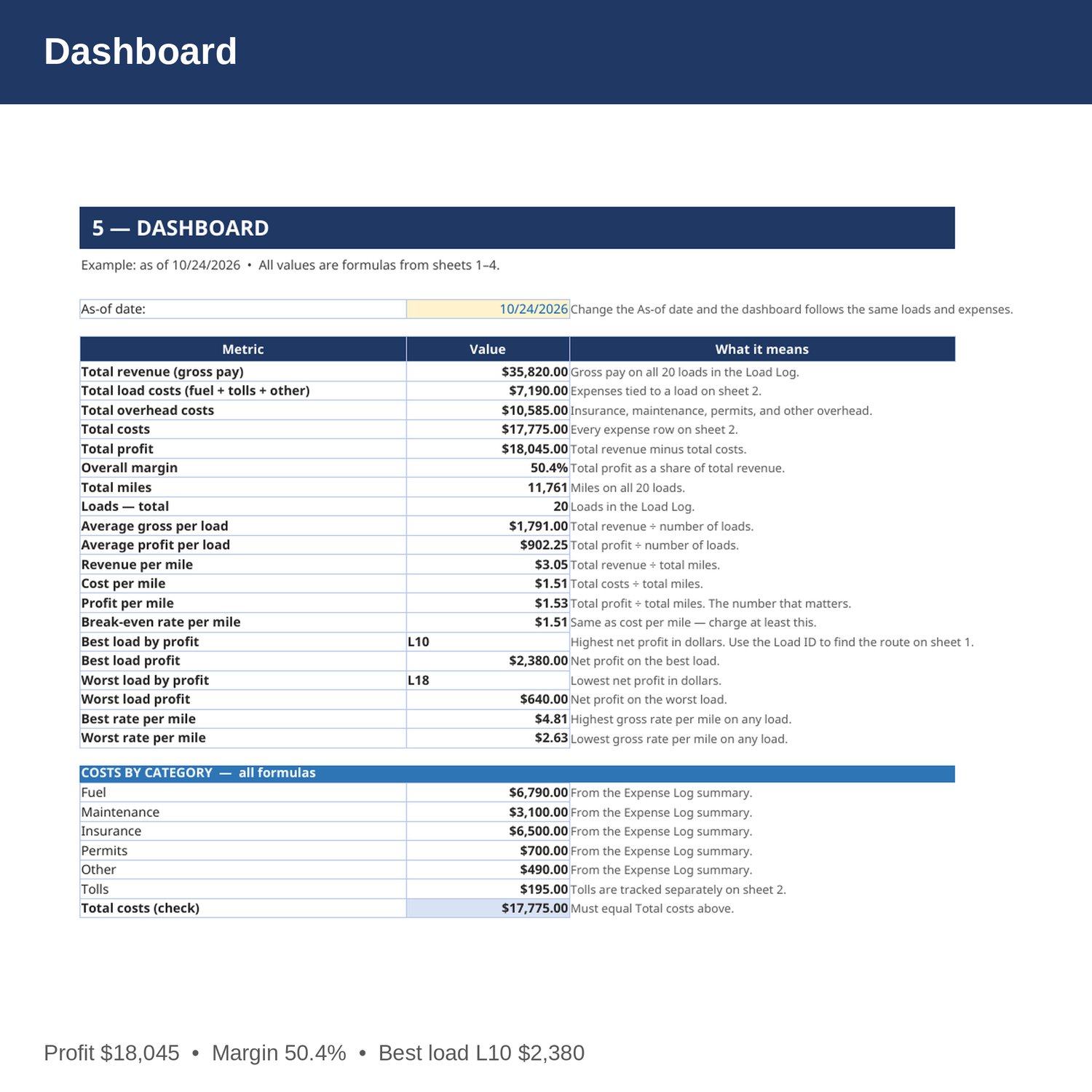
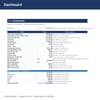
- Dashboard — total revenue, total costs, total profit and margin, profit per mile, best and worst loads by profit, best and worst rate per mile, and costs by category.
- Cover and How to Use — start here. Yellow cells are the only ones you edit.
EXAMPLE DATA (2026, 20 loads, Jan-Oct — replace with your own numbers):
- Total miles 11,761; total revenue 35,820; total costs 17,775; total profit 18,045; margin 50.4 percent.
- Revenue per mile 3.05; cost per mile 1.51; profit per mile 1.53; break-even rate 1.51 per mile.
- Costs by category: fuel 6,790; maintenance 3,100; insurance 6,500; permits 700; other 490; tolls 195.
- Best load: L10, Phoenix to Houston, profit 2,380. Worst load: L18, Dallas to Oklahoma City, profit 640. Best rate per mile 4.81; worst 2.63.
- Best month: May, profit 3,605. April is negative in the example (minus 115) because of a 1,150 tire purchase — the sheet shows a bad month honestly.
- Example truck: 2021 Freightliner Cascadia, paid off, so no truck loan payment is in the example. If you have a truck payment, add it as an Other row on the Expense Log.
HOW IT WORKS:
1. Download the Excel file instantly after purchase.
2. Add a row on the Load Log for every load: date, route, miles, and gross pay.
3. Log every expense on the Expense Log with the right Load ID (or Overhead) and category. A load's profit is only right if its fuel is logged.
4. Check profit per mile on the Monthly P and L weekly. If it falls below your break-even rate on the Truck sheet, the rate on the next load is too low.
HOW THE MONEY WORKS:
Net profit per load is gross pay minus fuel minus tolls minus other costs on that load. Total profit is total revenue minus all expenses, including overhead like insurance and maintenance. Profit per mile is total profit divided by total miles, and the break-even rate per mile is total cost per mile — you must charge at least that per mile to break even.
WHO IT'S FOR:
Owner-operators, independent truck drivers, and small fleets who want clean per-load books and a per-mile profit number they can trust before they accept the next load.
PLEASE NOTE:
- This is a digital download. No physical item will be shipped.
- Works in Microsoft Excel and Google Sheets (upload to Google Drive to open in Sheets).
- Example data for 2026 is included (20 loads, 49 expense rows, Jan-Oct). Replace it with your own numbers.
- This is a bookkeeping and planning tool only, not tax, legal, or CPA advice. Confirm tax, IFTA, and legal decisions with your own accountant or CPA.
- Due to the nature of digital downloads, refunds are not available. Message me before buying if you have a question.
Built by an accountant: B.S. Accountancy, ASU W. P. Carey, with revenue-reconciliation experience at Marriott and audit work at PwC.