
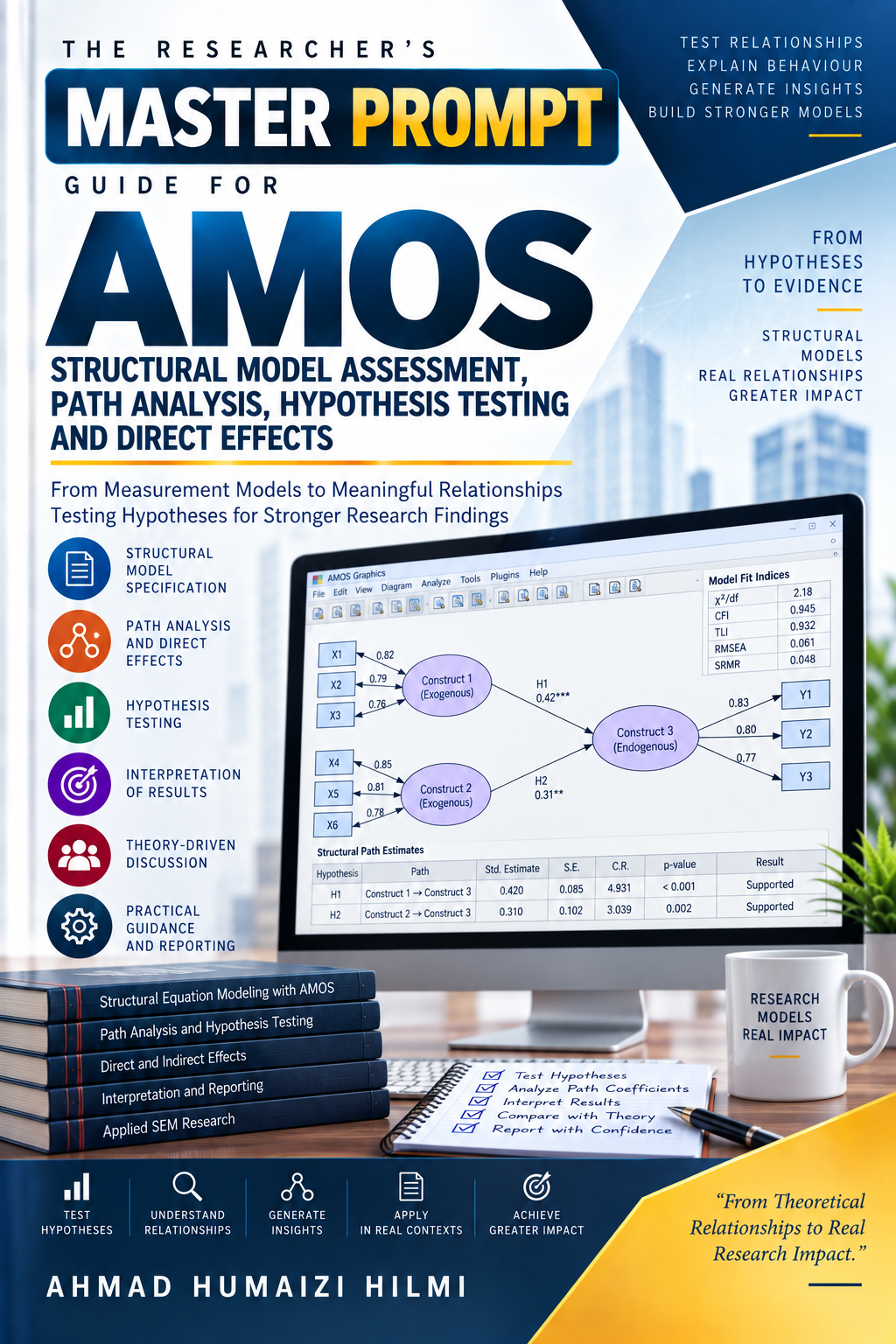
AMOS-STR-007 — Structural Model Assessment, Path Analysis, Hypothesis Testing and Direct Effects
Description
This Master Prompt focuses on transitioning from an acceptable AMOS measurement model to the structural model used to test theoretically specified relationships among latent constructs. It guides researchers in specifying and estimating structural paths, interpreting standardized and unstandardized regression weights, examining standard errors, critical ratios and probability values, assessing direct effects and explained variance, mapping every structural path to its corresponding hypothesis, and integrating statistical results with theoretical expectations and substantive interpretation.
A major emphasis is placed on maintaining the two-stage logic of CB-SEM. Measurement quality should first be established through CFA, reliability and validity assessment; only then should the structural model be used to test the hypothesized relationships. The uploaded UTAUT study explicitly follows this sequence, assessing the measurement model before using the structural model for hypothesis testing and simultaneous examination of direct and indirect relationships. Likewise, the mineral-extraction study establishes reliability, validity and measurement-model fit before developing the AMOS structural model and testing direct hypotheses.
The theme also emphasizes that statistical significance is not equivalent to theoretical importance, and a nonsignificant relationship should not simply be discarded as an unimportant result. Researchers should interpret the direction, magnitude, uncertainty and theoretical implications of each path; distinguish standardized coefficients from unstandardized coefficients; evaluate endogenous-construct explained variance; distinguish direct from indirect and total effects; and report supported and unsupported hypotheses transparently. The uploaded studies illustrate this approach by reporting both significant and nonsignificant direct paths, including examples where a nonsignificant direct relationship subsequently motivates examination of an indirect mechanism.