
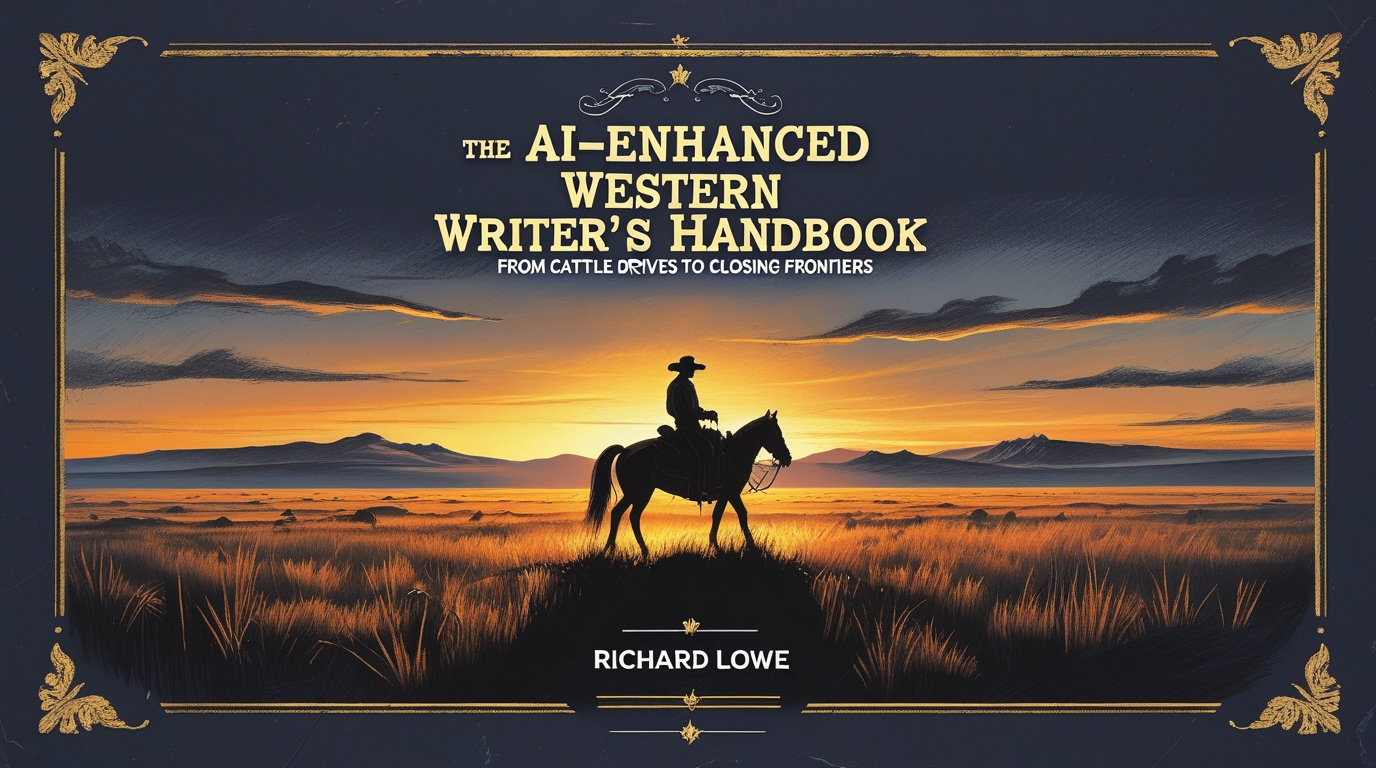
The AI-Enhanced Western Writer’s Handbook
The AI-Enhanced Western Writer's Handbook: From Cattle Drives to Closing Frontiers
522 pages. 34 prompt chapters. 816 AI prompts. 34 writing lessons. 4 craft chapters. Case studies from McMurtry, McCarthy, Eastwood, and Ford.
The western isn't cowboys and shootouts. It's the most psychologically complex genre in American fiction — where landscape shapes character, where freedom and law collide, where the cost of building a civilization is measured in what gets destroyed along the way.
Most western fiction fails because writers treat the genre as costume drama. Modern people in cowboy hats, saying modern things, solving modern problems against a painted backdrop. Readers who love westerns spot the fraud immediately. They put the book down and find a writer who understands the territory.
This handbook teaches the territory.
What's Inside:
✅ The Western Genre Contract — what western readers actually expect and why breaking that contract loses them
✅ Psychology of the Frontier — how landscape, isolation, and lawlessness shape character in ways no other genre replicates
✅ The Western Protagonist — loner psychology, competence hierarchies, and moral codes that operate outside institutional law
✅ Landscape as Character — how to write terrain that functions as antagonist, mirror, and crucible
✅ 34 Prompt Chapters covering every major western story type: cattle drives, gunfighters, frontier towns, lawmen, outlaws, Native American characters, frontier women, the Mexican border, range wars, bounty hunters, railroads, mountain men, stagecoach travel, buffalo hunters, vigilante justice, saloons, cavalry, ranch life, mining towns, western horror, weird west, revisionist westerns, neo-westerns, western mystery, survival stories, historical figures, comedy and satire, frontier religion, the closing frontier, bandits and heists, and science fiction westerns
✅ 816 AI prompts — 24 per chapter, each with a featured scenario developed into a full narrative seed with named characters, specific historical grounding, and moral complexity
✅ 34 Writing Lessons — deep-dive craft essays on mob psychology, solitude as crucible, the moving room, writing extinction, the landscape of power, time as antagonist, writing across the cultural divide, and 27 more
✅ 34 Exercises — structured development frameworks for building your own western stories
✅ Study This / Watch This — curated references from Lonesome Dove to Deadwood, Blood Meridian to Unforgiven, True Grit to Reservation Dogs
✅ AI Notes — research prompts for historical accuracy, cultural authenticity, and psychological realism
Case Studies Woven Throughout:
- Larry McMurtry — elegy, character investment, the closing frontier
- Cormac McCarthy — landscape as moral argument, violence as revelation, the border as psychological space
- Clint Eastwood — the revisionist western, aging gunfighters, moral ambiguity
- John Ford — the social microcosm, Monument Valley as visual argument, myth versus history
Who This Is For:
Writers who want their westerns to feel lived-in, not researched. You might be starting a western novel, revising a draft where the setting feels like wallpaper, exploring subgenres from neo-western to weird west, or using AI and getting the same generic frontier output everyone else gets. You're ready to treat the western as psychology-first craft.
What You Get:
📄 522-page PDF handbook
📄 Complete prompt library (816 prompts across 34 chapters)
📄 Instant digital download
📄 Lifetime access to updates
30-Day Money-Back Guarantee. If this handbook doesn't change how you approach western fiction, request a full refund within 14 days. No questions.
The territory ahead is uncharted. That's the point.
👉 Click "I want this!" to write westerns that feel like the real frontier.