

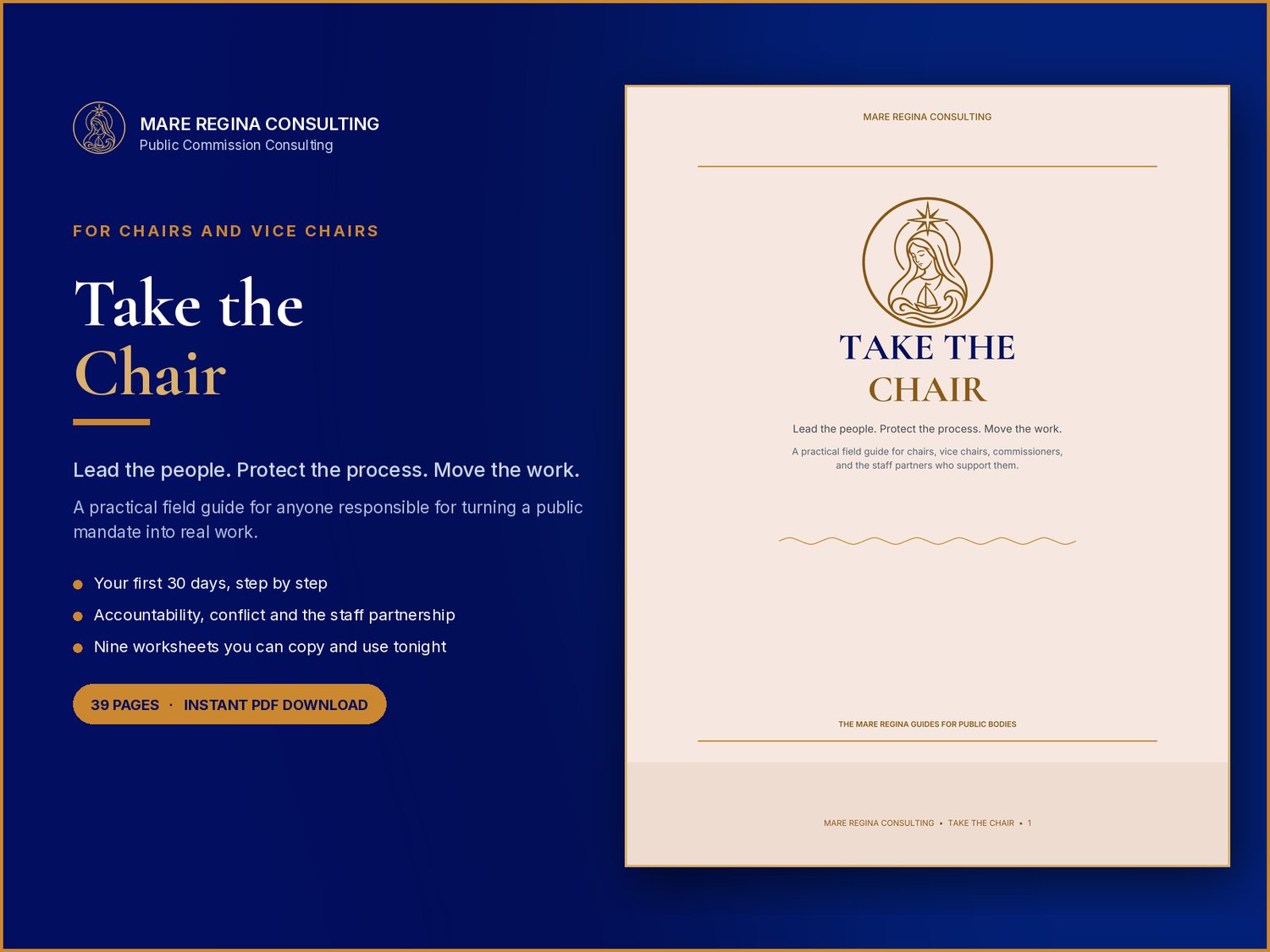
Take the Chair: A practical guide to leading a public board or commission
Take the Chair
A practical guide to leading a public board or commission
Somebody handed you the gavel. Maybe your colleagues elected you, maybe an appointing authority chose you, maybe nobody else raised a hand and you decided the work was too important to leave unled.
Nobody arrives knowing how to do this. Most chairs inherit a body mid-stream, with incomplete records, no handoff, and a set of problems that predate them.
This is a field guide to the part nobody trains you for: leading people, running meetings that produce decisions, building accountability without damaging relationships, partnering with staff, engaging the public, and leaving the body stronger than you found it. It is not a parliamentary-procedure manual. It is about the judgment calls that sit underneath the procedure.
Inside:
- Your first 30 days — the five questions to answer before you try to set direction
- The chair and staff partnership — where the line actually blurs, and how to protect it
- Accountability without being harsh — a five-step sequence that starts with asking how someone is doing, because most disengagement has a reason
- Conflict that stays out of the work — what to do in the room, and when to stop being the mediator
- Know your power and its limits — seven things a chair should never do
- Turning big ideas into a one-year plan — blue-sky first, then the reality check, then creative ways to close the gap when the money is not there
- When something goes sideways — the crisis sequence, before you answer the phone
- Building something that outlasts you — succession, documentation, and the handoff
- You are supposed to be here — for the chair who is nervous because they care about doing it well
Nine worksheets, including a first-30-days checklist, a board strengths inventory, a meeting action tracker, a chair-and-staff responsibility map, a difficult conversation planner, an annual priority canvas with a parking lot, a crisis checklist, a handoff checklist, and a twelve-point self-assessment.
Two editions included. A printable version with room to write, and a digital version with fillable fields and clickable navigation.
39 pages. Instant PDF download.
Educational and planning use only; not legal advice. Public bodies should confirm the rules that apply in their jurisdiction.