

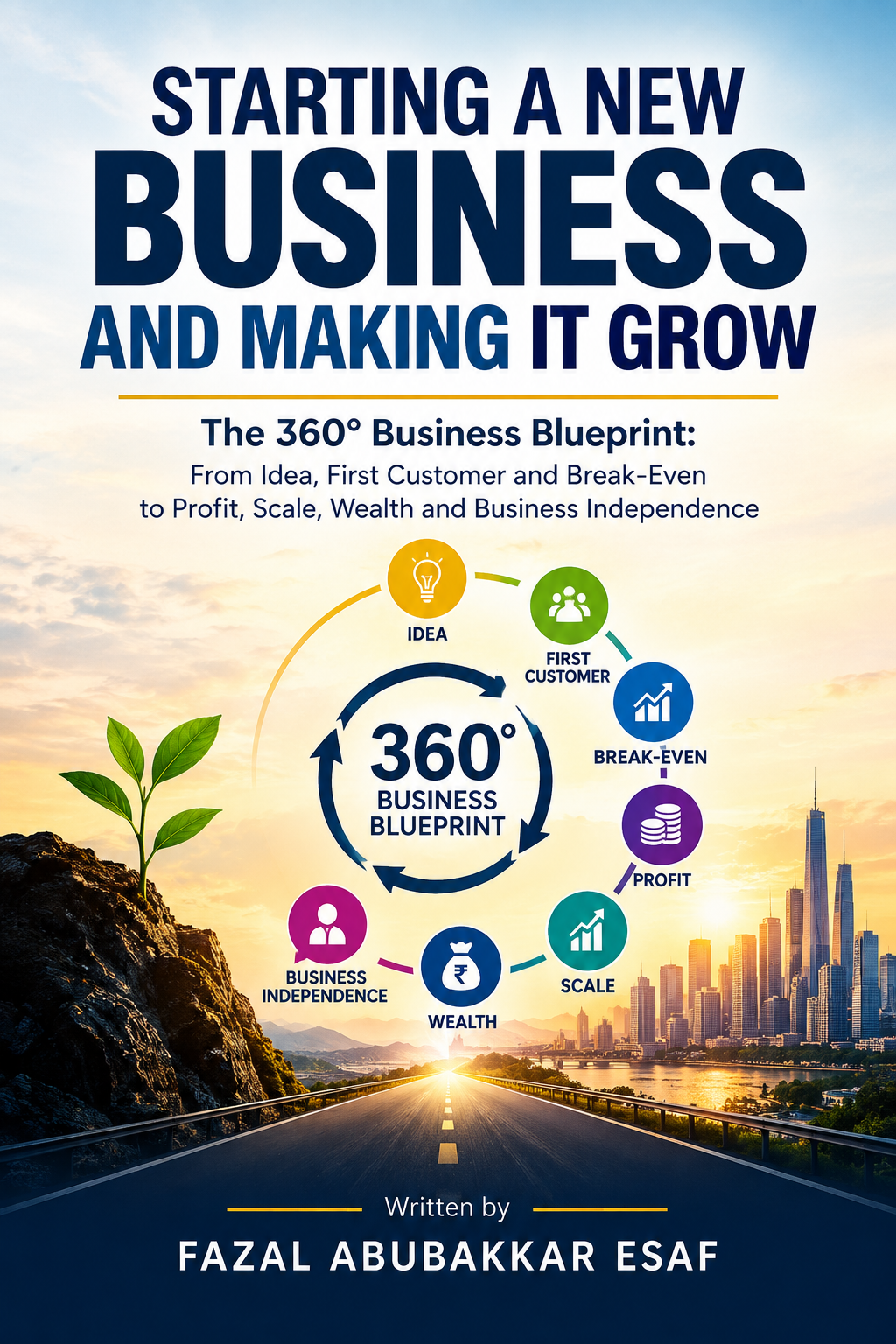
Starting a New Business and making it Grow
Starting a business is often described as a simple journey: find an idea, launch a product, attract customers, make sales and grow.
Reality is far more complicated.
A business can have a good idea and still fail because there is no real demand. It can have customers and still lose money because its pricing is wrong. It can generate accounting profit and still collapse because cash is trapped in inventory or receivables. It can grow rapidly and become weaker because its systems, people, suppliers and finances cannot support the growth.
Entrepreneurship therefore requires more than enthusiasm.
It requires the ability to identify an opportunity, test it before committing too many resources, understand the customer, design a useful offering, calculate the true cost, price intelligently, sell consistently, manage cash, build systems, protect the business and make informed decisions about growth.
This book was designed around that complete journey.
Its central philosophy is:
Find → Validate → Build → Cost → Price → Sell → Market → Advertise → Measure → Improve → Systemize → Protect → Scale → Value → Transfer.
The purpose is not to present entrepreneurship as a guaranteed path to wealth. There are no guaranteed outcomes in business. Markets change, competitors respond, customers change their preferences, regulations evolve, technologies become obsolete and unexpected shocks can affect even apparently successful companies.
The objective is therefore different: to improve the quality of entrepreneurial thinking and decision-making.
The book begins before the business exists. It examines the entrepreneur, opportunity selection and market validation. It then moves through customers, business models, products, branding, legal protection, suppliers, costing, pricing, profit, unit economics, break-even and cash flow.
From there, it follows the business into sales, marketplaces, direct commerce, wholesale, B2B and institutional markets, marketing, advertising, customer retention and CRM.
The later chapters address the challenges that emerge as a business becomes more complex: hiring, leadership, operations, standard operating procedures, technology, artificial intelligence, dashboards, scaling, international expansion, competition, crisis, business continuity, valuation, succession and wealth creation.
The book deliberately keeps these subjects within a single 25-chapter architecture rather than separating every business function into isolated manuals.
Every chapter also follows a recurring practical structure:
What You Need to Know.
What You Need to Calculate.
What You Need to Decide.
What You Need to Do.
What Can Go Wrong.
What to Measure.
Chapter Action Sheet.
This structure matters because information alone does not create a business.
Entrepreneurs must convert information into decisions, decisions into actions, actions into measurable results, and results into learning.
The ultimate goal is not simply to start a business.
It is to build a business that understands its customers, knows its numbers, controls its risks, creates genuine value, develops systems, learns from failure, adapts to changing conditions and becomes less dependent on the founder for every decision.
A small business can remain small and still be excellent.
A business does not have to become a corporation to be successful. Growth should serve a purpose. Sometimes that means more revenue. Sometimes it means greater profit. Sometimes it means greater independence, better working conditions, stronger cash reserves, a more valuable asset or the ability to create opportunities for others.
The entrepreneur's real challenge is to understand which form of growth is appropriate—and when growth itself becomes a risk.
This book is therefore intended to be used not only as something to read, but as something to work through.
Calculate.
Question assumptions.
Test ideas.
Speak to customers.
Measure results.
Document processes.
Build alternatives.
Learn from failure.
And above all, make decisions based on evidence rather than wishful thinking.
A business begins with an idea.
A sustainable business begins when that idea survives contact with reality.