


The Idea to Value field guide — how ideas become value at work
The Idea to Value field guide
A practical system for seeing how work actually moves — and where to intervene before cost accumulates.
Learn to see how work moves, and you start to notice things you can't stop noticing.
Watch an idea travel through an organisation. It arrives clear. It gets funded. Work begins, effort builds — and somewhere along the way, movement changes. Not everywhere at once. In particular places, for particular reasons. Most of the time, no one can see those places clearly enough to name them, so the change gets explained as priorities, or bandwidth, or timing.
That's the gap this guide is built for.
Not the idea, which was fine.
Not the outcome, which hasn't arrived yet.
The stretch in between — where value is either shaped or quietly lost.
The Idea to Value field guide is a way of seeing that stretch. It hands you a lens the work itself rarely gives you: a way to notice where effort is spreading without direction, where communication is fragmenting, where a decision is hesitating, and where good conditions are simply missing. Once you can see it, you know where to intervene — and you can do it before cost accumulates.
Most organisations don't have an idea problem.
What they have is harder to see: a movement problem.
This guide makes it visible.
What the field guide is — and what it isn't
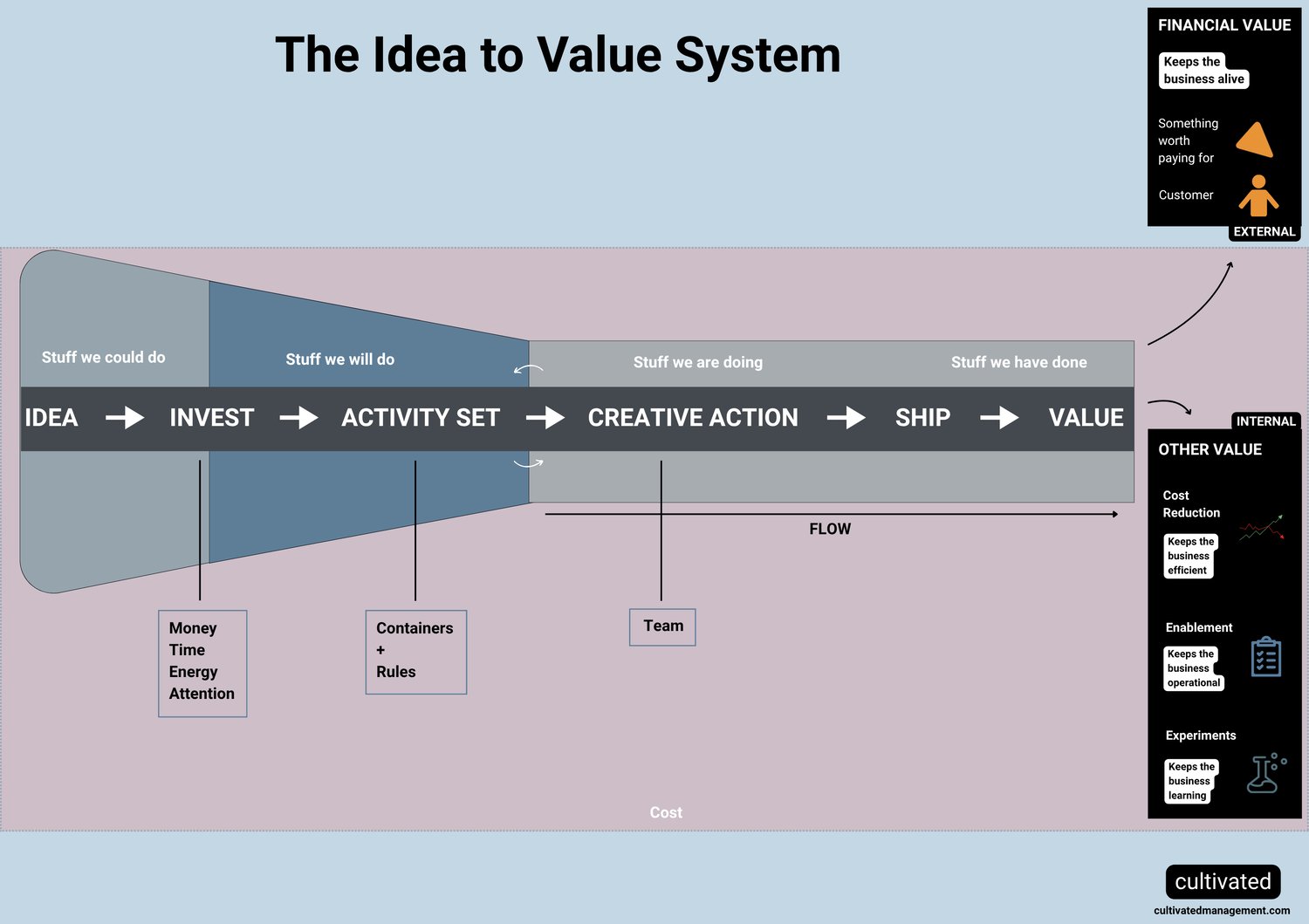
The field guide is the complete treatment of the Idea to Value system — all five layers, with its backbone in the Physics: the layer concerned with how ideas actually move from the moment they appear to the moment they produce value.
Its twenty-six principles range across every layer — orientation, communication, climate, and the habits that compound all show up throughout.
It's not a light overview.
It's the definitive treatment of how work moves, with enough depth to be used on live work in the room.
The system is not a methodology to install. It's a way of seeing.
Most of us are taught to see work through someone else's frame — the last method, the inherited process, the way it's always been done.
That borrowed seeing is what lets cost hide in plain sight. Learn to see the work as it actually is, and you'll know what to do — at any scale, on any initiative.
At its core is a simple observation: everything between idea and value is cost, unless it is deliberately shaped.
The flow that shaping applies to:
Idea → Investment → Activity Sets → Creative Action → Ship → Value
Not a rigid process. A way of noticing where effort accumulates without direction, where communication fragments, where decisions stall, and where creative potential is being suppressed by the conditions around it.
How it's structured
Twenty-six principles, walked through in six movements.
Each movement focuses on a specific part of the idea-to-value journey, and each one builds on the last.
Movement 1 — Seeing the whole. Understanding the system itself. Financial value as external. The painted picture. Clarity, alignment, and action as the three disciplines that hold everything together.
Movement 2 — Clarity. Deciding what deserves attention. Not all demand is created equal. Decisions versus choices. Funnel discipline.
Movement 3 — Alignment. Connecting funding to activity to value. The right team to get it done. Mapping the actual path from idea to outcome.
Movement 4 — Action. Turning alignment into movement. Baking creativity into the process. Choosing a delivery approach that supports feedback. Stability for teams.
Movement 5 — Feedback and measures. The metrics, retrospectives, and learning cycles that tell you what's really happening. Watermelon reporting and how to avoid it.
Movement 6 — Improvement. Continuous learning. How to treat mistakes and failure. Fun as an early warning system. The ongoing cycle that keeps the business — and the people inside it — growing.
Who it's for
- Leaders inside organisations who can see where things are stalling and want a clearer way to think about it.
- Consultants and trainers who want an intellectual spine for their practice.
- Teams navigating the gap between shipping work and producing value from it.
- Anyone moving ideas through organisational structure at any scale.
If you work outside an organisation — solo creator, independent practitioner, one-person business. A dedicated version exists for you: From Idea to Sustainable Work — the Solo Creator Guide (£9.99), which reframes the same system for work that lives outside an organisation.
What typically improves when the system is applied
- Clearer prioritisation, with fewer competing initiatives.
- Earlier recognition of friction and hidden cost.
- Calmer, more confident decision-making.
- Stronger alignment between intent, action, and outcome.
- A shared language that improves collaboration.
- Work starts to feel different — less reactive, more intentional. Not just faster. Clearer.
A working reference, not a one-time read
The field guide is designed to be used, not completed.
Most people start by applying it to one live initiative, and quickly realise this applies everywhere.
Return to it when work becomes unclear, when progress slows, or when decisions feel heavier than they should.
Clarity compounds from there.
What you get
- The complete Idea to Value field guide
- 87 pages, designed to be used in the room on live work
- Twenty-six principles, walked through in six movements
- Reflection questions and practical examples
- PDF download, lifetime access, Version 2 (2026)
£19.99
Want to go deeper?
The field guide and video course edition (£29.99) adds a 90-minute fireside-style video walk-through and a companion workbook.
The Studio membership is the deep-dive tier — over four hours of practitioner-level video across all twenty-six principles, extended field notes, and ongoing material as it's produced.
The full explanation of the system lives at cultivatedmanagement.com/idea-to-value-system.
Refunds
For digital products, you may request a full refund within 30 days of purchase by emailing products@cultivatedmanagement.com or visiting the FAQs.
You will receive a PDF file (2MB).