
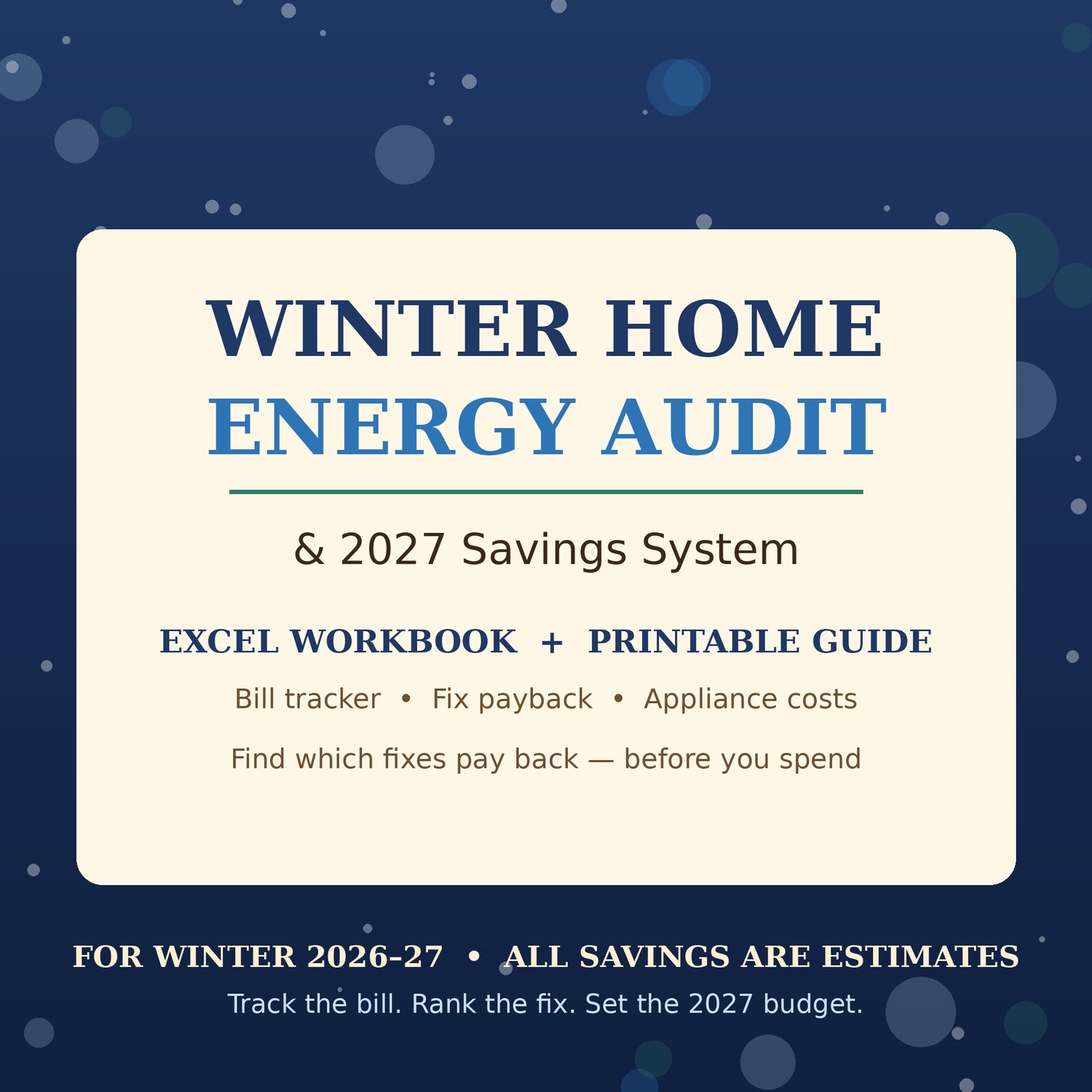
Winter Home Energy Audit & 2027 Savings System — Heating Bill Tracker & Fix Payback Calculator Excel + Guide
Heating bills peak from December 2026 to February 2027. Before you spend on a single fix, find out which ones pay back — and how fast.
Type in your home size, your winter bill, your budget and your electricity rate. The workbook does the rest: it tracks the real winter, ranks eight fixes by payback months, prices every appliance you own, and projects your 2027 winter spend.
WHAT YOU GET
- winter-energy-audit-system.xlsx — a working Excel workbook with real formulas. No macros. Works in Microsoft Excel and Google Sheets.
- winter-energy-audit-system-guide.pdf — a 4-page printable guide: setup, sheet-by-sheet help, the evidence behind the sample savings, renter-safe fixes, rebate facts for 2026–27, safety notes, and a January 2027 budget reset.
THE FIVE SHEETS
1. Start Here — four yellow input cells: home size, current monthly winter bill, savings budget, and electricity rate. Quick answers update on the same page.
2. Bill Tracker — November to March, electric and gas/oil side by side, with a total formula for each month, last winter's total, a year-over-year change formula, and a degree-day / weather note column so you can tell weather from waste.
3. Fix Payback Calculator — 8 pre-loaded fixes (window film kits, air sealing, LED swap, water heater blanket, smart power strips, smart thermostat, furnace filter + tune check, attic insulation top-up). Each row computes payback months (cost ÷ monthly saving), 1-year net, and a worth-it verdict by formula. Edit the yellow cost and saving cells to match your quotes.
4. Appliance & Usage Log — 8 pre-loaded loads with watts and hours per day. kWh per month and cost per month calculate from your own rate. Find the space heater and the old fridge before they find your wallet.
5. Savings Summary — one dashboard: total winter spend, average winter month, total fix cost, estimated monthly saving, projected annual saving, projected 2027 winter spend, budget left, status, and the best payback fix found by formula (INDEX + MATCH on the fastest payback). All cells are live formulas.
SAMPLE PRE-LOADED: 1,800 sq ft home, $285 monthly winter bill, $1,000 budget, $0.18/kWh → $1,288 tracked winter spend ($533 electric + $755 gas) vs $1,227 last winter (+5.0%), $257.60 average month. All 8 fixes: $914 total cost, $111 estimated saving per month, $418 1-year net, $86 of budget left. Best payback: window film kits at 2.7 months. Appliance log: 954.0 kWh and $171.72 per month. Projected: $1,332 annual saving, $555 winter saving, $733 projected 2027 winter spend. Change any input and every number updates.
EVERY SAVING IS AN ESTIMATE. Sample savings sit inside published DOE and ENERGY STAR ranges (thermostat setback up to 10% a year; sealing + insulation about 15% on heating and cooling). Your home, weather and prices decide your real result. The guide shows the sources and the math.
ONE FACT MOST SELLERS SKIP: the federal 25C efficiency tax credit ended December 31, 2025. This system tells you to check state and utility rebates instead, and the calculator takes after-rebate costs.
RENTERS: film kits, LED bulbs, power strips and draft fixes in the sample cost about $190 and save an estimated $48 a month in winter — no damage, no permission needed for most leases.
Instant download (.xlsx + .pdf). Digital product — no physical item ships. Personal use.